

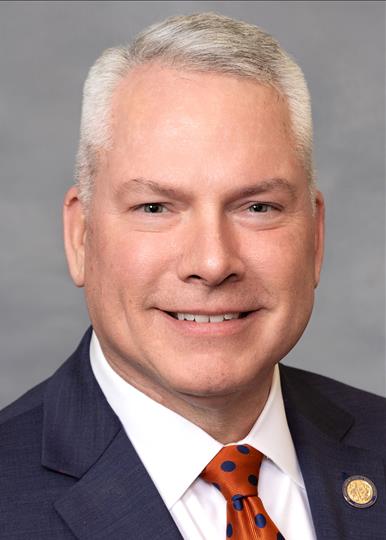
Photo of Grant Campbell
R North Carolina House · District 83 On the 2026 ballot

Rep. Grant Campbell

Compare
Total votes
481
all sessions
Attendance
91%
43 missed
Near the chamber average
With party
99%
of cast votes
Near the chamber average
Bipartisan score
0%
crosses aisle rarely
Near the chamber average
Sponsored
162
bills & resolutions
Near the chamber average
Committees
10
assignments
162 bills and resolutions

Sponsored bills

Total
162
Primary
43
Co-sponsor
119
This page
162
matching current filters
Primary HB 1081
In committee · North Carolina House · Lead sponsor
Veterans/Hyperbaric Oxygen Therapy/Funds.

Maddy summaryThis bill establishes a program to provide free hyperbaric oxygen therapy to North Carolina veterans diagnosed with traumatic brain injury or posttraumatic stress disorder. The legislation appropriates $3 million from the state General Fund to a nonprofit organization to deliver approximately 15,000 treatments to an estimated 350 eligible veterans over the 2026-2027 fiscal year. The program includes structured clinical care and requires the provider to submit a detailed report on outcomes and fund usage by June 2027.

In committee Apr 30, 2026 0 co-sponsors
Primary HB 1111
In committee · North Carolina House · Lead sponsor
Military Service Buyback Reduction: Teachers.

Maddy summaryThis bill reduces the cost for North Carolina public school teachers to purchase credit for their military service. Under the new provision, eligible veterans would only need to pay 25% of the usual cost, while the state would cover the remaining 75% through general appropriations. The law applies to full-time employees of the Teachers' and State Employees' Retirement System who served in the U.S. Armed Forces and allows them to buy up to four years of service credit. These changes would take effect on July 1, 2027, for any service credit purchases made on or after that date.

In committee Apr 30, 2026 0 co-sponsors
Co-sponsor HB 1118
In committee · North Carolina House · Co-sponsor
Workforce Housing Loan Renewal Act.

Maddy summaryThis bill appropriates $35 million in recurring state funds to the North Carolina Housing Finance Agency for the Workforce Housing Loan Program. The funding is designated to support the program's operations and loans for eligible workforce members seeking affordable housing. These funds will become available starting with the 2026-2027 fiscal year. The legislation takes effect on July 1, 2026.

In committee Apr 30, 2026 1 co-sponsor
Primary HB 1097
In committee · North Carolina House · Lead sponsor
Government Website Access Act.

Maddy summaryThis North Carolina bill appropriates $11.5 million for the 2026-2027 fiscal year to improve state government services and workforce programs. The Department of Information Technology will receive $11.5 million to create an artificial intelligence assistant that helps users navigate state agency websites and connects them with local workforce resources. Additionally, the Department of Commerce will get $20 million to fund local boards in designing job training programs specifically for veterans and individuals reentering society after incarceration. A separate $1.5 million allocation supports career planning tools for working adults. The legislation takes effect on July 1, 2026.

In committee Apr 30, 2026 0 co-sponsors
Co-sponsor HB 696
Signed into law · North Carolina House · Co-sponsor
Medicaid and HHS Adjust./Other Critical Needs.

Maddy summaryHB 696, the Health Care Practitioner Transparency Act, requires health care providers in North Carolina to clearly state their license type, certification, or registration in all advertisements and public representations. It prohibits deceptive claims about qualifications and bans unlicensed individuals from using medical titles like "doctor," "surgeon," or specialty terms (e.g., "cardiologist") to mislead patients. The law applies to licensed professionals (doctors, nurses, dentists, etc.) who advertise services, but exempts those in non-patient settings without direct care interactions. Violations could lead to disciplinary action by their licensing board, with daily noncompliance treated as separate offenses. The bill takes effect October 1, 2025.

Signed into law Apr 30, 2026 1 co-sponsor
Co-sponsor HB 1072
In committee · North Carolina House · Co-sponsor
Affordable Housing Infrastructure Development.

Maddy summaryThis bill creates a new loan program in North Carolina to help nonprofit organizations prepare land for affordable housing by offering below-market interest rate loans. The funds, totaling $50 million for the 2026-2027 fiscal year, can only be used for site-related expenses like land acquisition, utility installation, and environmental testing, but not for building the actual homes. To qualify, borrowers must be experienced nonprofits that provide zero-interest mortgages to buyers and ensure at least 40% of units in mixed-income projects are reserved for low- and moderate-income families. The program is designed to support the development of housing for households earning up to 80% of the local area median income.

In committee Apr 29, 2026 1 co-sponsor
Co-sponsor HB 434
Failed · North Carolina House · Co-sponsor
Lower Healthcare Costs.

Maddy summaryHB 434, titled "Lower Healthcare Costs," is a procedural bill focused on updating definitions related to health insurance utilization review in North Carolina. It rewrites statutory definitions (e.g., "medical necessity," "clinical peer," "closely related service") within existing insurance regulations but does not introduce new cost-saving mechanisms or policy changes. The bill directly affects insurers, healthcare providers, and covered individuals by standardizing terminology used in prior authorization processes. As a definition-only update, it has no concrete policy impact on healthcare costs or patient access, and the title does not align with its actual scope.

Failed Apr 6, 2026 1 co-sponsor
Co-sponsor HB 491
Failed · North Carolina House · Co-sponsor
Medicaid Rebase Funding.

Maddy summaryHB 491 prepares North Carolina's Medicaid program to implement work requirements if authorized by the federal Centers for Medicare and Medicaid Services (CMS). It requires the state's Division of Health Benefits to negotiate with CMS, notify oversight committees within 30 days of starting talks, and submit detailed reports after CMS approves any work requirements plan. The bill does not enact work requirements itself but establishes procedures for future implementation, including timelines for reporting funding needs. This would directly affect current Medicaid recipients if CMS approves work requirements, though the bill is procedural and conditional on federal approval. The legislation is currently in committee review and has not yet become law.

Failed Oct 23, 2025 1 co-sponsor
Co-sponsor HB 13
died · North Carolina House · Co-sponsor
Charges for Credit and Charge Cards.

Maddy summaryHB 13 prohibits North Carolina merchants from charging customers more for credit or debit card payments than what the merchant pays to process those transactions. It directly affects retailers and service providers in the state, requiring them to disclose any card fees clearly in advertisements if they impose them. The law mandates that merchants cannot add a markup to processing costs charged by payment networks (like Visa or Mastercard), and violations could result in civil penalties up to $5,000 per offense. The bill takes effect October 1, 2025, aiming to prevent unfair surcharges on card payments.

died Sep 23, 2025 1 co-sponsor
Primary HB 118
In committee · North Carolina House · Lead sponsor
Disabled Veterans Tax Relief Bill.

Maddy summaryHB 118 modifies North Carolina's property tax exemption for disabled veterans, replacing a flat $45,000 exclusion with a percentage-based system tied to the veteran's VA disability rating. It directly affects veterans with a 50% or higher service-connected disability rating (or surviving spouses under specific conditions), allowing them to exclude a portion of their home's appraised value from property taxes - equal to their disability percentage. For example, a veteran with a 70% disability rating would exclude 70% of their home's value from taxes. The bill takes effect for taxes due in 2025 and prohibits combining this relief with other property tax exemptions.

In committee Sep 23, 2025 0 co-sponsors
Showing 31 to 40 of 162 bills
Previous 1 … 3 4 5 … 17 Next