

Maddy summaryHB 239 modifies North Carolina's funding formula for children with disabilities in public schools. It changes how funds are allocated to local school districts by capping per-child funding at 13% of a district's total enrollment plus students using state scholarship programs. The bill requires the State Education Assistance Authority to provide annual scholarship data by March 15 to help calculate district funding. It also appropriates $25 million in recurring funds for the 2025-2026 fiscal year to support this revised funding structure, effective July 1, 2025.
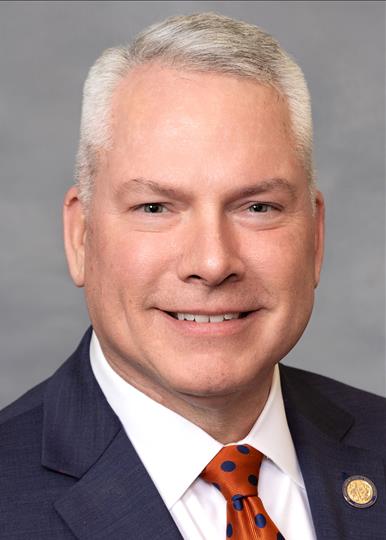
Rep. Grant Campbell
Sponsored bills
Maddy summaryHB 229 adjusts North Carolina's Medicaid reimbursement rates for ambulatory surgical centers (ASCs), requiring payments to be at least 95% of the current Medicare Ambulatory Surgical Centers fee schedule. This change directly affects ASCs by increasing their Medicaid payments, with the state appropriating $10.476 million annually from the General Fund to cover the cost and match $19.135 million in federal funds each year for the 2025-2027 fiscal biennium. The bill mandates these rate adjustments to take effect on July 1, 2025, ensuring ASCs receive consistent reimbursement aligned with Medicare rates. The legislation focuses solely on establishing the new payment structure and funding mechanism, without altering eligibility or services.
Maddy summaryHJR 157 is a procedural resolution inviting Governor Josh Stein to address a joint session of the North Carolina General Assembly on March 12, 2025. It directs a committee of five House members and five Senate members to extend the invitation and specifies that the governor's cabinet, Council of State members, and state judges may attend. This resolution does not create new policy or affect any laws; it solely schedules a ceremonial address. The invitation is effective upon ratification, as noted in the resolution's text.
Maddy summaryHB 130 establishes a $475 million program to provide financial assistance to North Carolina farmers who suffered crop losses from natural disasters in 2024. It directly affects farmers in counties designated by the USDA as disaster areas, requiring verified losses of eligible agricultural commodities (like crops, livestock, or specialty plants) planted but not harvested by January 1, 2024. The program uses county and state yield/price averages to calculate payments, mandates submission of USDA Form 578 or equivalent documentation within 30 days, and allocates funds from state reserves (Stabilization, IT, and Economic Development) to cover verified losses. Farmers must provide documentation for verification, and the Department of Agriculture may audit claims to ensure proper use of funds, with refunds required for inaccurate information.
Maddy summaryHB 205 allows Cabarrus County Schools to set an earlier student start date (no earlier than August 19, instead of the standard August 26) for the 2025-2026 school year, provided the district meets specific "good cause" criteria. This requires demonstrating that schools in the county experienced at least eight emergency closures (due to weather, power outages, etc.) over four of the past ten years. The bill maintains the requirement for sufficient instructional days and applies only to Cabarrus County Schools, not other districts. It becomes effective upon enactment for the 2025-2026 school year.
Maddy summaryHB 204 restores local government authority to initiate down-zoning in Cabarrus County and its municipalities by removing the requirement for all affected property owners' written consent. The bill amends state law to allow county or municipal governments to change zoning (e.g., reducing density or permitted building types) without unanimous owner approval, as long as the change is government-initiated. This directly affects property owners in Cabarrus County whose land may be subject to zoning changes that limit development potential. The law applies retroactively to December 11, 2024, meaning existing down-zoning actions taken after that date under the previous rule would be invalid.
Maddy summaryHB 120 appropriates $1,040,514 annually for fiscal years 2025-2026 and 2026-2027 to expand North Carolina's Project C.A.R.E. program. The bill directly funds support services for family caregivers of individuals living with Alzheimer's disease or related dementias. It provides recurring state funding to the Division of Aging and Adult Services to enhance existing caregiver assistance programs. The legislation becomes effective July 1, 2025, without altering eligibility or service requirements.
Maddy summaryHB 176 allows Kannapolis City Schools to start the school year as early as August 19 (instead of the standard August 26) if they demonstrate "good cause" - specifically, if the district has experienced at least eight emergency closures (due to weather, power outages, etc.) in any four of the past ten years. This exception applies only to Kannapolis for the 2025-2026 school year and does not change state requirements for other North Carolina school districts. The bill requires schools to still meet minimum instructional day requirements, and the change only affects Kannapolis’ calendar, not broader state education rules.
Maddy summaryHB 164 requires parental or guardian consent before releasing autopsy records for children under 18. It makes all autopsy-related materials - including photos, videos, and reports - confidential, except when disclosure is needed for public health, research, legal compliance, or to address safety concerns. If parents withhold consent, a court may override this through a special proceeding after reviewing factors like public interest and privacy intrusion. The bill also allows public access to autopsy recordings (with supervision) unless parents request confidentiality under this law. It applies to all child deaths under 18 in North Carolina, affecting medical examiners, families, and entities seeking autopsy records.
Maddy summaryHB 145 appropriates $50 million in one-time state funds to the University of North Carolina at Chapel Hill (UNC-CH) for the development of a diabetes research institute. This bill directly affects UNC-CH as the recipient of the funds and will support diabetes research activities at the university. The funds are designated for the 2025-2026 fiscal year and become effective July 1, 2025. The legislation is a straightforward funding allocation with no policy changes beyond the specified financial commitment.