

Maddy summaryHB 465 waives the renewal fee for North Carolina drivers licenses that display an "active duty military designation" or "veteran military designation." It directly affects military service members (currently serving) and veterans who have these designations on their licenses. The bill amends state law to remove the standard $5.50 annual renewal fee for these specific license holders when renewing their licenses. The fee waiver takes effect July 1, 2025, for licenses renewed on or after that date.
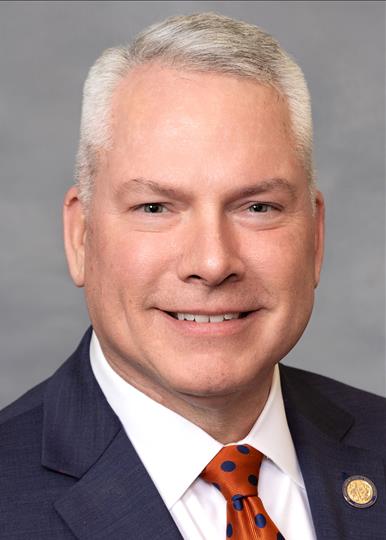
Rep. Grant Campbell
Sponsored bills
Maddy summaryHB 400, "Bentley's Law," requires defendants convicted of certain felony death-by-vehicle offenses (specifically violations of G.S. 20-141.4 subsections (a1), (a5), or (a6)) to pay child support as restitution to the minor children of the deceased victim. The court must order payments until each child turns 18 and graduates high school, considering the child’s needs, living standards, and custody arrangements. Payments are made to the clerk of court for distribution to the surviving parent or guardian within 10 days, with enforcement treated as a civil judgment. This law directly affects children of victims in these specific vehicular homicide cases and mandates financial support through the criminal sentencing process.
Maddy summaryHB 5, the NC Constitutional Carry Act, allows any U.S. citizen aged 18 or older to carry a concealed handgun without a permit, effective upon enactment. This directly affects most adult residents who are not prohibited from firearm ownership under existing state or federal law. The bill removes the permit requirement for concealed carry (per new Section 14-415.35(a)), while maintaining all existing prohibitions - such as for felons, domestic violence offenders, or those under indictment. It also preserves the ability to obtain permits for reciprocity or other purposes, and continues allowing officials with permits to carry while on duty. The law does not change restrictions for prohibited individuals, who remain barred from concealed carry.
Maddy summaryHB 425 raises North Carolina's legal sales age for all tobacco products, including vaping devices and e-liquids, from 18 to 21. It directly affects retailers (who must obtain a tobacco sales permit) and youth (who are prohibited from purchasing these products). The bill requires retailers to verify purchasers' ages using accepted ID and mandates inspections of retail locations to enforce compliance, with penalties including fines up to $1,000 for violations.
Maddy summaryHB 35 designates November of each year as Military Appreciation Month in North Carolina. The bill creates a symbolic recognition within state law, honoring military service members and veterans during this month. It does not establish new programs, funding, or requirements - it simply formally names November for this purpose. The bill affects the state government's official calendar and public recognition efforts, with no direct impact on individuals or organizations.
Maddy summaryHB 422, the "Beyond The Choice Act," eliminates a 12-month residency wait period for eligible veterans and their dependents at North Carolina public colleges and universities. It allows veterans who served 90+ days of active duty, their dependents, or other individuals covered under federal law (38 U.S.C. § 3679) to pay in-state tuition rates immediately upon admission, without needing to establish residency first. This change applies to all qualifying students enrolling in the 2025-2026 academic year and beyond. The bill directly benefits veterans and their families by reducing financial barriers to higher education in North Carolina.
Maddy summaryHB 62, the Farmers Protection Act, prohibits banks from denying or canceling financial services to farmers based on their greenhouse gas emissions, fertilizer use, or machinery type. It creates a rebuttable presumption that banks violating this rule are acting on ESG (environmental, social, governance) commitments, requiring banks to prove decisions were financially motivated. Banks must annually attest to compliance under penalty of perjury, and violations may result in civil penalties up to $10,000 per incident. The law directly affects farmers, banks, credit unions, and state financial associations by restricting discriminatory lending practices tied to environmental factors.
Maddy summaryHB 98, titled the "Patriotism Expression Act" (though misleadingly named), primarily modifies North Carolina's fireworks laws to permit the sale, possession, and use of specific consumer fireworks. It allows consumer fireworks (like sparklers, party poppers, and small novelty devices meeting safety standards under G.S. 58-82A-80) for public use, while maintaining an 18+ age restriction for purchase. The bill specifies that these fireworks must comply with defined safety limits (e.g., no more than 16 milligrams in party poppers, 75 grams per tube for sparklers) and prohibits indoor displays. It directly affects consumers, retailers, and fire safety enforcement, but does not change prohibitions on most fireworks or explosives.
Maddy summaryHB 137, the "Gabe Torres Act," expands death benefits under North Carolina's Public Safety Employees' Death Benefits Act to include public safety workers (like police, fire, and emergency personnel) who are killed while traveling to or from work. The bill amends the law to define "official duties" to explicitly cover commuting between home and work, as well as travel for training or responding to emergencies. It also appropriates $300,000 in recurring funds for these expanded benefits, effective July 1, 2025. This change directly affects eligible families of covered public safety employees who die during work-related travel, ensuring they qualify for death benefits previously limited to on-duty incidents.
Maddy summaryHB 276 expands the definition of "killed in the line of duty" for firefighters to include deaths caused by specific cancers that previously qualified them for benefits under North Carolina's Firefighters' Cancer Insurance Program. The bill adds seven specific cancers (like mesothelioma and testicular cancer) to the list and includes any cancer diagnosis that already provided benefits under the existing program. It also formally links the Firefighters' Health Benefits Pilot Program to the Cancer Insurance Program, ensuring consistent coverage, and appropriates $2 million annually for related death benefits starting July 1, 2025. This change directly affects firefighters diagnosed with covered cancers and their families, who will now qualify for death benefits under the Public Safety Employees' Death Benefits Act.