

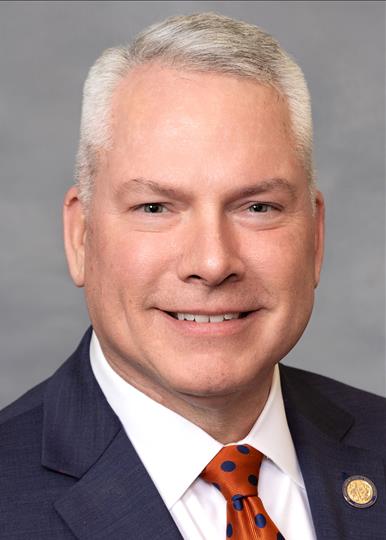
Photo of Grant Campbell
R North Carolina House · District 83 On the 2026 ballot

Rep. Grant Campbell

Compare
Total votes
481
all sessions
Attendance
91%
43 missed
Near the chamber average
With party
99%
of cast votes
Near the chamber average
Bipartisan score
0%
crosses aisle rarely
Near the chamber average
Sponsored
162
bills & resolutions
Near the chamber average
Committees
10
assignments
162 bills and resolutions

Sponsored bills

Total
162
Primary
43
Co-sponsor
119
This page
162
matching current filters
Primary HB 682
In committee · North Carolina House · Lead sponsor
Public Safety Through Food Access Act.

Maddy summaryHB 682 allows North Carolina to override federal restrictions that block food and cash assistance (TANF) for people convicted of certain drug-related felonies. It directly affects individuals with Class H or I controlled substance felony convictions who complete substance abuse treatment (while incarcerated or in the community) and avoid new drug offenses for six months. The bill requires counties to offer food and cash benefits to eligible individuals who meet these conditions, making treatment participation a requirement for accessing aid. This change aims to support successful reintegration by removing a barrier to basic needs assistance for this group.

In committee Apr 3, 2025 0 co-sponsors
Co-sponsor HB 680
In committee · North Carolina House · Co-sponsor
The Protect Children from Cannabis Act.

Maddy summaryThis bill would regulate hemp-derived consumable products (like edibles, vapes, and beverages) by requiring retailers to obtain permits, limiting THC content to 0.3%, and mandating age verification for all sales. It directly affects vape shops, gas stations, convenience stores, and online sellers currently selling these products to minors. The law creates new enforcement rules for the Commission, requiring proof of age (e.g., driver's license) and banning sales to anyone under 21.

In committee Apr 3, 2025 1 co-sponsor
Primary HB 692
In committee · North Carolina House · Lead sponsor
AEDs and CPR in Schools.

Maddy summaryHB 692 requires all North Carolina public schools to install at least two automatic external defibrillators (AEDs) per school building - one in a state-identified location and one in athletic facilities - and provide annual training for school staff in AED use and CPR. The bill directly affects public school personnel, students, and school districts by mandating specific installation, maintenance, and training protocols through new rules from the State Board of Education. Key provisions include requiring schools to coordinate with emergency medical systems, maintain AEDs properly, and develop policies aligned with state guidelines. The law takes effect for the 2025-2026 school year, using existing school funding for implementation.

In committee Apr 3, 2025 0 co-sponsors
Primary HB 744
In committee · North Carolina House · Lead sponsor
Fertility Preservation Pilot Program.

Maddy summaryHB 744 establishes a three-year fertility preservation pilot program (2025-2032) using $2.25 million annually to help cancer patients who face financial barriers to fertility treatments. It directly affects individuals diagnosed with cancer or undergoing cancer treatment who are uninsured, have limited insurance coverage for fertility services, or would pay over $1,000 out-of-pocket, including those with household incomes below 300% of the federal poverty level. The program covers up to $12,000 for egg preservation/storage (women), $1,500 for sperm preservation (men), and $26,000 for IVF/IUI procedures, administered by three designated North Carolina medical centers. Grantees must report annually on services provided and program effectiveness, with funds expiring June 30, 2032.

In committee Apr 3, 2025 0 co-sponsors
Co-sponsor HB 660
In committee · North Carolina House · Co-sponsor
Various Projects in Cabarrus County/Funds.

Maddy summaryHB 660 appropriates $22.65 million in nonrecurring state funds for specific projects in Cabarrus County and its towns. The bill directs $7 million to the Town of Midland for road improvements in Bethel Glen and Tucker Chase developments, $12.7 million to Harrisburg for turf fields, a passenger rail station, and YMCA building completion, $1.95 million to Cabarrus County for health center expansion, and $1 million to Cabarrus Cooperative Christian Ministry for crisis assistance. These funds are allocated for the 2025-2026 fiscal year and become effective July 1, 2025. The bill directly affects local governments and community organizations in Cabarrus County through targeted infrastructure, health, and social services funding.

In committee Apr 2, 2025 1 co-sponsor
Primary HB 658
In committee · North Carolina House · Lead sponsor
Optometrists Telehealth Services.

Maddy summaryHB 658 allows licensed optometrists in North Carolina to provide telehealth services (remote video consultations) to patients within the state, without requiring the optometrist to be physically present in North Carolina or hold a license in the state where they are located during the consultation. This directly affects optometrists licensed in North Carolina who wish to offer remote care to NC patients. The bill specifies that telehealth practice must follow all existing optometry laws and Board rules, and the North Carolina Board of Examiners in Optometry must create implementing rules by December 2025 covering patient records, diagnoses, and telehealth standards. The law takes effect on October 1, 2025.

In committee Apr 2, 2025 0 co-sponsors
Co-sponsor HB 300
In committee · North Carolina House · Co-sponsor
Vet Care for Retired First Responder Dogs.

Maddy summaryHB 300 establishes a program to reimburse owners of retired first responder dogs for veterinary care. It directly affects owners of canines that served with law enforcement, fire departments, or correctional agencies in roles like narcotics detection or search and rescue, after retiring on or after July 1, 2024. The bill requires registration of the dog and owner with the Department of Public Safety, then allows reimbursement of up to $1,500 annually for covered care - including routine check-ups, vaccinations, emergencies, surgeries, and euthanasia. Owners must submit itemized vet bills within 90 days of service.

In committee Apr 1, 2025 1 co-sponsor
Co-sponsor HB 426
In committee · North Carolina House · Co-sponsor
Workforce Diploma Program.

Maddy summaryHB 426 establishes the Workforce Diploma Program to help North Carolina adults aged 21+ without high school diplomas earn diplomas while gaining job skills. The program requires approved providers to offer courses combining diploma requirements with career training, including employability certifications and industry credentials. Participants receive milestone-based funding up to $7,500 per person, with payments tied to completing half-credits, certifications, or diplomas. The program mandates annual reports tracking participant outcomes like diplomas earned, credits, and workforce credentials. It appropriates $5 million for implementation starting July 2025.

In committee Apr 1, 2025 1 co-sponsor
Co-sponsor HB 611
In committee · North Carolina House · Co-sponsor
Increase Assistant Principals in Public Schools.

Maddy summaryHB 611 requires North Carolina public schools to increase full-time assistant principal positions based on student enrollment, directly affecting all local school districts. It mandates funding to achieve specific student-to-assistant-principal ratios: 1:90 students in the 2025-2026 school year ($23.56 million) and 1:80 students starting in 2026-2027 ($57.57 million), with funds supplementing but not replacing existing budgets. The bill, effective July 2025, directs the Department of Public Instruction to allocate these funds through the school building administration allotment. This policy change aims to support school operations and develop future principals by expanding administrative staffing.

In committee Apr 1, 2025 1 co-sponsor
Co-sponsor HB 571
In committee · North Carolina House · Co-sponsor
Posttraumatic Stress Disorder Treatment for Police Officers/Funds.

Maddy summaryHB 571 appropriates $500,000 from the state General Fund to the Department of Public Safety for a grant program treating police officers diagnosed with PTSD. It directly affects North Carolina police officers who have received a clinical PTSD diagnosis. The key provision establishes a state-funded grant program to cover treatment costs, with funds allocated for the 2025-2026 fiscal year. The program becomes effective July 1, 2025, and focuses solely on providing financial support for treatment, not on expanding eligibility or altering diagnosis standards.

In committee Apr 1, 2025 1 co-sponsor
Showing 101 to 110 of 162 bills
Previous 1 … 10 11 12 … 17 Next