

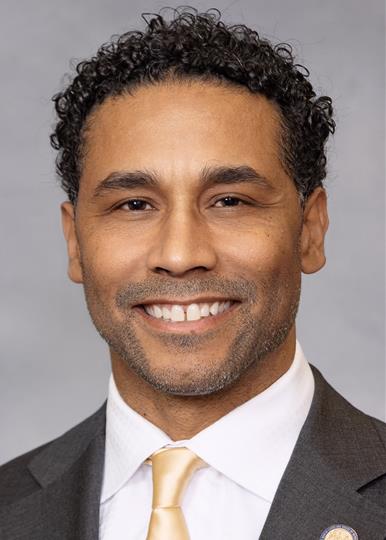
Photo of Brian Echevarria
R North Carolina House · District 82 On the 2026 ballot

Rep. Brian Echevarria

Compare
Total votes
481
all sessions
Attendance
100%
of floor votes
Higher than 91% of chamber peers
With party
100%
of cast votes
Higher than 87% of chamber peers
Bipartisan score
0%
crosses aisle rarely
Lower than 89% of chamber peers
Sponsored
94
bills & resolutions
Near the chamber average
Committees
8
assignments
94 bills and resolutions

Sponsored bills

Total
94
Primary
20
Co-sponsor
74
This page
94
matching current filters
Co-sponsor HB 142
In committee · North Carolina House · Co-sponsor
Implement Zero-Based Budgeting.

Maddy summaryHB 142 requires North Carolina state agencies to adopt zero-based budgeting for the 2031-2033 fiscal biennium, starting with a phased implementation beginning July 1, 2027. This means agencies must justify every funding request from scratch each budget cycle - starting with a $0 baseline - rather than carrying over previous appropriations. Agencies must submit detailed justifications for each budget item, including explanations of their functions, performance data, and goals. The bill directly affects all state agencies in the executive branch, requiring them to re-evaluate all programs and costs annually. The full zero-based budget will apply to the entire state budget starting in 2031-2033.

In committee Mar 4, 2025 1 co-sponsor
Co-sponsor HB 222
In committee · North Carolina House · Co-sponsor
Close Out Operations Provide Emergency Relief (C.O.O.P.E.R.) Accountability Act.

Maddy summaryHB 222 appropriates $217 million from the State Emergency Response Fund to North Carolina's Office of Recovery and Resiliency (NCORR) for homeowner recovery projects related to Hurricanes Matthew and Florence. The bill requires NCORR to submit detailed monthly reports on fund usage, including expenditures and project progress, and mandates weekly financial reports to the State Auditor for oversight. It also establishes a public online dashboard tracking funds versus actual spending and includes a clawback provision to return unused funds to the Savings Reserve after projects conclude. The law revises NCORR's responsibilities, ending its role in future storm recovery programs.

In committee Mar 4, 2025 1 co-sponsor
Co-sponsor HB 103
died · North Carolina House · Co-sponsor
NC American Indian Hunting/Fishing Rights.

Maddy summaryHB 103 exempts members of North Carolina-recognized tribes from needing hunting, trapping, or fishing licenses when hunting or fishing on tribal land (requiring ID verification) or off tribal land (requiring ID plus compliance with reporting, hunter education, and federal stamp rules). It directly affects tribal members recognized under Chapter 71A of North Carolina law, both on tribal property and in state waters/lands outside tribal areas. The bill amends licensing rules to remove fee requirements while maintaining other regulatory obligations like wildlife reporting and federal stamp purchases. It becomes effective October 1, 2025.

died Mar 4, 2025 1 co-sponsor
Co-sponsor HB 239
In committee · North Carolina House · Co-sponsor
Change to Exceptional Children Funding Formula.

Maddy summaryHB 239 modifies North Carolina's funding formula for children with disabilities in public schools. It changes how funds are allocated to local school districts by capping per-child funding at 13% of a district's total enrollment plus students using state scholarship programs. The bill requires the State Education Assistance Authority to provide annual scholarship data by March 15 to help calculate district funding. It also appropriates $25 million in recurring funds for the 2025-2026 fiscal year to support this revised funding structure, effective July 1, 2025.

In committee Mar 3, 2025 1 co-sponsor
Co-sponsor HB 234
In committee · North Carolina House · Co-sponsor
Little Federal Model NC Edition.

Maddy summaryThis bill proposes constitutional amendments to require each North Carolina senator to represent two counties (instead of one) and to fix the state at exactly 100 counties. It also updates rules for incorporating new cities or towns, preventing new municipalities within specific distances of existing cities based on their population size (e.g., within 1 mile of a city with 5,000+ residents). The changes would require voter approval in the November 2026 election. If approved, the new rules would take effect after certification by the State Board of Elections.

In committee Feb 27, 2025 1 co-sponsor
Co-sponsor HB 205
In committee · North Carolina House · Co-sponsor
School Calendar Flexibility/Cabarrus/Open Calendar.

Maddy summaryHB 205 allows Cabarrus County Schools to set an earlier student start date (no earlier than August 19, instead of the standard August 26) for the 2025-2026 school year, provided the district meets specific "good cause" criteria. This requires demonstrating that schools in the county experienced at least eight emergency closures (due to weather, power outages, etc.) over four of the past ten years. The bill maintains the requirement for sufficient instructional days and applies only to Cabarrus County Schools, not other districts. It becomes effective upon enactment for the 2025-2026 school year.

In committee Feb 26, 2025 1 co-sponsor
Primary HB 204
In committee · North Carolina House · Lead sponsor
Restore Down-Zoning Authority/Cabarrus County.

Maddy summaryHB 204 restores local government authority to initiate down-zoning in Cabarrus County and its municipalities by removing the requirement for all affected property owners' written consent. The bill amends state law to allow county or municipal governments to change zoning (e.g., reducing density or permitted building types) without unanimous owner approval, as long as the change is government-initiated. This directly affects property owners in Cabarrus County whose land may be subject to zoning changes that limit development potential. The law applies retroactively to December 11, 2024, meaning existing down-zoning actions taken after that date under the previous rule would be invalid.

In committee Feb 26, 2025 0 co-sponsors
Primary HB 127
In committee · North Carolina House · Lead sponsor
Voter Registration Drive Form.

Maddy summaryHB 127 requires North Carolina's State Board of Elections to create a sample voter registration form for use by organizations conducting organized voter registration drives. The form must clearly distinguish itself from official registration materials, include disclaimers that it is not a valid form, and provide information on where to obtain official forms, deadlines, and online registration. Organizations must register with county election boards before conducting drives, providing details like their structure, number of forms needed, and whether participants are paid or volunteers. Using the official voter registration form for drives is prohibited, with violations classified as a Class 2 misdemeanor. This bill applies to all organized voter registration activities in North Carolina starting when it becomes law.

In committee Feb 24, 2025 0 co-sponsors
Co-sponsor HB 31
died · North Carolina House · Co-sponsor
Make Election Day A State Holiday.

Maddy summaryHB 31 would amend North Carolina's State Human Resources Act to make every statewide general election day a paid holiday for state employees. This change would add election days to the current list of paid holidays (which includes Martin Luther King Jr.'s Birthday and Veterans Day), while maintaining the limit of 13 paid holidays per year. The bill directly affects state workers, ensuring they receive paid time off on election days without reducing the total number of paid holidays. It does not change election dates or voting procedures, only the employment benefits for state employees on those days. The legislation is currently pending in committee review.

died Feb 24, 2025 1 co-sponsor
Co-sponsor HB 108
In committee · North Carolina House · Co-sponsor
The Sober Operator Act of 2025.

Maddy summaryHB 108, "The Sober Operator Act of 2025," lowers North Carolina's legal blood alcohol concentration (BAC) limit for driving from 0.08% to 0.05% for all vehicles and vessels. It directly affects all drivers, requiring them to maintain a lower BAC level and facing faster license revocation if they refuse tests or exceed the new limit. Key provisions include mandating video recording of impaired driving court proceedings for transparency, requiring impaired drivers to cover processing costs, and allowing repeat offenders to prove sobriety to regain driving privileges. The bill also streamlines evidence rules by admitting BAC test results to reduce court delays and ensures equal treatment in impaired driving cases.

In committee Feb 13, 2025 1 co-sponsor
Showing 81 to 90 of 94 bills