

Maddy summaryHouse Bill 244, titled "Depoliticize Government Property Act," restricts the types of flags that can be flown or displayed on property owned or leased by the State of North Carolina or its local government entities. The bill specifies a limited list of permissible flags, including the U.S. flag, the North Carolina flag, flags of local government agencies, military branch flags, the POW/MIA flag, the Honor and Remember flag, and flags of recognized nations during official visits. It also clarifies that local governments cannot prohibit the display of official governmental flags on private or public property with consent. Any violation of the display restrictions on government property would be classified as a Class 3 misdemeanor.
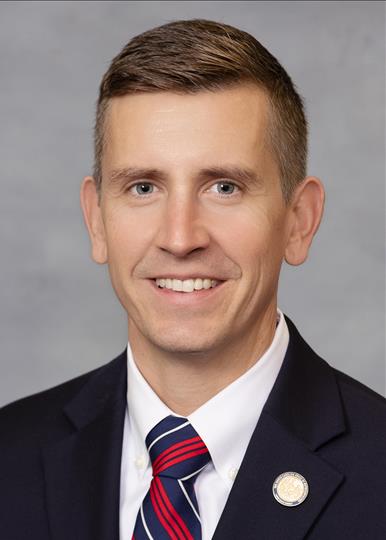
Rep. Jonathan Almond
Sponsored bills
Maddy summaryHB 636 establishes new procedures for public school units to select and review library media and materials, affecting students, parents, and school personnel. The bill requires schools to adopt policies that ensure materials are age-appropriate and do not contain content defined as "harmful to minors," which includes depictions of sexual activity or pervasively vulgar content. It mandates a review process involving a community library advisory committee, public posting of recommended materials, and a mechanism for public objections. Additionally, the bill requires the creation of a public database for rejected materials and allows parents, guardians, students, or residents to pursue private legal action against schools violating these provisions. Principals are also required to review all media available at school book fairs for compliance.
Maddy summaryHouse Bill 432 aims to provide various forms of property tax relief to North Carolina homeowners. It increases the property tax exclusion amounts for qualifying elderly or disabled homeowners and expands the exclusion for disabled veterans, allowing more of their home's value to be exempt from taxation. The bill also establishes a new "Homeowner Advantage Property Tax Relief Program" designed to cap the annual increase in a permanent residence's taxable value, based on inflation and a cumulative limit. To qualify for this program, homeowners must have occupied their residence for at least two years. Additionally, the bill creates an "Elderly Property Tax Homestead Circuit Breaker Program" and exemptions from the forced sale of a homestead.
Maddy summaryHB 830, "The Rolling Ink Act," proposes to allow motor vehicles to operate as mobile tattoo parlors in North Carolina. It establishes a permitting process through the Department of Health and local health departments, requiring an initial $5,000 fee and annual renewals, along with mandatory inspections. The bill outlines specific facility and equipment standards, such as functional sinks and sterilization devices, and requires compliance with existing tattoo parlor laws, motor vehicle regulations, and hazardous waste disposal rules. Tattooing is prohibited while the vehicle is in motion, and operators must maintain detailed records for inspection. Violations can result in civil penalties, permit suspension or revocation, or misdemeanor charges, with most provisions taking effect on July 1, 2026.
Maddy summaryHB 949, known as the School Protection Act, proposes to allow specific armed security guards to carry firearms on nonpublic educational property in North Carolina. The bill amends existing law to create an exemption for sworn law enforcement officers who are hired as armed security guards by nonpublic schools and are acting in their official duties on school premises. This includes officers certified under state law enforcement chapters, company police officers, and campus police officers. If enacted, this change would become effective on December 1, 2025.
Maddy summaryHB 69, the Military and Veterans Educational Promise Act, provides two key benefits for military-affiliated individuals and veterans at North Carolina's University of North Carolina (UNC) schools. First, it requires UNC institutions to allow eligible military members (including reservists) and their spouses to defer admission for up to five years (for active duty) or two years (for reserve service) upon enrollment notice. Second, it establishes in-state tuition rates for honorably discharged veterans who served at least 90 days in the military, graduated from a North Carolina high school after 2004, had a North Carolina duty station, or received a Purple Heart. The bill applies to all UNC institutions beginning in the 2025-2026 academic year.
Maddy summaryHB 211, "The Kelsey Smith Act," authorizes wireless telecommunications carriers to provide a device's location information to law enforcement under specific emergency circumstances. This includes situations where a 911 call was made or there is reasonable suspicion of an emergency involving risk of death or serious physical harm. Wireless carriers are required to submit their emergency contact information to the State Bureau of Investigation, which will maintain a database for public safety answering points. The bill protects carriers from legal action if they provide this information in good faith.
Maddy summaryHouse Bill 272, known as "The Sergeant Mickey Hutchens Act," allows certain law enforcement, probation/parole, and correctional officers in North Carolina to purchase additional retirement service credit. Officers who hold an advanced law enforcement or corrections certificate and have at least five years of membership service can buy up to four years of creditable service. This purchase applies to members of the Teachers' and State Employees' Retirement System or the Local Governmental Employees' Retirement System. To do so, they must pay a lump sum covering the full cost of the increased retirement system liability and an administrative fee, with the option for their employer to contribute to this cost.
Maddy summaryHB 929 bans adding fluoride to public water systems in North Carolina, effective January 1, 2026. It directly affects municipal water utilities that currently add fluoride for dental health purposes. The bill includes exceptions for naturally occurring fluoride in water sources and industrial uses unrelated to water treatment. It does not apply to private wells, bottled water, or water systems using naturally present fluoride.
Maddy summaryHB 939 allows North Carolina public school districts to hire or accept volunteer chaplains, with specific requirements for their employment. School districts must adopt a policy covering certified training (via organizations like the National School Chaplain Association), services provided, continuing education, and discipline procedures. The bill mandates criminal background checks for chaplains before service, reviewed by the Superintendent of Public Instruction, and shields chaplains from civil liability for normal duties (except gross negligence). It explicitly states that hiring chaplains does not endorse any religion. The law takes effect for the 2025-2026 school year.