

Maddy summaryHB 807 raises teacher salaries for the 2025-2026 school year with new pay scales based on experience and adds supplements for certified teachers, school nurses, counselors, and specialists. It allocates $89.4 million annually and $109.2 million as a one-time fund to provide weighted, per-child funding for children with disabilities based on the cost of services provided. The bill also mandates free breakfast and lunch for all public school students, funded through state appropriations tied to school food authority evaluations, and includes funding for a one-to-one device refresh in public schools.
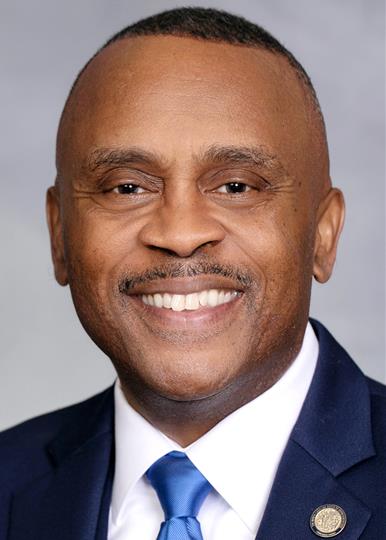
Rep. Robert Reives
Sponsored bills
Maddy summaryHB 788 ("Fix Our Democracy") proposes amending the North Carolina Constitution to establish a nonpartisan redistricting process for state legislative and U.S. House districts. It would require a constitutional amendment (voting required in 2026) to remove the General Assembly's role in drawing districts, mandating that districts be contiguous, avoid dividing counties where possible, and remain unchanged until the next census. The bill also includes related provisions like online voter registration, automatic registration, banning voter roll purging, and campaign finance transparency changes. This constitutional change would directly affect how electoral districts are created for state legislators and U.S. representatives in North Carolina.
Maddy summaryHB 798 appropriates $1.72 million annually from the General Fund to create a Cold Weather Shelters Grant Program, administered by the Department of Health and Human Services, Division of Aging. The program provides grants to municipalities and nonprofits to establish or expand temporary emergency shelters for people experiencing homelessness during severe weather events. Grants are limited to $215,000 per recipient annually, with selection considering poverty rates in the service area and existing funding availability. Recipients must report annually on shelter usage, funds spent, and the number of people served, starting in 2027.
Maddy summaryHB 786, the "Working Families Act," reduces child care costs for low-income families by lowering parent copayments from 10% to 7% of income (effective 2025), reinstates a refundable state child tax credit with income-based payments (effective 2025), and phases up North Carolina’s minimum wage to $15/hour by 2030 with annual inflation adjustments. It also increases income limits for property tax relief, creates a homebuyers’ assistance program for public servants (like firefighters and EMTs) as first-time buyers, and establishes a paid family leave insurance program funded through an employer grant program. The bill directly affects working families, hourly workers, public-sector employees, and households using subsidized child care or property tax relief. Key mechanisms include phased wage increases, income-tiered tax credits, and targeted housing support, all designed to reduce financial strain on low-to-moderate-income households.
Maddy summaryThis is a House Resolution (HR 769), not a bill, urging Congress to support H.R. 4052, which would create a National Infrastructure Bank. The resolution cites North Carolina's infrastructure needs - like roads, bridges, water systems, and lead pipe replacement - and states the proposed bank would be funded through existing Treasury debt (without new taxes or spending). It calls for Congress to pass the bank legislation to finance infrastructure projects nationwide, including those in North Carolina. The resolution itself does not create the bank but advocates for its adoption.
Maddy summaryHB 713 mandates that all North Carolina public schools provide free breakfast and lunch to every student, eliminating meal fees for all. This affects every student enrolled in public schools, including those in charter schools and regional school units, starting with the 2025-2026 school year. The bill appropriates $144 million from the state General Fund to cover costs, with funds allocated based on school size, student eligibility for free/reduced meals, and nutritional quality standards. Schools must comply with federal nutrition guidelines while using state funds to supplement, not replace, existing meal program funding.
Maddy summaryHB 715 appropriates $13.3 million annually from the General Fund to expand access to North Carolina's Prekindergarten (NC Pre-K) program for eligible children. The funding, allocated to the state's child development agency, will create additional program slots for children seeking enrollment starting July 1, 2025. This bill directly affects low-income 4-year-olds who qualify for the NC Pre-K program by increasing available spots through dedicated state funding. The legislation focuses solely on providing financial resources for program expansion, with no changes to eligibility criteria or program structure.
Maddy summaryHB 691, the "Voter Protection and Reliance Act," ensures voters' ballots are counted based on election-day rules by prohibiting the exclusion of valid ballots cast under procedures in place on election day. It requires courts and election officials to apply election rules as they existed on election day, not later changes, and mandates that technical registration errors (like incomplete forms) cannot invalidate a ballot if the voter relied on the process. The bill also creates expedited court procedures for election challenges filed within 90 days before an election or after an election concludes, directing such cases to Wake County Superior Court for faster resolution. This directly affects voters, election officials, and courts by prioritizing ballot integrity based on election-day procedures over post-election interpretations.
Maddy summaryHB 685, the Rural NC Reinvestment Act, allocates $605 million in nonrecurring state funds for rural North Carolina communities during the 2025-2026 fiscal year. It provides grants for water/sewer infrastructure ($200M), law enforcement/fire equipment ($10M), economic development land ($20M), rural school construction ($200M), broadband expansion ($50M), early childhood education ($100M), and physician placement ($5M). Local governments, schools, emergency services, and healthcare providers in rural areas directly receive these funds, with allocations prioritized based on need, efficiency, and community impact. The bill becomes effective July 1, 2025, focusing on tangible infrastructure and service improvements without creating new regulations.
Maddy summaryHB 724 establishes the NC-Federal Alignment for Critical Technologies Task Force (NC-FACT) within North Carolina's Department of Commerce. The task force, composed of state agency staff and potentially partners from UNC institutions or the private sector, must study ways to improve collaboration between state, federal, and private entities in science and technology. It is required to develop economic strategies focused on attracting out-of-state investment and streamline resources for tech industries, then submit annual reports with actionable recommendations to the legislature by April 1 each year. The bill creates a study group with specific research duties and reporting requirements but does not enact direct funding or regulatory changes.