

Maddy summaryNew Jersey's S 3114, the "Law Enforcement Officer Protection Act," requires police officers and other law enforcement personnel to reveal their faces and show official identification before detaining or arresting someone during public interactions. Officers must wear non-concealing uniforms, display a photo ID card, show a numbered badge, or verbally state their name and agency. Exceptions include undercover work, medical masks (with physician approval), smoke protection during emergencies, or when safety or an investigation is at risk. The law applies to all state, county, and municipal officers and takes effect immediately.
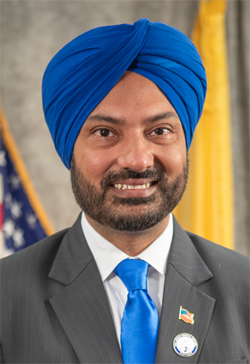
Asm. Balvir Singh
Sponsored bills
Maddy summaryThis bill requires New Jersey law enforcement officers to reveal their facial identity during public interactions (except during undercover operations, medical mask use with physician approval, or smoke exposure during emergencies) and to present valid identification before detaining or arresting someone. Officers must show a uniform with agency insignia, a photo ID card, a numbered badge, or verbally state their name and agency. It applies to all state, county, municipal, and federal officers performing public duties, with exemptions for safety risks, ongoing investigations, or stealth operations. The law aims to increase transparency during police encounters while allowing necessary operational flexibility.
Maddy summaryThis bill prohibits the operation of certain prediction markets in New Jersey while allowing athletic event markets that comply with existing sports wagering regulations. It defines restricted categories such as political markets, death markets, and catastrophic event markets, which are banned from operating within the state. The legislation also requires prediction market platforms to publicly disclose their settlement sources and establish a public awareness campaign about the risks associated with these markets.
Maddy summaryThis bill requires nursing homes in New Jersey to provide detailed financial and ownership information to the Department of Health before a sale or transfer of ownership occurs. The new requirements include submitting a transfer fee, a cover letter identifying the facility, a description of the transaction with full details on current and proposed owners, and copies of sales and management agreements. The Department of Health must post these applications on its website within 30 days while redacting personal and proprietary information, and the public will have an opportunity to comment on each transfer. Additionally, ownership transfer approval depends on the Department reviewing the new owners' disciplinary history and ensuring all outstanding Medicaid claims and penalties are resolved or assumed by the new owners.
Maddy summaryThis bill requires New Jersey public schools to create policies for administering nasal seizure rescue medication and using manual vagus nerve stimulators for students with seizure disorders during emergencies. It defines specific roles for school nurses as primary responders while allowing them to designate at least two additional trained staff members to assist when the nurse is not present. The legislation mandates that designated staff receive CPR and defibrillator training, obtain written parental consent, and includes provisions protecting school employees from liability when acting in good faith during emergency medical situations.
Maddy summaryThis bill requires school bus drivers and personnel to call 911 in potential life-threatening emergencies involving students. It mandates that school buses transporting students with disabilities be equipped with specific safety features (though exact features aren't detailed in the text). The bill also requires annual safety training for all bus personnel, including emergency procedures and recognizing signs of life-threatening situations for students with disabilities. Funding for these requirements is included through an appropriation. The bill directly affects school bus operators, drivers, aides, and students with disabilities in New Jersey.
Maddy summaryThis bill requires all New Jersey state agencies, counties, municipalities, school districts, and other local government entities to purchase at least 5% of their goods and services from the Central Nonprofit Agency (CNA), which supports rehabilitation facilities. It grants the CNA a "right of first refusal" for any goods/services typically bought through cooperative purchasing catalogs, provided they can match prices within 15% of fair market value. The bill also mandates that the Division of Purchase and Property create training protocols for all purchasing agents to ensure awareness of the CNA program, with annual reporting on compliance by all affected entities. These requirements apply to all state and local government bodies authorized to make purchases.
Maddy summaryThis bill establishes minimum nurse-to-patient staffing ratios for hospitals, ambulatory surgery centers, and state developmental/psychiatric hospitals in New Jersey. It requires specific ratios, such as 1 nurse per 4 patients on medical/surgical units and 1 nurse per 2 patients in critical care, along with unlicensed staff ratios (1 per 7 patients during day shifts). Hospitals must implement an acuity-based staffing system approved by the health department to adjust staffing based on patient needs and unit conditions. The law aims to ensure safe staffing levels without reducing existing standards, directly affecting healthcare facilities and patient safety.
Maddy summaryThis bill requires New Jersey health insurance companies (carriers) to maintain networks with sufficient physicians so that all plan members can access care within reasonable distance and time. Specifically, it mandates that 100% of members live within 20 minutes or 10 miles (whichever is less) of at least three primary care physicians per specialty, and within 30 minutes or 15 miles for specialists. The law also sets access timelines (e.g., emergency care triaged within 1 hour, routine appointments within 2 weeks) and prohibits counting telehealth or non-physician providers toward network adequacy requirements. Carriers must publicly display plain-language network descriptions and face penalties for noncompliance, with patients able to file complaints about network access.
Maddy summaryThe bill title claims to prohibit player-specific proposition bets on college sports, but the provided text only contains amendments to licensing procedures for sports wagering (e.g., casino/racetrack operations, online platforms, and server requirements). The actual prohibition on player-specific bets is not reflected in the excerpted bill text. The document focuses on administrative rules for license issuance, renewal, and operational standards under existing law (P.L.2018, c.33), with no mention of the proposed ban. Without the specific language of the amendment, a factual summary of the policy change cannot be provided.