

0 co-sponsors
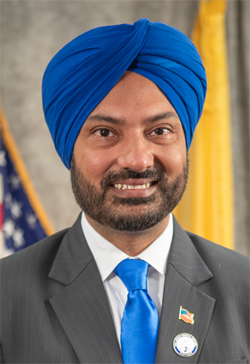
Total votes
0
all sessions
Attendance
-
of floor votes
With party
0%
of cast votes
Bipartisan score
0%
crosses aisle rarely
Sponsored
123
bills & resolutions
Committees
3
assignments
123 bills and resolutions
Sponsored bills
Total
123
Primary
44
Co-sponsor
79
This page
123
matching current filters
0 co-sponsors
"End Data Center Tax Credits Act"; reduces tax credits available for Next New Jersey Program.*
Maddy summaryThis bill, titled the "End Data Center Tax Credits Act," aims to restructure how New Jersey distributes tax credits for economic development and energy projects. It establishes a new nine-year spending cap of $11.5 billion for various incentive programs, which limits the total amount of money available annually for initiatives like historic preservation, brownfields redevelopment, and manufacturing. To support energy goals, the legislation authorizes the Board of Public Utilities to issue tax credits specifically for energy storage projects and creates a temporary income tax credit for certain residential utility customers. Additionally, it sets specific annual and total dollar limits for existing programs such as the Next New Jersey Program and the Innovation Evergreen Act, while reserving $2.5 billion for transformative projects under the Aspire Program.
Budget & TaxesOpposes Budget & TaxesBill imposes a $11.5B spending cap on economic development and energy incentives, effectively restricting available funds for these programs.
EnergySupports EnergyBill authorizes tax credits for energy storage projects and sets spending caps to protect funds for energy initiatives.
Signed into law Aug 27, 2026
0 co-sponsors
Secures protections for patients and providers accessing and providing reproductive health care services; establishes right of residents to reproductive health care activity that is restricted in other states.*
Maddy summaryNew Jersey's S 2260 strengthens legal protections for patients and providers accessing or delivering reproductive and gender-affirming health care services within the state. The bill explicitly defines "legally protected health care activities" to include seeking, providing, or assisting with these services (such as abortion, contraception, or gender-affirming care), regardless of a patient's location. It prohibits obstruction, intimidation, or physical barriers at facilities offering these services and grants licensing boards authority to impose civil penalties for violations. This directly affects patients traveling to New Jersey for care (not available in their home states) and healthcare providers operating in these fields. The law codifies existing protections to prevent harassment or violence against these services, following increased threats and protests nationwide after the overturning of Roe v. Wade.
Signed into law Aug 20, 2026
1 co-sponsor
"New Jersey Kids Code Act"; adopts New Jersey Age-Appropriate Design Code and requires certain online service providers to implement certain measures concerning minors' use of online service.*
Maddy summaryNew Jersey Assembly Bill 4015, the "New Jersey Kids Code Act," requires major online services (like social media and games) that minors are likely to use to set default privacy settings to the highest protection level for children. It prohibits these services from showing targeted ads to minors, using manipulative design tricks to change privacy settings, collecting certain personal data without clear consent, or promoting restricted products to children. The bill also mandates annual public reports detailing how these platforms protect minors’ privacy, their data practices, safety tools for parents, and how much time children spend on their services. This law directly affects large online platforms operating in New Jersey, not small websites or services not used by minors.
Signed into law Aug 11, 2026
1 co-sponsor
Authorizes funding for on-demand micro transit service under Senior Citizen and Disabled Resident Transportation Assistance Program.
Maddy summaryThis bill authorizes funding for on-demand micro transit services under New Jersey's Senior Citizen and Disabled Resident Transportation Assistance Program. It directly affects senior citizens and disabled residents by allowing them to access technology-enabled shared transportation that lets them choose pick-up and drop-off locations via phone or mobile app. The legislation amends existing state law to formally define "on-demand micro transit" and update related terminology within the transportation assistance framework. The program operates through the New Jersey Transit Corporation in coordination with local counties and advisory committees to ensure services meet accessibility needs.
TechnologySupports TechnologyBill funds technology-enabled transportation services, expanding digital access for seniors and disabled residents through mobile apps and phone-based services.
TransportationSupports TransportationBill authorizes funding for on-demand micro transit services, expanding transportation options for seniors and disabled residents through technology-enabled shared transportation.
Signed into law Aug 6, 2026
1 co-sponsor
Designates June 10 of each year as "Christina Grimmie Day" in NJ.*
Maddy summaryThis bill designates June 10, 2026, as "Christina Grimmie Day" in New Jersey to honor the late singer and songwriter who grew up in Marlton, New Jersey. The resolution formally requests the Governor to issue a proclamation recognizing the date, which marks the tenth anniversary of Grimmie's passing. While the bill does not alter laws or funding, it serves to acknowledge Grimmie's cultural contributions and her family's foundation that supports families affected by gun violence.
Signed into law Jul 30, 2026
0 co-sponsors
Establishes "Fair Price Protection Act."*
Maddy summaryNew Jersey Assembly Bill A4085 prohibits businesses from using consumers' personal data to set prices for goods or services. It specifically bans pricing strategies that vary prices based on biometric data, genetic information, or protected class data (like race, gender, or disability) through methods such as personalized algorithmic pricing or surveillance pricing. The law applies to all business entities selling merchandise or services within New Jersey and imposes fines up to $10,000 for first violations and $20,000 for repeat offenses, plus potential penalties like cease-and-desist orders. Businesses may still offer standard discounts, promotions, or loyalty programs, which are explicitly exempted from the ban.
Signed into law Jul 23, 2026
1 co-sponsor
Requires paratransit vehicle operators to announce stops for passengers.*
Maddy summaryThis bill (A 2132) requires operators of New Jersey's Access Link paratransit service to announce every scheduled stop on their route, either verbally or via a recording system. It directly affects Access Link drivers and the New Jersey Transit Corporation, which operates this ADA-compliant paratransit service for riders with disabilities. Currently, only fixed-route transit systems (like buses on set schedules) must announce stops, but Access Link - being a non-fixed-route service - was previously exempt. The bill extends the stop-announcement requirement to all Access Link vehicles to improve accessibility and rider awareness. It takes effect two months after enactment.
Signed into law Jul 22, 2026
1 co-sponsor
Exempts poll workers wages from affecting unemployment compensation.
Maddy summaryThis bill exempts wages earned by poll workers during election cycles from being counted when calculating an individual's unemployment benefits. It directly affects poll workers who may otherwise have their unemployment compensation reduced due to income earned from temporary election work. The key provision amends New Jersey's unemployment law to exclude poll workers' wages from the "annual payroll" calculation used to determine benefit eligibility. This change ensures poll workers can receive full unemployment benefits without their election-season earnings affecting their claim. The bill focuses solely on adjusting the calculation method for this specific group of workers.
Signed into law Jul 22, 2026
1 co-sponsor
Ask Maddy
·
AI policy assistant
Ask Maddy about Balvir Singh
Scope: new-jersey
Hi! I can help you understand Balvir Singh's legislative record. What would you like to know?
Try one of these
i
Maddy answers using official bill text and legislative records. Always verify before sharing.
Sources cited inline