

Maddy summaryThis New Jersey bill (A 3723) requires licensed healthcare providers offering prenatal care to offer and provide, upon request, a screening for postpartum depression to pregnant patients with a history of depression. It directly affects pregnant individuals with prior depression diagnoses by adding a specific screening step during prenatal visits. Key provisions include mandating education about postpartum depression for patients and families, requiring screenings before birthing facility discharge and at early postnatal visits, and involving partners/family in education and support. The bill amends existing law (P.L.2000, c.167) to expand screening requirements beyond current universal postnatal checks.
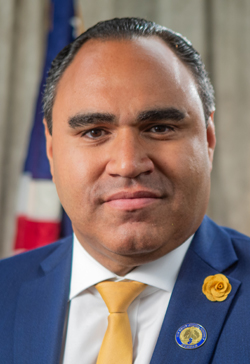
Asm. Gabe Rodriguez
Sponsored bills
Maddy summaryBill A 2338 required public transportation employees, motorbus operators, hotel/motel staff, healthcare facility workers, and judicial personnel to complete one-time training on recognizing human trafficking signs and responding appropriately. The training, mandated as a condition for license renewals or employment, must include specific content about victim signals observed in public spaces and be reviewed biennially. It applied directly to licensed entities like hotels, healthcare facilities, and transit operators, with enforcement handled by the Department of Community Affairs and Department of Health. The bill was withdrawn on January 13, 2026, after being approved as P.L.2025, c.343.
Maddy summaryThis bill creates a three-year "Male Teachers of Color Mentorship Pilot Program" to pair male students of color in teacher training programs with male teachers of color. It requires the Commissioner of Education to select 19 eligible students (in their final year of training) and 19 male teachers from participating schools, pairing them for mentorship through the student's final training year and first two teaching years. Mentors receive a $5,000 annual stipend, and schools must make a good-faith effort to hire students with favorable performance reviews. The program is funded by a $95,000 appropriation and requires a final report evaluating its effectiveness and recommending potential expansion.
Maddy summaryThis resolution declares September 22-28, 2024, as "Diaper Need Awareness Week" in New Jersey. It defines "Diaper Need" as a lack of sufficient clean diapers, which affects infants, toddlers, and low-income families (noting one in three mothers experience it). The resolution urges state agencies to organize diaper drives during this week and requests the Governor issue a proclamation encouraging public participation in supporting diaper banks. It does not create new funding or eligibility rules but aims to raise awareness and promote community action.
Maddy summaryThis bill expands New Jersey's "Nosey's Law" to prohibit the use of rabbits, hares, and rodents in traveling animal acts, while removing previous exemptions for domestic animals like cattle, horses, and dogs. It bans wild or exotic animals (including newly added lagomorphs and rodents) from performances requiring mobile transport, such as circuses or carnival acts. Exceptions for educational outreach are now limited exclusively to programs at schools or universities, eliminating broader allowances for permanent institutions or government entities. The law aims to restrict animal performances in mobile settings, directly affecting traveling entertainment venues and performers using these animals.
Maddy summaryNew Jersey's A465 prohibits employers from firing, demoting, or punishing employees who cannot work due to a declared state of emergency (e.g., evacuations or travel bans). It also prevents employers from requiring employees to use sick or personal leave for emergency-related absences. Employees must notify employers of their absence and return to work as soon as safety permits, but employers are not required to pay them during the emergency. Violations can result in civil penalties up to $10,000 per offense. The law excludes healthcare workers, public safety personnel, and contractors for emergency services from its protections.
Maddy summaryThis bill establishes a state-funded program to improve access to menstrual hygiene products (like tampons and sanitary napkins) for low-income residents in New Jersey. The Department of Agriculture will administer the program, awarding annual grants of up to $10,000 to participating food pantries to purchase these products, with $200,000 appropriated from the state General Fund. The department must list participating pantries and their hours online, coordinate with pharmacies for efficient product distribution, and develop educational materials about menstrual hygiene. The program requires implementation within six months of the bill's effective date.
Maddy summaryThis bill establishes a three-year pilot program in eight New Jersey counties (Passaic, Union, Essex, Hudson, Gloucester, Atlantic, Camden, and Mercer) to help low-income renters cover security deposits. It appropriates $400,000 to create a dedicated fund that reimburses landlords if tenants violate leases, while requiring eligible tenants to pay 1/12 of their security deposit monthly for the first year. To qualify, households must meet "very low income" housing standards under state law and rent must not exceed 40% of their income. Landlords cannot refuse leases to participants, as this would violate the state’s anti-discrimination law. The program requires the commissioner to report on its effectiveness after three years.
Maddy summaryThis bill (A 3349) amends New Jersey law to explicitly include "emergency, transitional, and permanent housing" as a funded service for domestic violence victims through the existing "Domestic Violence Victims' Fund." The Fund, managed by the Division of Child Protection and Permanency, is financed by civil penalties ($50-$500) from domestic violence convictions and other designated moneys. It directly affects victims of domestic violence by ensuring these housing needs are covered alongside existing services like shelter, food, utilities, and legal assistance. The change clarifies that housing must be funded from this dedicated account, not other general funds.
Maddy summaryThis bill creates a new Department of Early Childhood within New Jersey's Executive Branch to oversee early childhood programs. It transfers specific responsibilities from the Department of Education (covering preschool through grade 3 programs like teacher licensing and Title I services) and the Departments of Human Services and Children and Families (including child care programs, home visiting initiatives, and early intervention services) to this new department. The department will be led by a commissioner appointed by the governor, who will manage all programs for children from pregnancy through age eight. The law establishes the department's structure, authority, and administrative procedures to consolidate early childhood services under one agency.