

Maddy summaryThis bill requires New Jersey's Department of Transportation to mandate that electric vehicle charging stations be accessible to drivers with disabilities. New charging stations must meet specific accessibility standards within 18 months, including a minimum 11-foot-wide charging space with a 5-foot-wide access aisle, clear floor space meeting ADA requirements, and features like one-handed operation for connectors requiring minimal force. Existing charging stations must comply with accessibility standards to the maximum extent feasible. The bill directly affects charging station operators and the DOT, requiring them to implement these accessibility features for drivers with mobility and communication disabilities.
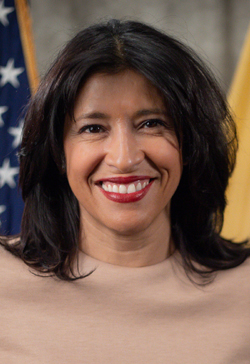
Asm. Rosy Bagolie
Sponsored bills
Maddy summaryThis bill prohibits distributing intentionally deceptive audio or visual media (such as deepfakes) within 90 days of an election if the intent is to deceive voters about a candidate or election. It criminalizes such distribution as a disorderly person offense, punishable by up to six months in jail, a $1,000 fine, or both. The prohibition does not apply if the media includes a clear, visible disclosure (e.g., "This advertisement contains manipulated images or sound") that remains readable throughout video or audible at the start of audio. Registered voters and candidates can seek court injunctions or sue for damages in violation cases. News organizations publishing such media for newsworthy purposes with the required disclosure are exempt from the law.
Maddy summaryThis bill requires health insurance plans in New Jersey to cover preimplantation genetic testing (PGT) with in vitro fertilization (IVF) for people who are not infertile, specifically to prevent certain serious genetic conditions from being passed to offspring. Coverage is required when both partners are carriers of specific genetic disorders, one partner is a carrier with a child who has the disorder, or the genetic condition would cause significant health problems in offspring. The bill defines specific medical conditions that qualify for coverage and limits it to those cases, while allowing religious employers to request exclusions if coverage conflicts with their religious beliefs. The coverage must be provided at facilities meeting specific medical standards, with the same copayments and deductibles as other pregnancy-related services.
Maddy summaryThis bill, known as the New Jersey Immigrant Trust Act, prohibits state and local government agencies from collecting immigration status information unless strictly necessary for service eligibility and from assisting federal immigration authorities. It requires government entities to adopt policies protecting sensitive locations like schools, hospitals, and shelters from immigration enforcement activities, ensuring immigrants can access public services without fear. The law mandates law enforcement training on these restrictions, prohibits detaining individuals based on immigration status, and requires annual reporting on interactions with federal immigration authorities. It also establishes a public awareness campaign to inform immigrants of their rights under the law.
Maddy summaryThis bill requires early intervention service providers (for infants and toddlers with disabilities) to submit specific information to the child's local school district and New Jersey Department of Education. Annually by September 1, providers must share a list of names and ages of all eligible children they serve. Additionally, 120 days before a child turns three, providers must notify the district and DOE about the child's upcoming transition to school-age special education services, including recent evaluations and the child's service plan. Non-compliance could result in penalties like loss of state funding or provider status.
Maddy summaryThis bill requires New Jersey's public colleges and universities to publicly disclose the names of all individuals and organizations that donated money to the institution or its student organizations. Institutions must publish this information on their websites by July 31 each year, showing all donors from the previous academic year without using placeholders like "unknown" or "not available." Failure to comply could result in fines determined by the Secretary of Higher Education, and repeated violations may lead to loss of tax-exempt status. The bill aims to increase transparency about financial relationships between public higher education institutions and their donors.
Maddy summaryThis bill requires New Jersey school boards to create a policy allowing board members to attend meetings remotely under specific circumstances, such as medical issues, childcare needs, or work obligations. The policy must specify approved situations, require advance approval from the board president, ensure remote participants can hear and see all discussions, and limit remote attendance to three consecutive meetings. School boards must also provide necessary technology for remote participation, and remote members count toward quorum. The policy applies directly to school board members and their local school districts.
Maddy summaryThe New Jersey Low Income Household Water Assistance Program, established by this bill, provides water bill payment assistance to households with monthly income at or below 60% of the state median income. It appropriates $25 million from the General Fund to fund direct financial assistance, debt relief for past water bills, and water efficiency measures for eligible households. Public water utilities, local authorities, and municipal utilities must enter into vendor contracts with the Department of Community Affairs to participate in the program and provide assistance to qualifying customers. The program aims to prevent water service disconnections due to inability to pay and restore service to disconnected households. The Department of Community Affairs must submit annual reports detailing program participation, funding use, and outcomes.
Maddy summaryNew Jersey Assembly Bill A4931 requires all members of local or regional school board of education to maintain a principal residence within their school district and spend at least 292 days there annually. The bill defines "principal residence" as a permanent home, excluding vacation properties or rental holdings, and states that board membership automatically ends if this requirement is not met. Exceptions apply if a member's primary residence is damaged by disaster, requiring temporary relocation. This amends existing law (N.J.S.18A:12-1 and N.J.S.18A:12-3) to add the 292-day residency requirement, replacing the previous standard of merely being a district resident.
Maddy summaryThis bill creates a Preschool Snack Reimbursement Grant Program to reimburse New Jersey public preschools for snack costs incurred while awaiting federal approval to participate in the Child and Adult Care Food Program (CACFP). It specifically targets federally unapproved participant preschools (those with pending federal CACFP applications) and requires the state to cover costs for free snacks provided to all enrolled preschoolers during the application review period. The bill appropriates $100,000 from the General Fund to the Department of Agriculture for this purpose, to be deposited into the existing "Nourishing Young Minds Initiative Fund." This reimbursement covers costs that would otherwise remain uncovered by federal funding during the waiting period for CACFP approval.