

Maddy summaryThe Freedom to Read Act establishes requirements for library materials in New Jersey public school libraries and public libraries, requiring school boards and library governing bodies to adopt policies that ensure access to diverse and inclusive materials. The bill defines "diverse and inclusive material" as content reflecting protected classes under New Jersey's Law Against Discrimination, materials produced by authors regardless of their protected class status, and materials containing authors' views on contemporary issues, while excluding age-inappropriate content. It creates procedures for challenging library materials, including review committees and requiring that challenged materials remain available until a final decision is made. The bill also provides legal protections for school library media specialists and librarians, granting them immunity from liability for good-faith actions and a civil cause of action against those who harass them for complying with the law.
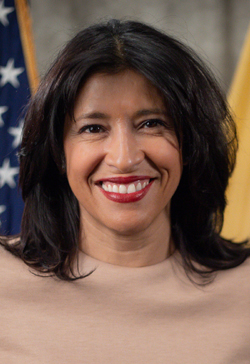
Asm. Rosy Bagolie
Sponsored bills
Maddy summaryThis bill excludes certain military compensation from New Jersey's gross income tax for residents who serve outside the state. Specifically, it applies to New Jersey residents stationed or deployed out-of-state for at least six months during a taxable year. The exclusion covers pay from the U.S. Armed Forces, including mustering-out payments and housing allowances, but only for service performed outside New Jersey. It directly affects New Jersey military members stationed or deployed out-of-state, reducing their state tax burden on that income.
Maddy summaryThis bill (A5071) allows specific protected individuals to list a post office box or alternative contact address on their New Jersey driver's license or identification card instead of their home address. It applies to "covered persons" under Daniel's Law (P.L.2021, c.371), including active or retired judicial officers, law enforcement officers, child protective investigators, prosecutors, and their immediate family members living in the same household. These individuals must have already received approval from the Director of the Office of Information Privacy to redact or keep their home address confidential. The law updates existing rules to ensure consistent privacy protections across state agencies by permitting this alternative address option for covered persons, while still requiring a physical street address for most license applicants.
Maddy summaryThis bill permits New Jersey municipalities, sewerage authorities, and water utilities to reduce water, sewer, and stormwater fees for low-income residents. To qualify, households must have income at or below a percentage of federal poverty guidelines (capped at the threshold used for the Low Income Household Water Assistance Program), and residents must provide documentation about their income, household, and housing status. Local authorities must establish clear eligibility procedures, advertise the program to residents, and demonstrate through a rate study that the fee reductions won't cause unreasonable rate increases or compromise infrastructure maintenance. The bill appropriates $200,000 from the General Fund to cover costs for conducting the required rate studies. This program directly affects low-income households who pay for essential utility services in New Jersey communities.
Maddy summaryThis bill amends New Jersey's invasion of privacy law to clarify that consent to being photographed, filmed, or recorded in a sexual manner does not automatically cover consent for disclosing the image. It requires that any consent for sharing such images must be explicit, specific to the purpose given, and not implied by prior consent for taking the image. The law treats the act of capturing the image and the act of disclosing it as separate offenses, each needing distinct permission. This directly affects individuals whose intimate images are taken without consent and then shared without their explicit agreement for that sharing.
Maddy summaryThis bill would allow restaurants and licensed alcoholic beverage retailers (including bars, wineries, breweries, and distilleries) to operate in designated outdoor spaces adjacent to their business premises, including on public sidewalks. It creates a "premises expansion permit" process requiring applications to either the Division of Alcoholic Beverage Control (for licensed businesses) or municipal zoning officers (for restaurants without alcohol licenses), with requirements for security plans and property descriptions. Municipalities may regulate hours of operation but must allow outdoor service outside specific hours (10pm-11am on Sundays-Wednesdays, and 12am-11am on Thurs-Sat), and cannot prohibit outdoor service for businesses already operating under legal or disciplinary restrictions. The bill specifies that State-owned rights-of-way require separate approval from the New Jersey Department of Transportation, with setback requirements for roads intersecting state highways.
Maddy summaryThis bill increases penalties for assaulting law enforcement officers, making it a second-degree crime when bodily injury occurs (previously a third-degree crime). It expands protection to include firefighters and emergency medical personnel who are assaulted while performing their duties. The bill requires offenders to provide a blood or biological sample for testing for communicable diseases, with any positive results shared with the victim. It also prohibits plea bargains for assault on law enforcement officers and prevents convictions from merging with other offenses. The bill takes effect immediately.
Maddy summaryThis bill allocates $3 million from the General Fund to provide one-time bonus awards to State workers in Local 195 of the International Federation of Professional and Technical Engineers who provided essential frontline service during the COVID-19 pandemic. The funds will be distributed by State agencies in consultation with the union president, with each eligible employee receiving a direct bonus payment. It specifically targets workers who maintained critical state operations amid pandemic challenges. The appropriation is supplemental to existing 2024-2025 funding and takes effect immediately.
Maddy summaryThis New Jersey Assembly Resolution (AR 165) urges the U.S. federal government to create legislation providing proportional property tax relief for veterans with service-connected permanent disabilities. It proposes that veterans receive tax relief based on their U.S. Department of Veterans Affairs disability rating (e.g., 30% disability would yield 30% tax relief), limited to their primary residence and veterans earning under $200,000 annually. The resolution highlights that New Jersey currently offers full property tax exemptions for veterans with 100% service-connected disabilities, but this federal standard would extend similar proportional benefits to veterans nationwide. It does not create new state law but calls for federal action to ensure consistent support for veterans across all states.
Maddy summaryThis bill allows restaurants and licensed alcohol beverage retailers and manufacturers to expand their operations into designated outdoor spaces adjacent to their business locations, including public sidewalks. Businesses must apply for a "premises expansion permit" with their municipal zoning officer and the Division of Alcoholic Beverage Control, providing detailed plans for outdoor space design, sanitation, and safety measures. Municipalities can set reasonable operating hour limits (generally allowing most hours except late-night on Sundays-Wednesdays and early morning on Thurs-Saturdays), but must follow state requirements for permit renewal. Restaurants without alcohol licenses must renew their outdoor permits annually, while those with alcohol licenses renew with their main business license. The bill specifies that municipal ordinances on sanitation, noise, and other matters still apply unless specifically modified by the municipality.