

Maddy summaryThis bill requires large food waste generators (like restaurants, hospitals, supermarkets, and farms producing 52+ tons annually) to separate organic waste at the source and recycle it at authorized facilities within 25 miles. If no nearby facility exists or recycling costs exceed disposal costs by 10%, generators may dispose of waste or apply for a waiver. Violations carry civil penalties of $250-$1,000 per offense, with ongoing violations treated as separate offenses. The law amends existing waste management rules to expand recycling obligations for commercial food waste producers.
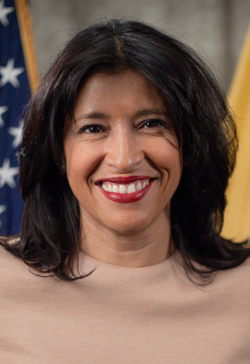
Asm. Alixon Collazos-Gill
Sponsored bills
Maddy summaryThis bill designates September 14 each year as "Latino Business Day" in New Jersey to highlight the economic contributions of Latino-owned businesses. It requests the Governor issue an annual proclamation encouraging public officials and citizens to observe the day through activities that recognize these businesses' impact. The resolution emphasizes that Latino-owned businesses contribute significantly to job creation and economic growth in the state, noting their rapid expansion compared to other business sectors. As a ceremonial resolution, it does not create new laws or funding but aims to raise public awareness of this economic segment.
Maddy summaryThis bill ensures New Jersey State Police officers assigned to temporary reassignments ("detachment from service") or sensitive roles requiring access to confidential information ("confidential positions") cannot be excluded from promotion or penalized for these assignments. It specifically requires that time spent in these roles counts toward an officer's eligibility for promotion. The bill defines "detachment" as temporary reassignment to a different location/unit for a specific duty, and "confidential positions" as roles involving protective services for government branches or sensitive information access. Officers will have their time in these assignments included in promotion calculations, removing barriers to advancement for such assignments. The law takes effect immediately upon enactment.
Maddy summaryThis bill (A 3426) sets new requirements for members of New Jersey's Board of Public Utilities (BPU). It mandates that at least two members have at least three years of professional experience in areas like energy policy, utility regulation, or infrastructure, while at least one member must have experience in consumer advocacy or ratepayer representation. The bill also requires BPU members to reside in diverse geographic areas across the state (urban, suburban, rural) and complete 12 hours annually of training on topics including energy markets, grid modernization, and utility rate-setting. All training must be documented and submitted to the Governor and Legislature each year.
Maddy summaryThis New Jersey bill (A 1736) prohibits law enforcement officers from wearing masks or disguises during public interactions while performing official duties. It directly affects all state, county, and municipal officers authorized to enforce laws, including federal officers working in New Jersey. Key exceptions include undercover operations, face shields not hiding the face, medical masks with a doctor's note, and smoke protection during emergencies. Violations are classified as disorderly persons offenses, punishable by fines up to $1,000 or up to six months in jail. The bill takes immediate effect upon passage.
Maddy summaryAJR 17 designates July each year as "Cleft and Craniofacial Awareness and Prevention Month" in New Jersey. This resolution aims to raise public awareness about cleft lip and palate birth defects - conditions affecting about 1 in 1,700 U.S. babies - which can cause feeding, speech, and dental challenges. It encourages New Jersey community organizations, medical institutions, and advocacy groups to collaborate on education, outreach, and research to support affected families and advance understanding of these conditions. The bill is procedural, requesting the Governor issue an annual proclamation to recognize the month.
Maddy summaryThis bill directs New Jersey's State Board of Education to create a "general science" endorsement for teacher instructional certificates. It allows certified teachers to teach any high school science course (grades 9-12) with this endorsement. To qualify, teachers must hold a science-related bachelor's or master's degree, maintain a 3.0 GPA, pass basic skills and subject-specific tests, and meet other commissioner-set requirements. Current teachers with specific science endorsements (biology, chemistry, etc.) can apply for this broader endorsement if they meet these standards.
Maddy summaryThis bill would have established criminal penalties (fourth-degree crimes) for employers who knowingly falsify payroll records required under New Jersey's Prevailing Wage Act or make false statements on public works contractor registration forms. It directly affects employers working on public construction projects subject to prevailing wage requirements. Currently, such violations are punishable only as minor offenses (up to 90 days in jail), but this bill would have increased penalties to up to 18 months in jail or $10,000 fines. The bill was withdrawn on January 13, 2026, as it was approved as part of P.L.2025, c.356, meaning the changes are now law.
Maddy summaryNew Jersey's bill A 2031 standardizes food date labeling by requiring manufacturers to use "BEST if Used By" for quality dates (indicating food may decline in quality but remains safe) and "USE By" for safety dates on time/temperature control foods (indicating potential health risks after that date). Retailers must not sell or donate food past a safety date, and the bill prohibits "sell-by" dates on consumer-facing labels (except coded formats). It also mandates the Commissioner of Health to create a public education program explaining label differences to reduce food waste from confusion. The law directly affects food manufacturers, retailers, and consumers in New Jersey, excluding alcoholic beverages.
Maddy summaryThis bill requires New Jersey's Department of Health (DOH) to form formal partnerships with businesses, community groups, healthcare facilities, universities, and other stakeholders to strengthen emergency responses during public health crises. It directs the DOH to identify critical resources and at-risk populations, then develop collaborative response plans, joint training exercises, and systems for sharing partnership data. The law mandates these partnerships to improve the state's ability to coordinate rapid, effective crisis management across multiple sectors. It directly affects the DOH, its partner organizations, and communities most vulnerable during emergencies like pandemics or natural disasters. The bill takes effect immediately upon enactment.