

Maddy summaryThis bill (A 3705) modifies New Jersey's medical aid in dying law by waiving the standard 15-day waiting period between the patient's initial and second oral requests when a physician determines, with reasonable medical certainty, that the patient is not expected to survive 15 days. It directly affects qualified terminally ill patients with rapidly declining health who meet this medical criterion. The bill retains a 48-hour waiting period between the written request and prescription issuance, while requiring physicians to document the medical basis for waiving the 15-day period. All other requirements for medical aid in dying - such as written requests, physician consultations, and patient rights to rescind - remain unchanged.
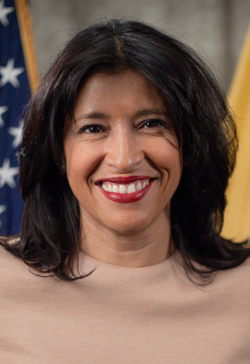
Asm. Alixon Collazos-Gill
Sponsored bills
Maddy summaryThis New Jersey bill (A3712) requires all law enforcement agencies to adopt a mandatory "duty-to-intervene" policy. The policy compels officers to stop colleagues from committing unjustified force, civil rights violations, or other criminal acts during duty. Agencies must either use the Attorney General’s model policy or get approval for a comparable one, and report all intervention incidents quarterly to the Attorney General. Failure to intervene could result in disciplinary action under the policy. The law aims to create standardized accountability for officer conduct.
Maddy summaryThis bill sets minimum staffing requirements for school library media specialists in New Jersey public schools based on student enrollment. Schools with under 300 students must employ at least a half-time specialist, those with 300-1,499 students must have one full-time specialist, and schools with 1,500+ students must have two full-time specialists. It also requires schools with 500+ students to employ library clerks (one full-time clerk plus one additional clerk per 500 students). The bill includes limited waivers for schools unable to hire certified staff, allowing up to two waivers within five years. These requirements apply starting the first full school year after enactment.
Maddy summaryThis bill modifies New Jersey's process for filling vacancies in the U.S. House of Representatives. It requires the Governor to use the next general election date for vacancies occurring after July 1 but before 70 days prior to the general election, eliminating the need for a special election. For vacancies before July 1 or after the 70-day window with over a year remaining, it mandates a special election 70-80 days after the writ is issued, with no primary election. The changes directly affect New Jersey's U.S. House seat and streamline the timeline for filling vacancies based on when they occur during the election cycle.
Maddy summaryThis New Jersey Assembly Resolution (AR 108) formally condemns the Russian Federation and Vladimir Putin for actions leading to the death of opposition leader Alexei Navalny. It does not create new laws or affect any group directly; instead, it expresses legislative disapproval of Russia's treatment of Navalny, including his poisoning, imprisonment under harsh conditions, and death in 2024. The resolution specifies that copies will be sent to the U.S. Secretary of State, New Jersey’s congressional delegation, the Russian ambassador, and the UN representative. It is a procedural statement of condemnation, not a policy change.
Maddy summaryThis bill (A 2612) requires New Jersey's Secretary of Higher Education and public colleges/universities to create specific programs aimed at increasing Hispanic and Latino representation in leadership roles. Key provisions include establishing leadership development programs for faculty, creating pathways for undergraduates to pursue academic careers, and mandating institutions to adopt diversity-focused hiring policies for leadership search committees. Public institutions must implement recruitment/retention programs, submit annual reports tracking leadership diversity (by race/gender), and review their progress. The bill directly affects all public higher education institutions in New Jersey and their leadership hiring processes.
Maddy summaryBill A 3721 renames Greystone Park Psychiatric Hospital to Richard J. Codey Psychiatric Hospital. The bill requires the New Jersey Department of Health to update all official publications, signs, and public indicators to reflect the new name, and amends all existing laws, regulations, and documents to use the new designation. This change affects the hospital’s official identity and all references to it in state law, without altering services or operations. The bill is procedural, with no substantive policy changes beyond the name update.
Maddy summaryThis bill requires New Jersey's Department of Human Services (DHS) and Department of Health (DOH) to provide SNAP (food assistance), WFNJ (cash assistance), and WIC (nutrition program) recipients with clear information about card skimming, cloning, and fraud prevention. It mandates that agencies replace stolen benefits through established claims processes using federal funds (per the 2023 Consolidated Appropriations Act) or state funds if federal funds are unavailable. DHS and DOH must also coordinate with card vendors to implement security measures like embedded microchips and transaction alerts. The bill directly affects millions of low-income New Jersey residents who rely on these programs for essential support.
Maddy summaryThis bill prohibits businesses in New Jersey from selling, manufacturing, or distributing personal flotation devices (PFDs) like lifejackets, water wings, or puddle jumpers that lack U.S. Coast Guard approval. It directly affects businesses selling PFDs designed for children under 12 years old. Violators face tiered fines: up to $100 for a first offense, $250 for a second, and $500 for subsequent offenses, enforced by the Division of Consumer Affairs. The law aims to remove unapproved, potentially unsafe PFDs from the market to ensure consumers can access reliable safety equipment.
Maddy summaryThis bill (A 3739) designates May of each year as "Water Safety Month" in New Jersey to raise public awareness about preventing water-related accidents and drowning. It directly affects public schools and students in grades kindergarten through five, encouraging the Department of Education (with the Department of Health) to provide resources for water safety education during this month. Key provisions include supporting school presentations, partnerships with nonprofits, and educational activities focused on age-appropriate safety practices. The bill aims to address drowning as a leading cause of death for young children, per CDC data, through proactive school-based learning.