

Maddy summaryNew Jersey's S 2260 strengthens legal protections for patients and providers accessing or delivering reproductive and gender-affirming health care services within the state. The bill explicitly defines "legally protected health care activities" to include seeking, providing, or assisting with these services (such as abortion, contraception, or gender-affirming care), regardless of a patient's location. It prohibits obstruction, intimidation, or physical barriers at facilities offering these services and grants licensing boards authority to impose civil penalties for violations. This directly affects patients traveling to New Jersey for care (not available in their home states) and healthcare providers operating in these fields. The law codifies existing protections to prevent harassment or violence against these services, following increased threats and protests nationwide after the overturning of Roe v. Wade.
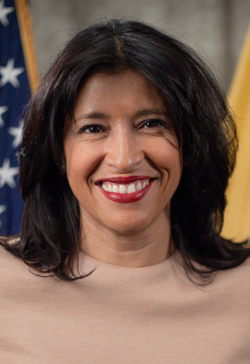
Rep. Alixon Collazos-Gill
Sponsored bills
Maddy summaryThis bill exempts wages earned by poll workers during election cycles from being counted when calculating an individual's unemployment benefits. It directly affects poll workers who may otherwise have their unemployment compensation reduced due to income earned from temporary election work. The key provision amends New Jersey's unemployment law to exclude poll workers' wages from the "annual payroll" calculation used to determine benefit eligibility. This change ensures poll workers can receive full unemployment benefits without their election-season earnings affecting their claim. The bill focuses solely on adjusting the calculation method for this specific group of workers.
Maddy summaryThis bill, titled the "John R. Lewis Voter Empowerment Act of New Jersey," is a commemorative resolution naming a state initiative after civil rights leader John Lewis. It appropriates $2.5 million but does not establish new voting procedures or protections. The bill primarily includes recognition language affirming New Jersey’s commitment to voting rights for protected classes and defines terms like "covered entity" for future reference, though no specific implementation mechanisms are detailed. As it is pending technical review and lacks concrete policy changes, it functions as a symbolic gesture rather than a substantive legislative action.
Maddy summaryThis bill allows for-profit movie theaters in New Jersey to obtain a license to sell alcoholic beverages on their premises. The license would permit the sale of alcohol during the two hours before a first-run movie screening and throughout the screening itself, subject to approval by the municipal governing board and the Division of Alcoholic Beverage Control. Movie theaters must apply for this license annually and pay an initial fee of at least $210,000, which is reduced to $150,000 if 10 percent or more of the alcohol sold comes from local craft producers. The license is restricted to use only at the theater location and cannot be transferred to other premises.
Maddy summaryThis bill codifies protections for patients and providers accessing or offering legally permitted reproductive and gender-affirming health care in New Jersey. It prohibits obstructing or intimidating individuals at facilities providing these services - including blocking entrances, causing reasonable fear of harm, or threatening violence. The law defines "legally protected health care activity" to cover all such services lawful in New Jersey, regardless of a patient’s location, and applies to both in-state residents and out-of-state patients seeking care here. It expands existing safeguards by explicitly banning physical obstructions and threats at facilities offering these services.
Maddy summaryThis bill allows qualifying nonprofit organizations to receive full funding from the Green Acres Fund for projects on state-owned land, removing the usual requirement for them to contribute matching funds. It specifically applies to groups seeking grants for the development, capital repair, or improvement of state property used for purposes like education, research, or recreation. By eliminating the matching fund rule, the legislation enables these nonprofits to utilize state resources entirely to maintain and upgrade facilities without needing to secure additional private or public contributions.
Maddy summaryThis bill restructures the governance of New Jersey's State Health Benefits Program by creating a new State Health Benefits Commission with 13 members. The commission will include existing state officials, representatives from local and higher education employers, and members appointed by various public employee unions, including specific seats for police and firefighters. A key provision is the addition of a non-voting expert member selected by the other commissioners to provide independent advice on health care plan design. The bill also establishes a new committee to assist with plan design and outlines how members will be appointed, serve terms, and manage conflicts of interest. Ultimately, the legislation aims to broaden representation and oversight in how the state manages health benefits for its employees.
Maddy summaryThis bill requires private contractors performing construction work in New Jersey (excluding public projects or home improvements) to register with the Department of Labor. To register, contractors must submit business details, proof of required licenses, worker's compensation insurance, and disclose compliance with state and federal labor laws (like wage laws and safety regulations). Contractors must also disclose past labor law violations or criminal offenses related to their work. Exemptions apply to contractors already registered under New Jersey’s public works registration system.
Maddy summaryThe Climate Superfund Act (A 3735) holds fossil fuel companies liable for climate change damages by requiring them to pay compensatory payments into a state fund. Companies that extracted or refined fossil fuels during 1995-2026 and emitted over one billion metric tons of greenhouse gases must pay based on their proportional liability, with joint liability for companies in a "controlled group." Funds collected will be distributed to implement climate adaptation projects, such as flood protection, infrastructure upgrades, and health programs in overburdened communities. The Department of Environmental Protection will administer the Climate Superfund Cost Recovery Program to manage payments and fund these projects.
Maddy summaryThis bill expands New Jersey's existing requirement for health insurance plans to cover prostate cancer screenings without any out-of-pocket costs. It specifically requires coverage for annual screenings - including digital rectal exams and PSA tests - for men aged 50 and older (asymptomatic) and men aged 40 and older with a family history of prostate cancer or other risk factors. The law applies to most health insurance plans, including high-deductible plans where permitted by federal law, and mandates coverage "to the same extent as for any other medical condition." It does not alter existing coverage for other preventive services but ensures no cost-sharing (like deductibles or copays) applies to these specific screenings.