

Maddy summaryThis bill updates the enabling legislation for New Jersey's Infrastructure Bank by clarifying and expanding the definitions of specific project types it can fund. The changes directly affect local governments, airports, ports, and environmental agencies by providing clearer guidelines on what qualifies as an aviation, marine, or environmental infrastructure project. Key provisions include new definitions for terms like "combined sewer overflow" and "cross-investment," as well as a broader list of eligible entities such as regional transportation authorities and water districts. By refining these legal descriptions, the bill aims to streamline how the bank allocates funds for construction, repair, and improvement projects across the state.
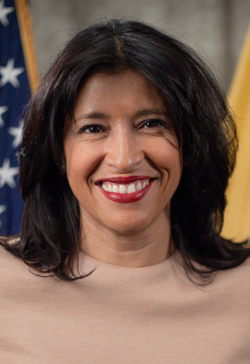
Asm. Alixon Collazos-Gill
Sponsored bills
Maddy summaryThe "Immigrant Tenant Protection Act" (A4492) prohibits landlords in New Jersey from threatening to disclose or disclosing a tenant’s immigration or citizenship status to force them out of housing, or from using that status as a basis for eviction. It bans evictions solely or partially tied to immigration status and allows tenants to sue for up to $2,000 per violation, plus damages and legal fees. The bill also blocks courts from inquiring into a tenant’s immigration status during housing rights cases, except in limited circumstances like federal program compliance. It directly affects residential tenants (particularly immigrant communities) and landlords, while clarifying that landlords may still request standard financial or identity verification for legitimate rental purposes.
Maddy summaryThis bill proposes to increase the gross income tax rate for individuals in New Jersey whose taxable income exceeds $2,000,000. It directly affects high-income earners by amending the state tax code to apply a higher percentage to income above this specific threshold. The legislation would modify the existing tax tables to ensure that only the portion of income surpassing $2 million is taxed at the new, elevated rate. This change aims to generate additional revenue from the wealthiest taxpayers while leaving tax rates for lower and middle-income earners unchanged.
Maddy summaryThis bill requires corporations in New Jersey that file combined tax returns to calculate their total income on a worldwide basis rather than limiting calculations to income generated within the state. The law mandates that companies include the full net income of all their foreign branches and subsidiaries, adjusting these figures to align with U.S. accounting standards and converting them into U.S. dollars. It also updates how partnership income is counted within these groups and clarifies rules for foreign corporations with existing tax treaties to ensure consistent reporting across all entities in the group.
Maddy summaryThis New Jersey bill increases fines for retailers selling tobacco or vaping products to people under 21. Retailers face $750 for a first violation, $1,500 for a second, and $3,000 for third or subsequent violations. It also allows license suspension after a second violation and requires retailers to post warning signs at point-of-sale. Five percent of collected fines fund public education about vaping risks and illegal sales. The law directly affects stores selling tobacco or vaping products, aiming to reduce underage access through stricter penalties.
Maddy summaryThis New Jersey bill prohibits the use of Green Acres funds to purchase, install, or replace artificial turf fields at schools, municipalities, and state agencies. The legislation restricts these specific expenditures by directing that money instead be used for natural grass playing fields, citing concerns over harmful chemicals and environmental impacts associated with synthetic turf. By banning the use of these state funds for artificial surfaces, the bill aims to prevent the purchase of fields containing rubberized pellets and microplastics while promoting organic maintenance practices for natural grass.
Maddy summaryThis New Jersey bill creates an "uninsured employer's fund" to pay workers' compensation claims when employers fail to provide coverage. It requires insurance companies and self-insured employers to pay annual surcharges to maintain the fund, and imposes personal penalties on employers (including $1,000 plus 15% of the award per claim, capped at $5,000) for nonpayment. Owners, executives, or directors of uninsured employers face personal liability for these penalties, extending joint responsibility beyond the business itself. The fund ensures employees receive compensation from the state when employers default, while shifting the financial burden to noncompliant businesses and their leadership.
Maddy summaryThis New Jersey bill (A-1728) prohibits public school districts from denying students admittance due to tardiness or violations of dress code or uniform policies. It specifically allows denial only for clothing indicating gang affiliation with criminal activity. Schools may still enforce other conduct policies not covered by this law. The bill directly affects all public school students and districts in New Jersey, ensuring students cannot be barred from school for these specific infractions.
Maddy summaryThis bill increases the monthly personal needs allowance (PNA) from $50 to $140 for low-income residents in nursing homes, state/county psychiatric hospitals, and state developmental centers. It directly affects eligible residents who receive medical assistance under New Jersey’s Medicaid program but are not eligible for Supplemental Security Income (SSI). The allowance is intended for personal discretionary spending on items like phone calls, meals out, clothing, or hobbies. The amount will automatically increase annually starting January 1 after enactment, adjusted by the same percentage as the Social Security cost-of-living adjustment.
Maddy summaryThis bill requires New Jersey's Department of Health (DOH) and Department of Education (DOE) to create and distribute annual guidelines for school districts and colleges. The guidelines must include research-backed materials on vaping's health risks (lung effects, mental health, comparison to smoking, dangers to pregnant people and children), age-appropriate anti-vaping campaigns, decision-making tools to resist peer pressure, and promotional materials for students from middle school through college. Schools and colleges must use these guidelines to implement campus anti-vaping programs. The DOH and DOE will update the guidelines yearly and post them online with additional resources.