

Maddy summaryAJR 64 designates November of each year as "Transgender Awareness Month" in New Jersey. The resolution requests the Governor issue an annual proclamation encouraging public officials and citizens to observe the month with activities that raise awareness of transgender individuals' challenges, including discrimination and violence. It also recognizes the contributions and resilience of transgender people, referencing existing New Jersey observances for Transgender Awareness Week and Transgender Day of Remembrance. This is a symbolic designation with no new legal requirements or funding.
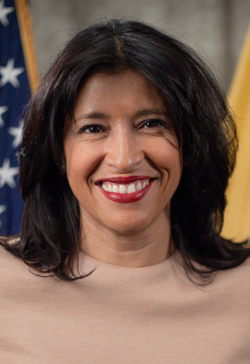
Asm. Alixon Collazos-Gill
Sponsored bills
Maddy summaryThis bill creates the Jersey Strong Public Service Scholarship Program to help students working in critical public service roles. It provides scholarships covering up to $25,000 for two years (after one year of employment) or $50,000 for four years (after two years of employment) at New Jersey public colleges or universities. Eligible students must be NJ residents, U.S. citizens, employed full-time in designated sectors like hospitals, schools, or first responder roles, and meet income and academic requirements. The program requires repayment of funds if a student withdraws without approved reasons or is dismissed from school.
Maddy summaryThis proposed New Jersey bill (A 2740) requires large warehouses and distribution facilities - specifically those generating 50+ daily truck trips or exceeding 50,000-100,000 sq. ft. - to obtain annual permits from the Department of Environmental Protection (DEP) and implement yearly measures to reduce air pollution from truck traffic. Key provisions include a 2050 deadline for zero emissions (via solutions like electric trucks or solar power), shorter 3-year permits for facilities near overburdened communities, and a points-based system for tracking pollution-reduction efforts. The bill directly affects major logistics hubs in or near communities already facing disproportionate pollution impacts, mandating DEP oversight and community input for permit renewals. It aims to address localized air quality issues missed by broader monitoring, focusing on high-traffic facilities as priority targets.
Maddy summaryThis bill prohibits membership-based retail clubs (like warehouse stores) from restricting motor fuel sales to only their members at company-operated gas stations. It directly affects clubs that sell fuel as part of their business, requiring them to serve all customers regardless of membership status. Key provisions include banning membership restrictions on fuel sales, imposing civil penalties up to $10,000 per violation, and defining "club" as establishments selling discounted goods through membership. The Legislature states this ensures public access to fuel stations, supporting commuters, tourism, and overall convenience without harming the broader public interest.
Maddy summaryThis bill establishes New Jersey's "Voting Improvement Task Force" within the Department of State to study and improve voting systems. The task force, made up of 9 members including election officials and public experts, will evaluate vote-by-mail processes, explore ways to speed up counting ballots, research ranked-choice voting feasibility, and identify methods to expand mail voting. It must hold three public hearings across the state and submit findings and recommendations to the Governor and Legislature within one year. The task force expires after submitting its final report.
Maddy summaryThis New Jersey bill (A-3753) requires crisis pregnancy centers to clearly disclose two key facts in English and Spanish: (1) that they are not licensed health care facilities, and (2) whether they employ a physician to supervise pregnancy-related services on-site. Centers must display this information conspicuously in waiting areas, exam rooms, and during client consultations, and include it in all advertisements (online, print, radio, etc.). Violations could trigger penalties under New Jersey's Consumer Fraud Act. The bill applies to all crisis pregnancy centers operating in New Jersey that provide non-medical pregnancy counseling and referrals.
Maddy summaryThis bill amends New Jersey's unemployment benefits law to clarify disqualification rules, primarily affecting agricultural workers. It specifies that workers who voluntarily leave agricultural jobs without "good cause" lose benefits until they work 8 weeks and earn 10 times their weekly benefit rate. The bill also adds protections: workers switching employers within 7 days (with equal pay/hours) won't lose benefits, and disqualifications for "misconduct" now require employers to provide written proof. It further clarifies that refusing work due to strikes, poor pay, or union requirements won't disqualify individuals. The bill is currently pending in the Assembly Labor Committee (introduced January 13, 2026).
Maddy summaryNew Jersey's ACR 106 is a formal statement condemning President Trump's 2025 decision to end federal protections preventing immigration enforcement in sensitive locations like schools, hospitals, places of worship, and shelters. The resolution states this policy reversal - reversing Biden-era guidance that had barred ICE actions in these areas - undermines community trust and deters immigrants from accessing essential services. It does not change laws but sends a formal disapproval to the White House, Homeland Security, and New Jersey's congressional delegation. The resolution reaffirms New Jersey's commitment to equal access to healthcare, education, and community resources for all residents, regardless of immigration status.
Maddy summaryThis bill prevents New Jersey school districts from facing state school aid cuts exceeding 5% in the 2024-2025 school year and beyond. It creates "stabilized reduction aid" to guarantee districts receive the greater of either their prior year's funding (reduced by no more than 5%) or the amount calculated under existing law. County vocational school districts receive similar protection, getting the higher of two calculated aid amounts. The policy directly affects all public school districts and covers key aid types like equalization, special education, and transportation funding.
Maddy summaryThis bill eliminates the automatic presumption that defendants charged with sex offenses against minors can be released before trial. It directly affects individuals accused of sexual crimes involving victims under 18, requiring courts to weigh public safety and victim protection rather than assuming release is appropriate. Key provisions mandate that judges must consider specific risks (like community safety and victim contact) before ordering pretrial release, and if release is granted, it must include strict conditions such as avoiding the victim and complying with supervision. The bill does not change sentencing but alters pretrial detention decisions for these specific offenses. The bill was introduced on January 13, 2026, and referred to the Assembly Judiciary Committee.