

Maddy summaryThis bill authorizes all New Jersey state, county, and municipal law enforcement officers to access crime scenes and evidence under their agency's jurisdiction. It directly affects officers (who gain clear access rights) and anyone who obstructs them (including federal officers), making such obstruction a violation punishable under existing law. The key provision requires officers to access evidence only within their agency's responsibility, while prohibiting interference with this access. The Attorney General must issue implementation guidelines, and the law takes effect four months after enactment.
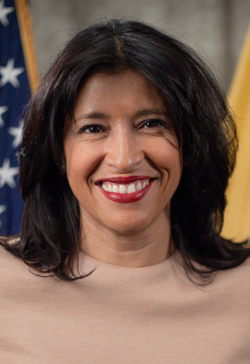
Asm. Alixon Collazos-Gill
Sponsored bills
Maddy summaryThis bill upgrades penalties for repeat offenses of buying sex (prostitution as a patron) in New Jersey. A first offense remains a disorderly persons offense, but a second or third offense becomes a fourth-degree crime, and a fourth or subsequent offense becomes a third-degree crime. The bill also requires that fines collected from these offenses be directed to the "Human Trafficking Survivor's Assistance Fund" to support survivors of human trafficking. It applies specifically to individuals who repeatedly engage in purchasing sexual services.
Maddy summaryThis bill imposes a 50% tax on gross receipts from contracts between private companies and public entities for operating carceral facilities in New Jersey (e.g., private jails or detention centers). It directly affects private businesses running such facilities, requiring them to pay the tax annually based on their prior year’s revenue from these contracts. All tax revenue must be deposited into a new "Immigrant Protection Fund," which the state will use exclusively to fund immigration-related services. The fund is non-lapsing, meaning money stays available for future appropriations without annual renewal.
Maddy summaryThis bill establishes a state standard to protect New Jersey workers from heat-related illnesses and injuries by requiring employers to implement specific safety measures. It directly affects all employers and employees in New Jersey, including those in high-risk outdoor jobs (like construction and agriculture) and indoor settings without climate control. Key provisions mandate written prevention plans that include providing cool water (under 59°F), paid rest breaks in shaded or cooled areas, monitoring heat exposure, and activating a heat alert system during forecasted heat waves - requiring adjustments like shifting work schedules or increasing rest breaks. Employers must develop these plans within 30 days of the law's effective date, with the Department of Labor setting the heat stress standard by June 1, 2025.
Maddy summaryThis bill gradually increases New Jersey's cigarette tax rate over four years, starting July 1, 2024. The tax will rise from $0.135 per cigarette ($2.70 per pack) to $0.20 per cigarette ($4.00 per pack) by 2027. Retailers and distributors must file annual tax returns showing cigarette inventory and pay the increased tax by specific dates each year. The additional revenue generated will go to the state General Fund, while existing dedications for smoking cessation programs and hospital subsidies remain unchanged.
Maddy summaryThis bill establishes minimum nurse-to-patient staffing ratios for hospitals, ambulatory surgery centers, and state developmental/psychiatric hospitals in New Jersey. It requires specific ratios, such as 1 nurse per 4 patients on medical/surgical units and 1 nurse per 2 patients in critical care, along with unlicensed staff ratios (1 per 7 patients during day shifts). Hospitals must implement an acuity-based staffing system approved by the health department to adjust staffing based on patient needs and unit conditions. The law aims to ensure safe staffing levels without reducing existing standards, directly affecting healthcare facilities and patient safety.
Maddy summaryThis bill creates the "New Jersey Reparations Task Force" to research and develop proposals addressing generational harms from New Jersey's role in slavery and systemic racial discrimination. The task force will examine historical and current disparities affecting Black communities, including voter disenfranchisement, youth incarceration rates, housing discrimination, wealth gaps, and school segregation. It will produce a report with policy recommendations for state-based reparations based on documented harms. The bill directly affects Black residents of New Jersey who face these systemic inequities, as outlined in the legislative findings.
Maddy summaryThis bill requires New Jersey's Department of Environmental Protection (DEP) to set a maximum contaminant level of 10 parts per billion for hexavalent chromium (chromium-VI) in drinking water. It directly affects public water systems, with deadlines varying by system size: large systems (10,000+ connections) must comply within 2 years, mid-sized systems (1,000-9,999 connections) within 3 years, and small systems (<1,000 connections) within 4 years after the bill takes effect. The bill does not change existing limits for total chromium but explicitly prohibits hexavalent chromium from exceeding 10 ppb. The DEP may adopt stricter standards later if recommended by the Drinking Water Quality Institute.
Maddy summaryThis New Jersey bill (A 946), now law as P.L.2025, c.177, requires mental health services to be provided in the communication method preferred by each deaf or hard of hearing individual - such as sign language or oral communication - based on their assessment. It mandates that mental health professionals be fluent in that method, trained in cultural needs, and able to collaborate with interpreters. The law also requires a state resource guide listing specialized mental health services and ensures individuals can help shape their own care plans. It directly affects all deaf or hard of hearing residents seeking mental health support in New Jersey, addressing long-standing barriers in access and care quality.
Maddy summaryThis non-binding Assembly Resolution (AR 72) expresses New Jersey's opposition to President Trump's tariff policies, specifically targeting 25% tariffs on steel/aluminum and cars/auto parts, plus a 10% universal import duty. It states the resolution will be formally transmitted to the President, Vice President, and U.S. Trade Representative. The resolution cites economic concerns, noting tariffs function as taxes that raise prices for consumers and businesses, increase living costs, and threaten New Jersey's economy - particularly its port-dependent trade. It does not alter any laws or impose new requirements, serving solely as a symbolic statement of opposition.