

Maddy summaryThis New Jersey bill gradually increases the cigarette tax rate over four years, raising the tax from $2.70 per pack (20 cigarettes) to $4.00 per pack by 2027. The tax will rise to $3.25 per pack starting July 1, 2024; $3.50 per pack in 2025; $3.75 per pack in 2026; and $4.00 per pack beginning July 1, 2027. Retailers and distributors must file annual tax reports and pay the increased tax by September 1 each year using forms provided by the Division of Taxation. The bill maintains current revenue dedications for smoking cessation programs and hospital subsidies, directing any new tax revenue to the General Fund.
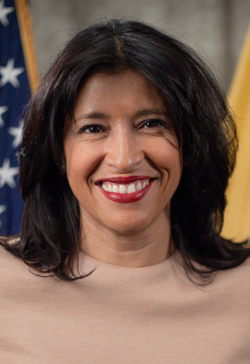
Asm. Alixon Collazos-Gill
Sponsored bills
Maddy summaryThis bill requires New Jersey's Department of Human Services (for SNAP and WFNJ programs) and Department of Health (for WIC) to provide recipients with clear information about card skimming and cloning fraud risks, prevention tips, and how to report stolen benefits. It mandates that both departments establish a process to replace stolen benefits using federal funds first (following federal SNAP rules), then state funds if federal funds are unavailable. The bill also requires departments to work with card vendors to implement security upgrades like microchips, transaction alerts, and usage limits on electronic benefits cards. Additionally, departments must report annually on fraud incidents, replaced benefits, and fraud prevention efforts to the Governor and Legislature.
Maddy summaryThis bill (A3991) directs New Jersey's State Board of Education to create a new "general science" endorsement for teaching certificates. This endorsement would allow certified teachers to teach any high school science course (grades 9-12), rather than being restricted to specific subjects like biology or chemistry. To qualify, teachers must hold a science-related degree (biology, chemistry, physics, or equivalent), maintain a 3.0 GPA, pass basic skills and subject matter tests, and meet other commissioner requirements. Existing science teachers with specialized endorsements (e.g., biology, chemistry) can apply for this general endorsement if they meet the new standards.
Maddy summaryThis bill provides $2 million in state funding to New Jersey's Department of Labor to support county prosecutors in enforcing wage payment laws. It requires each county prosecutor's office to assign a dedicated assistant prosecutor to investigate and prosecute cases where employers fail to pay wages or violate wage-hour laws. The funding covers both financial resources and training for prosecutors to handle these cases more effectively. This directly affects workers who are owed wages and county prosecutors who will now have dedicated staff and resources for wage enforcement.
Maddy summaryThis bill establishes a five-year "Conception to Cradle Pilot Program" within New Jersey's Department of Education to provide integrated early childhood services. The program targets 50 public schools with the worst student performance in low-income communities, requiring them to partner with health and social service providers to offer prenatal care, pediatric health services, and developmental support for infants and toddlers from birth to age three. A nonprofit organization will manage the pilot, train school staff, assign site coordinators (employed by the nonprofit, not the school), and develop selection criteria prioritizing schools serving under-resourced communities. The program includes annual audits and an evaluation, funded through a dedicated nonlapsing state fund that may accept private contributions.
Maddy summaryThis bill increases New Jersey's Medicaid reimbursement rate for basic life support emergency ambulance transports from $58 to a minimum of $200 per transport. It directly affects ambulance providers who deliver emergency medical transportation to Medicaid patients across all Medicaid service models (fee-for-service and managed care). The key provision sets a mandatory minimum payment rate, requiring the Commissioner of Human Services to implement the change through rules and secure federal funding approval. This policy change aims to address New Jersey's current rate being the lowest in the region, which is significantly below neighboring states' rates.
Maddy summaryThis bill establishes minimum nurse-to-patient staffing ratios for hospitals, ambulatory surgery centers, and state developmental/psychiatric facilities in New Jersey. It requires specific ratios (such as 1 nurse for every 4 medical/surgical patients, 1 nurse for every 2 critical care patients, and 1 unlicensed personnel for every 7 daytime patients) while mandating hospitals to implement an acuity-based staffing system to ensure adequate staffing levels. Hospitals found in violation may face civil penalties that increase with repeat offenses, with penalty revenue funding a dedicated "Patient Protection and Staffing Fund" to support nursing recruitment, retention, education, and inspector staffing. The bill also requires the Commissioner of Human Services to review staffing standards in developmental centers and psychiatric hospitals to align with these new requirements.
Maddy summaryThis non-binding resolution urges the U.S. Congress to study food deserts and assess whether federal action could address them. It directly affects approximately 1.3 million New Jersey residents living in areas with limited access to affordable, healthy food due to factors like lack of supermarkets, poor transit, and high poverty. The resolution requests Congress conduct a study on the feasibility of federal solutions, noting that existing state programs (like New Jersey’s $40 million annual Food Desert Relief Program) are insufficient. It emphasizes the need for updated federal research to guide state-level policies and address root causes such as transportation barriers and investment risks in low-income neighborhoods.
Maddy summaryThis bill requires all New Jersey swimming pools to offer deep water swimming tests to children 12 years old or younger upon request by the child or their guardian. The test, conducted by a pool lifeguard, assesses a child's ability to swim 50 meters (two laps) and tread water for 30 seconds to determine if they can safely enter deeper water. Until a child successfully completes this test, they must be accompanied by an adult within arm's length while swimming, with swim team members exempt. Pools must confirm test availability during health inspections and include it in the Department of Health's bathing facility checklist. The law takes immediate effect.
Maddy summaryThis bill requires every New Jersey county to install at least one drive-up ballot drop box at a location designed for accessibility (with features like turning radius, curb cuts, and handicap parking). It mandates that all ballot drop boxes be clearly marked as "Official Ballot Drop Box" and display specific information in required languages, including tampering penalties, a voter hotline, "no postage needed" notice, county-specific ballot acceptance rules, and the 8:00 p.m. Election Day deadline. The bill also requires counties to post electioneering restrictions (no political activity within 100 feet) and ensures compliance with accessibility standards. These changes apply directly to county election boards, affecting how voters deposit mail-in ballots statewide.