

Maddy summaryAJR 113 designates November of each year as "Transgender Awareness Month" in New Jersey. The resolution requests the Governor to issue an annual proclamation encouraging public officials and citizens to observe the month with activities that raise awareness of transgender issues and recognize the community's contributions. It does not create new laws or requirements but formally acknowledges challenges transgender individuals face, including discrimination and violence, while highlighting their societal contributions. The measure follows existing New Jersey designations for Transgender Awareness Week (November 14-20) and Transgender Day of Remembrance (November 20).
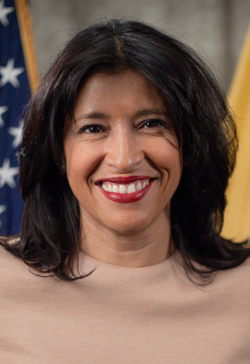
Asm. Alixon Collazos-Gill
Sponsored bills
Maddy summaryThis bill prohibits the New Jersey Turnpike Authority (NJTA) from charging toll payers or E-ZPass account holders any fees related to processing credit card or electronic payments. It requires the NJTA to cover these processing costs within its operating budget instead of passing them to customers. The law directly affects all drivers using New Jersey toll roads who pay with credit cards or electronic methods. The bill codifies an existing NJTA practice where they currently absorb these fees, making it permanent law.
Maddy summaryThis New Jersey bill (A2216) makes several changes to voting by mail procedures. It requires the Secretary of State to create informational posters promoting mail-in voting for display at polling places and include ballot status checking information with mail-in ballots. The bill mandates that county election boards count mail-in ballots received within 48 hours after polls close as valid, whether postmarked on election day or received via USPS within that timeframe. It also clarifies that all voted mail-in ballots, including those received after the 48-hour window, must be retained by county boards for two years, including their envelopes, and made available for voter inspection. These changes aim to increase mail-in voting accessibility and ensure proper handling of ballots.
Maddy summaryThis bill (A668) requires New Jersey's Commissioner of Education to create a water safety fact sheet for schools. The fact sheet must include practical tips for parents to prevent child drowning, highlight the importance of swimming lessons, and list free/reduced-cost water safety courses by county. Public school districts must distribute this fact sheet to parents when a child is first enrolled, while nonpublic schools are encouraged but not required to do the same. It directly affects parents of newly enrolled students in New Jersey schools and aims to improve access to water safety resources.
Maddy summaryThis bill prohibits membership clubs (like warehouse stores) that operate gasoline stations from restricting fuel sales to only their members. It requires these clubs to sell motor fuel to all customers, regardless of membership, directly affecting clubs operating gas stations in New Jersey. Key provisions include a civil penalty of up to $10,000 per violation for non-compliance, enforced by the Division of Consumer Affairs. The law aims to ensure broader public access to fuel stations, particularly in areas with limited options, without restricting membership club operations.
Maddy summaryThis bill creates a new first-degree crime called "home invasion" for entering a residence with intent to commit certain serious crimes (like robbery, sexual assault, or kidnapping) while another person is present and using force, threats, or being armed. It mandates a 10-30 year prison sentence with 85% served without parole under the No Early Release Act. Additionally, it upgrades burglary of a residence to a second-degree crime if anyone other than the offender is present in the home (regardless of the offender’s knowledge), increasing the maximum sentence from 5 years to 10 years. These changes directly affect individuals committing such offenses in residential settings.
Maddy summaryThis bill automatically suspends child support payments (both current and past-due amounts) for individuals incarcerated or detained for over 180 consecutive days, without requiring a court order. It applies to all child support orders monitored by New Jersey’s IV-D agency or probation division, while past-due amounts (arrearages) remain due and can be collected through administrative methods like tax offsets or license suspension. Both the person ordered to pay support and the custodial parent must receive written notice about the suspension, expected reinstatement date (90 days after release), and their right to request payment if the person has income while incarcerated. The Department of Corrections and Juvenile Justice Commission must also inform individuals about this suspension during intake processing.
Maddy summaryThis bill establishes a 9-member "Voting Improvement Task Force" within New Jersey's Department of State (though independent of it) to evaluate and improve the state's voting systems. The task force, appointed by key state leaders and including election officials and public members with voting expertise, must examine vote-by-mail processes, explore faster ballot counting, assess ranked-choice voting feasibility, and research mail voting enhancements. It is required to hold three public hearings across the state and submit a report with findings and recommendations to the Governor and Legislature within one year. The task force expires upon submitting its final report, with no automatic policy changes mandated by this bill.
Maddy summaryThis bill amends New Jersey's medical aid in dying law to waive the 15-day waiting period for terminally ill patients who, within reasonable medical certainty, are not expected to survive 15 days. It directly affects qualified terminally ill patients with rapidly declining health and their attending physicians, who must document the medical basis for the waiver. The bill retains the existing 48-hour waiting period between a patient's written request and prescription issuance. This change allows eligible patients to access medical aid in dying more quickly when their condition is rapidly deteriorating, without altering other procedural requirements.
Maddy summaryThis bill creates a $1,000,000 grant program to help licensed child care centers in New Jersey build kitchen facilities and implement nutrition education for children. Child care centers must apply with specific details - including their need for a kitchen, a curriculum for teaching healthy eating, kitchen designs, and proof of compliance with safety codes - to receive funding. The Commissioner of Children and Families will administer the program and distribute grants equitably across all regions and community types (urban, suburban, rural) if funds remain available. The program aims to improve access to healthy meals and nutrition education in child care settings through direct infrastructure support.