

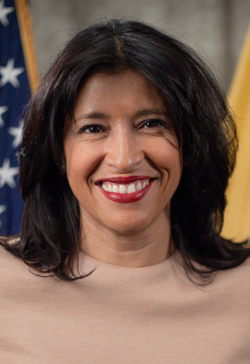
Photo of Alixon Collazos-Gill
D New Jersey General Assembly · District 27

Asm. Alixon Collazos-Gill

Compare
Total votes
1,310
all sessions
Attendance
99%
7 missed
Near the chamber average
With party
99%
of cast votes
Near the chamber average
Bipartisan score
0%
crosses aisle rarely
Near the chamber average
Sponsored
371
bills & resolutions
Near the chamber average
Committees
3
assignments
371 bills and resolutions

Sponsored bills

Total
371
Primary
217
Co-sponsor
154
This page
371
matching current filters
Primary A 4679
In committee · New Jersey General Assembly · Lead sponsor
Requires certain high-traffic facilities to obtain permit from DEP and annually implement measures to reduce air pollution caused by facility.

Maddy summaryThis bill requires large distribution facilities (100,000+ square feet) or those in overburdened communities (50,000+ square feet) that generate 50+ truck trips daily to obtain a permit from New Jersey's Department of Environmental Protection (DEP) and annually implement air pollution reduction measures. The permit program mandates facilities to earn points through specific actions like purchasing electric trucks, installing solar power, or using cleaner equipment to achieve zero emissions by 2050. Facilities must pay annual permit fees and face penalties of $10,000-$20,000 per violation for non-compliance, while the DEP will monitor compliance through truck counting, emissions monitoring, and facility inspections.

In committee Sep 12, 2024 0 co-sponsors
Primary S 2869
Signed into law · New Jersey Senate · Lead sponsor
Establishes penalties for employers who disclose or threaten to disclose employee's immigration status for purpose of concealing violation of State wage, benefit or tax laws.*

Maddy summaryThis bill imposes civil penalties on New Jersey employers who threaten or disclose an employee's immigration status to prevent them from reporting violations of state labor, wage, or tax laws. Employers face escalating fines: up to $1,000 for a first violation, $5,000 for a second, and $10,000 for subsequent violations, with each affected employee counted as a separate violation. It directly affects employers who use immigration status as coercion - such as threatening to report an undocumented worker to hide unpaid wages or benefits - to avoid accountability under laws like the State Wage and Hour Law or Gross Income Tax Act. The penalties apply in addition to any existing penalties for the underlying labor violation.

Signed into law Aug 8, 2024 0 co-sponsors
Co-sponsor S 3384
Signed into law · New Jersey Senate · Co-sponsor
Appropriates funds to DEP for environmental infrastructure projects for FY2025.

Maddy summaryS 3384 appropriates funds to New Jersey's Department of Environmental Protection (DEP) to provide zero-interest loans and principal forgiveness for environmental infrastructure projects. The bill authorizes the DEP to make loans to local governments and public water utilities for clean water and drinking water projects, with specific funding limits including $20 million for combined sewer overflow projects and $10 million for water quality restoration. Funds will come from state revolving funds, federal grants from the Infrastructure Investment and Jobs Act, and unexpended balances from previous programs, with projects requiring repayment within 30-45 years. The bill's funding authorization expires on July 1, 2025.

Signed into law Jul 10, 2024 1 co-sponsor
Primary A 4081
In committee · New Jersey General Assembly · Lead sponsor
Establishes penalties for employers who disclose or threaten to disclose employee's immigration status for purpose of concealing violation of State wage, benefit or tax laws.*

Maddy summaryThis New Jersey bill (A4081) imposes civil penalties on employers who threaten or disclose an employee's immigration status to prevent them from reporting violations of state labor laws. It directly affects employers and immigrant workers, particularly in cases where employers withhold wages, benefits, or comply with tax laws and then pressure workers about their immigration status. The bill adds tiered penalties: $1,000 for a first violation, $5,000 for a second, and $10,000 for subsequent violations per affected employee. These penalties apply in addition to existing penalties under laws like the New Jersey State Wage and Hour Law, targeting employers who misuse immigration status to conceal other violations.

In committee Jun 28, 2024 0 co-sponsors
Primary A 4665
In committee · New Jersey General Assembly · Lead sponsor
Requires Secretary of Higher Education and public institutions of higher education to develop programs for improving Hispanic and Latino representation in higher education leadership positions.

Maddy summaryNew Jersey Assembly Bill A4665 requires the state’s Secretary of Higher Education and public colleges/universities to create programs improving Hispanic and Latino representation in leadership roles. Key provisions include establishing leadership development for Hispanic/Latino faculty, building pipelines from undergraduate students to academic careers, and providing institutions with guidance to address barriers in recruitment and retention. Public institutions must adopt diversity-focused policies for leadership search committees and implement specific recruitment programs within 180 days. Each institution must also submit annual reports detailing leadership demographics and program effectiveness to the Secretary, who will compile statewide data for the Governor and Legislature. The bill directly affects all 16 public higher education institutions in New Jersey and Hispanic/Latino faculty/staff seeking leadership opportunities.

In committee Jun 28, 2024 0 co-sponsors
Co-sponsor A 3872
In committee · New Jersey General Assembly · Co-sponsor
Requires private bus operators to provide notice and hold public meetings for certain service changes.

Maddy summaryThis bill requires private bus companies operating regular scheduled routes (excluding charter, casino, or tourism-focused services) to notify the public and government agencies before making major service cuts. Specifically, operators must provide 4 months' written notice to state agencies (NJ Motor Vehicle Commission and NJ Transit) and 3 months' notice to riders before reducing service. They must also hold a public meeting in the affected area within 15 days of notifying riders, with prior notice to local officials. Violations could result in civil penalties up to $10,000 per instance.

In committee Jun 28, 2024 1 co-sponsor
Co-sponsor AR 147
Passed · New Jersey General Assembly · Co-sponsor
Condemns recent U.S. Supreme Court decision and reaffirms that bump stocks are a dangerous firearm component.

Maddy summaryThis New Jersey Assembly Resolution (AR 147) condemns the U.S. Supreme Court's 2024 ruling in *Garland v. Cargill*, which determined that bump stocks do not qualify as machine guns under federal law. It reaffirms New Jersey’s existing ban on bump stocks, established by P.L.2017, c.323, which prohibits their sale and possession as dangerous devices. The resolution states the Court’s decision undermines federal gun safety regulations and contradicts New Jersey’s commitment to public safety, citing the 2017 Las Vegas shooting where bump stocks were reportedly used. As a non-binding resolution, it does not change laws but expresses the state’s position to lawmakers.

Passed Jun 28, 2024 1 co-sponsor
Co-sponsor A 4426
In committee · New Jersey General Assembly · Co-sponsor
Appropriates funds to DEP for environmental infrastructure projects for FY2025.

Maddy summaryThis bill appropriates funds to New Jersey's Department of Environmental Protection (DEP) to provide zero-interest loans or principal forgiveness for clean water and drinking water infrastructure projects. It authorizes funding for 156 specific clean water projects and 72 drinking water projects across the state, totaling approximately $2.6 billion in estimated loan amounts. The funding is intended to help municipalities and public water utilities finance infrastructure improvements that reduce pollution, improve water quality, and address environmental challenges. The bill includes specific provisions for varying levels of principal forgiveness based on project type and community need, with a focus on making these projects more affordable for local governments.

In committee Jun 28, 2024 1 co-sponsor
Co-sponsor A 4637
In committee · New Jersey General Assembly · Co-sponsor
Requires certain consumer disclosures relating to rabies testing and establishes optional training for veterinarians.

Maddy summaryThis bill requires veterinarians to provide clear, written disclosures to pet owners before rabies testing on dead domestic companion animals. It mandates specific information about testing reasons, protocols for handling and disposing of the animal's body (including head removal), and prohibits misrepresentation using euphemisms. Veterinarians must also distribute a pamphlet and display a poster about rabies testing protocols to pet owners at the time of rabies vaccination. Additionally, the bill establishes an optional, trauma-informed mental health training program for veterinarians, developed in consultation with state health agencies. These provisions directly affect veterinarians, pet owners, and the Departments of Health and Consumer Affairs.

In committee Jun 25, 2024 1 co-sponsor
Co-sponsor A 4658
In committee · New Jersey General Assembly · Co-sponsor
Requires affirmative written consent for certain entities to disclose individual's medical information regarding reproductive health care services, with limited exceptions, unless disclosure is necessary to provide those services.

Maddy summaryThis bill requires health care providers and insurance companies to obtain written consent before sharing a patient's medical information about reproductive health care services (including pregnancy, contraception, or abortion care). Patients must be informed of their right to withhold consent before receiving services or when disclosing previous reproductive health information. Exceptions allowing disclosure without consent include medical emergencies, legal requirements, court orders, and investigations into abuse or complaints. Violations could result in $1,000 per violation in damages plus legal fees, while explicitly maintaining existing federal HIPAA protections.

In committee Jun 25, 2024 1 co-sponsor
Showing 301 to 310 of 371 bills
Previous 1 … 30 31 32 … 38 Next