

Maddy summaryThis bill would have established criminal penalties (fourth-degree crimes) for employers who knowingly falsify payroll records required under New Jersey's Prevailing Wage Act or make false statements on public works contractor registration forms. It directly affects employers working on public construction projects subject to prevailing wage requirements. Currently, such violations are punishable only as minor offenses (up to 90 days in jail), but this bill would have increased penalties to up to 18 months in jail or $10,000 fines. The bill was withdrawn on January 13, 2026, as it was approved as part of P.L.2025, c.356, meaning the changes are now law.
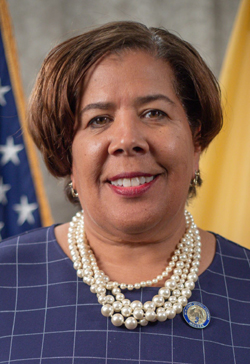
Asm. Linda Carter
Sponsored bills
Maddy summaryThis bill prohibits landlords in New Jersey from restricting how tenants pay rent or where they must pay it. Specifically, landlords cannot require rent to be paid only by cash, check, or card, must accept all standard payment methods, and cannot demand payment outside the building or charge fees for common payment methods. It applies to all residential leases signed after enactment and requires landlords to accept cash, checks, or card payments made by tenants. Violations are punishable as disorderly persons offenses, with fines up to $1,000 or six months in jail.
Maddy summaryThis bill (A 2066) establishes the "New Jersey STEM Scholars Grant Pilot Program" to provide competitive grants to public school districts, renaissance schools, and charter schools. The program funds three specific STEM education approaches: project-based learning, after-school STEM activities, and out-of-school STEM experiences. Schools applying must detail how funds will enhance existing programs or create new ones, recruit students, support educators, and ensure long-term sustainability. Grants must supplement, not replace, existing STEM funding and are subject to annual state appropriations. The program runs for four years, with funding sourced from state appropriations and private donations.
Maddy summaryThis New Jersey bill establishes a central registry for newborns diagnosed with sickle cell trait (carrying one sickle cell gene, not the full disease) and requires health officials to notify parents about genetic counseling. It mandates that doctors inform parents about the risk of passing the trait to future children and the need for follow-up care. Parents will receive targeted notifications during early adolescence (regarding sports safety risks) and later adolescence (regarding reproductive planning), with similar outreach for patients turning 18. All registry information remains confidential, with penalties for unauthorized disclosure, including fines or imprisonment.
Maddy summaryThis bill removes an exemption in New Jersey's Smoke-Free Air Act that previously allowed smoking in casinos and casino simulcasting facilities. Currently, these venues could permit smoking in areas used for gambling (like slot machine rooms or table games), but the bill would eliminate that exception. After passage, all indoor areas of casinos and simulcasting facilities open to the public for gambling would be required to be smoke-free. This change aligns these venues with the state's general indoor smoking ban, which applies to most public workplaces and spaces.
Maddy summaryThis bill (A-2540, "Cancer Patient Care and Compassion Act") requires health insurance plans and Medicaid in New Jersey to cover specific cancer treatments without cost-sharing for patients with Stage III, IV, or terminal cancer. It mandates coverage for parenteral treatments (like IV medications), survivorship care plans, and other services determined by regulators. The bill also adds protections: mortgage lenders must pause foreclosure during active treatment, creditors cannot initiate collections, and tenants facing eviction can request a 45-day stay with physician certification. These provisions directly affect cancer patients and their families by removing financial barriers to care and preventing housing/financial instability during treatment. The bill is pending before the Assembly Financial Institutions and Insurance Committee.
Maddy summaryThis bill requires pharmacies to provide written notice to their local municipality at least 90 days before closing, in addition to existing state and federal notification requirements. It directly affects pharmacy owners and local municipalities by giving communities advance warning of potential pharmacy closures. The key provision mandates that pharmacy permit holders or their authorized representatives send this written notice to the municipality's governing board 90 days prior to closure. The bill also directs the State Board of Pharmacy to create implementing rules, but does not change current state or federal closure notification processes.
Maddy summaryACR 61 is a New Jersey legislative resolution urging Congress to provide emergency funds to modernize air traffic control infrastructure and increase staffing at facilities supporting Newark Liberty International Airport (EWR). It directly addresses EWR's operational challenges, including system disruptions from outdated infrastructure (like aging copper lines), insufficient controller staffing at Philadelphia TRACON (only 22 certified controllers), and resulting flight delays, cancellations, and ground stops. The resolution emphasizes that EWR serves 50 million passengers annually and is vital to New Jersey's economy, with immediate action needed before a planned long-term FAA system upgrade completes. It does not create new law but formally requests federal funding and staffing adjustments to improve safety and efficiency.
Maddy summaryThis New Jersey bill (A 449) requires all colleges and universities to place automatic external defibrillators (AEDs) in unlocked locations within athletic facilities and student centers, accessible during normal operating hours. It also mandates that institutions maintain a supply of naloxone nasal spray near each AED for opioid overdose emergencies, with designated staff trained to use both devices. Institutions must ensure at least two staff members are CPR- and AED-trained during facility hours and regularly test/maintain equipment, while also designating a campus medical professional to oversee naloxone use. The bill provides liability protection for institutions and staff acting in good faith when implementing these requirements.
Maddy summaryThis bill requires New Jersey's Department of Human Services (DHS) to create a quality-based reimbursement system for registered family child care providers who participate in both the state's subsidized child care program and the Grow NJ Kids quality initiative. It directs DHS to provide enhanced payments to these providers based on their quality ratings within the Grow NJ Kids system. The bill mandates DHS to seek necessary federal waivers to maintain funding for subsidized child care programs serving low-to-moderate income families. This directly affects registered family child care providers enrolled in Grow NJ Kids who serve subsidized families. The key mechanism is a tiered payment structure tied to quality ratings, replacing the previous reimbursement approach.