

Maddy summaryThis is a symbolic resolution (ACR 116) passed by the New Jersey legislature to recognize Prince Hall's historical contributions. It formally honors Prince Hall, a free Black man in colonial Boston (1735-1807), as a Revolutionary Era activist and founder of "Prince Hall Freemasonry." The resolution details how he co-founded African Lodge #1 in 1775 after being denied entry to an all-white Masonic lodge, becoming its leader and establishing the oldest continuously active African American-founded organization in the U.S. The resolution has no policy impact; it simply acknowledges his legacy through a ceremonial declaration and directs copies to New Jersey's Prince Hall Grand Lodge.
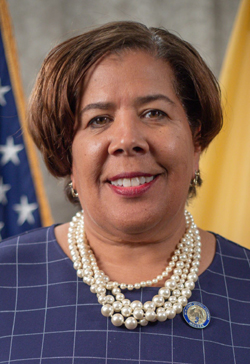
Asm. Linda Carter
Sponsored bills
Maddy summaryThis bill prohibits New Jersey state and local governments (including counties and municipalities) from using public funds or property to support immigrant detention facilities. Specifically, it bans state/local spending on constructing, renovating, or leasing public property for detention, paying private facility costs, or covering detention expenses for privately-owned facilities. The law allows public health and safety resources for detained individuals but does not affect existing detention operations. It directly affects state/local budgets and property decisions related to immigration enforcement. The bill takes effect immediately upon enactment.
Maddy summaryThis bill requires streaming services earning over $250,000 annually in New Jersey to pay a 5% tax on their gross receipts. The revenue funds a new "Streaming Entertainment Fund" managed by the New Jersey Board of Public Utilities. The fund supports public broadcasting and non-commercial public, educational, and governmental channels - like community information, school programming, and emergency alerts - without advertising or cable operator control. It excludes traditional cable services and defines "streaming services" as subscription-based entertainment delivered via public rights-of-way.
Maddy summaryThis bill requires New Jersey SNAP retailers (stores that accept SNAP benefits) to install technology on all checkout terminals to prevent card skimming - where criminals illegally steal payment card details. Starting January 31, 2027, retailers must equip terminals with anti-skimming features approved by the Department of Human Services. The department can inspect stores, impose fines up to $5,000 per violation, and exclude repeat offenders from the SNAP program after four violations. The law directly affects SNAP retailers and aims to protect customers' payment information.
Maddy summaryThis bill allocates $3 million annually from cannabis tax revenue (Social Equity Excise Fee) to fund Freedom Schools in New Jersey. The funds are directed to the Department of State for direct support of these schools, subject to budget approval. It specifically affects Freedom Schools - public or community-based educational programs - by providing dedicated state funding through an existing tax revenue stream, without altering eligibility or program requirements. The measure takes immediate effect upon enactment.
Maddy summaryThis bill requires all New Jersey state agencies, counties, municipalities, school districts, and other local government entities to purchase at least 5% of their goods and services from the Central Nonprofit Agency (CNA), which supports rehabilitation facilities. It grants the CNA a "right of first refusal" for any goods/services typically bought through cooperative purchasing catalogs, provided they can match prices within 15% of fair market value. The bill also mandates that the Division of Purchase and Property create training protocols for all purchasing agents to ensure awareness of the CNA program, with annual reporting on compliance by all affected entities. These requirements apply to all state and local government bodies authorized to make purchases.
Maddy summaryThis bill requires drivers to stop at least 25 feet from school buses loading/unloading children or individuals with developmental disabilities on undivided highways, and to slow to 10 mph on divided highways. It establishes that violations captured by school bus monitoring systems (like cameras) will result in a $300 civil penalty instead of criminal charges or license points. The law directly affects drivers near school buses, school bus operators, and enforcement agencies. Key provisions include standardized stopping distances, speed limits for divided highways, and shifting penalties for monitored violations to a civil fine system. This changes enforcement by prioritizing evidence from monitoring systems to reduce penalties for documented violations.
Maddy summaryThis bill (A4054) transfers specific school district employees from the Defined Contribution Retirement Program (DCRP) to the Public Employees’ Retirement System (PERS). It applies to school employees hired between November 2, 2008, and May 21, 2010, who work over 20 hours weekly but were previously ineligible for PERS due to work-hour rules. The bill requires their enrollment in PERS within 180 days of enactment, granting service credit for benefits eligibility (like health coverage) but not for calculating pension amounts. The state will cover the one-time cost of transferring funds via IRS-compliant trustee-to-trustee transfers, with unfunded liability amortized over 20 years.
Maddy summaryThis bill requires New Jersey's Department of Education to partner with a nonprofit to create a free, public online registry of tutors and tutoring organizations. It allows eligible participants - including certified teachers, retired educators, college students, industry professionals, and relevant organizations - to list their contact details, subject expertise, and availability without charging students for services. All registrants (except certified teachers with prior background checks) must undergo a criminal history check, and the registry will include a disclaimer noting the information hasn't been verified or endorsed by the state. The registry will be accessible on the Department of Education's website to connect students with free tutoring support.
Maddy summaryThis bill requires all individuals under 17 years old to wear a properly fitted helmet meeting ANSI or Snell safety standards while operating a bicycle, scooter, motorized scooter, or roller skates on public property. It applies to both riders and operators, with exemptions for specific trails or closed roads. Businesses selling or renting these devices must post clear signage about the helmet law and provide helmets to minors who don’t have one. The New Jersey Division of Consumer Affairs enforces the requirement, including penalties for businesses that fail to comply.