

Maddy summaryThis bill (A592) requires every public school in New Jersey to have at least one full-time school social worker employed by the local school board. Schools with over 500 students must add additional social workers proportionally based on enrollment. It applies to all New Jersey public school districts and takes effect for the first full school year after enactment. The law defines a "school social worker" as a certified professional holding a New Jersey standard educational services certificate with the required endorsement.
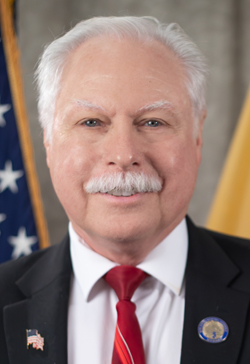
Asm. Robert Karabinchak
Sponsored bills
Maddy summaryThis bill requires all New Jersey colleges and universities to maintain a supply of naloxone nasal spray (an opioid overdose reversal medication) in secure but accessible campus locations and develop specific emergency response policies. The policy must designate a licensed medical professional to oversee naloxone use, permit trained staff (including resident assistants) to administer it in good faith during suspected overdoses, and mandate hospital transport after administration. Institutions must also provide required training on naloxone protocols to designated personnel, with liability protection for good-faith actions. The bill specifically exempts licensed athletic trainers from violating their licensure act when using naloxone under these protocols.
Maddy summaryThis bill requires public and nonpublic schools with lunch programs in New Jersey to gradually expand free lunch eligibility over a five-year period, eventually providing free lunch to all students regardless of income or federal eligibility. Starting with the 2023-2024 school year, schools must provide free lunch to students from families with incomes between 186-199% of the federal poverty level, with the income threshold increasing each year until all students qualify by the 2028-2029 school year. The state would provide funding to school districts to cover the costs of serving free lunch to students who are federally ineligible but meet the income criteria. The bill also includes reporting requirements for schools to track eligibility and income levels of students receiving free lunch, and mandates that schools take steps to minimize program costs while maintaining nutritional standards.
Maddy summaryThis bill allows licensed professionals (such as those regulated under Title 45 or Chapter 11C of New Jersey law) to work remotely from their home or another chosen location, provided they meet specific conditions. Key requirements include ensuring no in-person client interactions occur at the remote site, maintaining secure data practices with tools like encrypted networks, and keeping all client records accessible for regulatory review. The bill prohibits storing client information at remote locations and mandates confidentiality training for remote work. It directly affects licensed professionals whose services can be delivered remotely without compromising safety or regulatory standards. The law takes effect 180 days after enactment.
Maddy summaryThis bill allows state employees who were temporarily working at New Jersey psychiatric hospitals or correctional facilities before joining the Public Employees' Retirement System (PERS) to apply for accidental disability benefits if injured during that temporary employment. It deems injuries sustained while performing duties (e.g., as nurses, correction officers, or healthcare workers) at those facilities as occurring "during membership" for PERS benefit eligibility, even if the injury happened before PERS enrollment. The change applies retroactively to January 1, 2003, and covers employees who later become PERS members without interruption in their job. This specifically affects temporary workers in state psychiatric or correctional facilities who were previously ineligible for PERS disability benefits after becoming members.
Maddy summaryACR 67 is a New Jersey legislative resolution that formally condemns all forms of anti-Semitism and rejects efforts to justify anti-Jewish hatred. It references rising anti-Semitic incidents, including the 2018 Pittsburgh synagogue attack and New Jersey’s ranking as third-highest in the U.S. for such incidents that year. The resolution urges vigilance against hate crimes, supports Holocaust education, and calls for state leaders to join national efforts against anti-Semitism. As a symbolic measure, it has no binding legal effect but expresses the state legislature’s position on the issue.
Maddy summaryThis bill requires businesses bidding on New Jersey state contracts exceeding $50,000 to disclose all labor and employment law violations committed by the business within the past two years. It applies to violations of federal, state, or local laws covering wage/hour rules, workplace safety (like OSHA), workers' compensation, and the New Jersey Employer-Employee Relations Act. State agencies must review these disclosures and may disqualify bidders with serious violations that threaten employee health/safety or show disregard for labor laws. The requirement applies to all state agencies contracting for goods, services, or public construction.
Maddy summaryThis bill requires New Jersey's Board of Public Utilities (BPU) to establish a program that encourages gas utilities to adopt renewable natural gas (RNG) and invest in related infrastructure. It provides gas utilities with a mechanism to recover costs for qualifying investments and RNG procurement from customers through regulated rate adjustments, subject to BPU approval. Utilities must purchase RNG at market rates, and the BPU will set customer charges based on actual costs, including RNG supply, commodity, and administrative expenses. The program aims to support greenhouse gas reduction efforts while ensuring ratepayer protections through BPU oversight.
Maddy summaryThis bill directs New Jersey's Department of Environmental Protection (DEP) to create a rebate program for residents purchasing microfiber washing machine filters. It appropriates $2.5 million to cover rebates of up to $100 per filter (capped at the filter's cost), helping residents offset the expense of devices that capture microfibers from laundry wastewater before they enter waterways. The DEP must determine eligible filters, manage applications, and report annually on program effectiveness, including rebates issued and pollution reduction impact. The program aims to reduce microfiber pollution - a major source of plastic contamination in waterways - by encouraging filter adoption.
Maddy summaryThis bill prohibits businesses from using receipt paper containing bisphenol A (BPA), a chemical added during manufacturing to improve paper properties, for transaction records like receipts, credit/debit card transactions, or banking records. Violators face civil penalties of $250 to $500 per offense, with each day of ongoing violation treated as a separate offense. The law would take effect 18 months after enactment, giving businesses time to switch to BPA-free alternatives. It directly affects retailers, restaurants, banks, and any business issuing transaction receipts.