

Maddy summaryThis bill requires CATV companies (cable providers) to provide free broadband Internet service, including necessary equipment like routers, to public libraries, fire stations, police stations, public schools, and other municipal buildings used for public purposes. It directly affects CATV companies operating under system-wide franchises in New Jersey, mandating this service without charge as part of their franchise applications or renewals. Key provisions include requiring business-class bandwidth for public libraries proportional to their needs, while other covered buildings receive basic service. The requirement applies only to buildings explicitly listed in the bill and is tied to new franchise approvals or renewals after the bill's effective date.
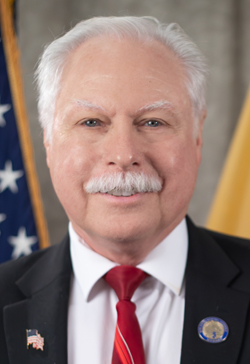
Asm. Robert Karabinchak
Sponsored bills
Maddy summaryThis bill provides tax credits for businesses purchasing hydrogen fuel cell vehicles for commercial use. Businesses can claim up to 25% of the vehicle cost (capped at $15,000) in 2023, decreasing to 8% ($5,000 cap) by 2025. To qualify, businesses must obtain certification from the Environmental Protection Commissioner confirming the vehicle meets specifications and is used exclusively for business operations. The credits apply against both New Jersey's corporation business tax and gross income tax.
Maddy summaryThis bill requires New Jersey's Motor Vehicle Commission (MVC) to create an electronic system for salvage processors to handle salvage certificates of title. It directly affects insurers, salvage processors, and vehicle owners when a car is totaled and the owner fails to transfer the title within 30 days of an insurance payout. Key provisions include mandating electronic applications, requiring insurers to send 30-day written notice to owners and lienholders before applying, and specifying proof needed (like payment records and proof of notice) for the MVC to issue a salvage title in the insurer's name. The change streamlines the process for insurers to legally transfer totaled vehicles without physical title documents.
Maddy summaryThis bill requires public community water systems (like municipal water utilities) to test water quality quarterly for secondary drinking water standards, including sampling from at least 10% of customer taps. It mandates that water system operators submit test results to the state environmental agency, local municipalities, and customers annually and quarterly. If tests exceed standards, operators must create a compliance plan within 30 days to fix issues within 30 days (or sooner if needed for health risks), followed by a maintenance plan to prevent future violations. These rules aim to ensure ongoing water quality for communities served by public water systems.
Maddy summaryThis bill requires New Jersey municipal assessors to conduct periodic reassessments of all real property to ensure the ratio of assessed value to market value stays between 90% and 110% for every tax year. If the ratio falls outside this range, assessors must perform a reassessment to correct it. Assessors must annually certify compliance with this ratio to the Division of Taxation, and failure to do so constitutes "good cause" for removal from office. The bill directly affects municipal assessors and homeowners, as it aims to align property tax assessments more closely with current market values.
Maddy summaryThis bill requires New Jersey's Department of Transportation (DOT) to study whether the state's public roads can safely support the heavier weight of electric vehicles (EVs). Within six months of the bill's effective date, the DOT must examine each highway to determine its capacity for EV weight, recommend improvements, and rank all highways from least to most capable. The DOT must then report findings to the Governor and Legislature, and prioritize highway projects addressing the least capable roads in the state's annual transportation funding plan. Additionally, any highway project seeking state funding must certify it will enable the road to accommodate EV weight.
Maddy summaryThis bill (A-3920) requires New Jersey's Attorney General to create clear, multilingual materials listing weapons, accessories, and modifications banned under state law - including specific items like barrel or magazine changes. It mandates that real estate contracts, the Motor Vehicle Commission website, and college websites link to these materials for new residents. The materials must be available in the five most common languages in New Jersey, based on census data, with hyperlinks for digital and printable access. The bill focuses solely on informing residents about existing bans, not changing the laws themselves.
Maddy summaryThis bill establishes the Eagleton Science and Politics Fellowship Program at Rutgers' Eagleton Institute of Politics, creating a formal structure for recruiting scientists, engineers, and healthcare professionals with PhDs. It requires appointing a minimum of four fellows annually - two to work with the New Jersey Legislature (in specified offices) and two with the Executive Branch - to provide expert analysis on policy issues. The bill appropriates $360,000 for initial program costs and mandates annual funding of $520,000 starting in fiscal year 2025 to cover fellow stipends, benefits, and administrative expenses. Fellows, designated as "John Weingart Science Fellows," serve full-time for one year.
Maddy summaryThis bill requires contractors performing specific construction services (civil design, mechanical engineering, electrical engineering, plumbing design, and structural engineering) on public projects funded by government or college money to carry errors and omissions insurance. It mandates that contractors provide proof of this insurance to the government entity overseeing the project and post the insurance declarations page publicly on relevant government websites (Treasury, Community Affairs, Education, or municipal sites). The requirement applies to contracts awarded under New Jersey's Local Public Contracts Law, Public School Contracts Law, State College Contracts Law, or similar statutes. This policy change directly affects professional service providers on public construction projects by adding a mandatory insurance safeguard for professional errors or omissions.
Maddy summaryThis bill requires public employees (including elected officials and local government workers) to automatically lose their positions upon conviction for certain crimes, such as dishonesty, third-degree offenses, or crimes directly related to their job. It also permanently bans convicted individuals from holding any future public office, position, or employment in New Jersey. The law mandates courts to issue immediate forfeiture orders and creates a state registry tracking all disqualifications. Key triggers include convictions under New Jersey law for crimes like fraud or third-degree offenses, or similar crimes committed elsewhere. The registry ensures transparency by documenting all disqualifications, though courts may waive penalties for minor offenses like disorderly conduct.