

Maddy summaryThis New Jersey bill (A 3945) protects hospitality franchisees - such as owners of hotels, motels, and inns - from certain unfair practices by franchisors. It prohibits franchisors from: - Keeping hidden payments from vendors (requiring full disclosure and sharing with franchisees or a committee), - Forcing franchisees to buy goods/services exclusively from them (unless reasonable standards apply), - Opening competing locations in a franchisee’s protected territory, or - Unilaterally changing terms without justification (like health/safety updates). The law also requires franchisors to disclose all fees in advance and get franchisee approval for new charges, with a Franchisee Advisory Committee overseeing fund use. It applies only to franchises operating in New Jersey.
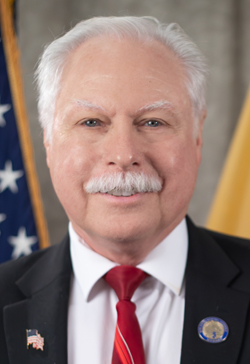
Asm. Robert Karabinchak
Sponsored bills
Maddy summaryThis New Jersey bill expands the definition of "burglar's tools" to include devices or software designed to bypass keyless locking mechanisms (like smart locks or digital keypads). It makes manufacturing, possessing, or publishing instructions for such tools a crime: manufacturing or publishing is a fourth-degree offense (up to 18 months jail or $10,000 fine), while mere possession is a lesser disorderly persons offense (up to 6 months jail or $1,000 fine). The law directly affects individuals who create, distribute, or possess tools specifically adapted to access premises without physical keys. It targets modern security vulnerabilities without altering existing burglary statutes for traditional methods. The bill is currently pending in the Assembly Public Safety Committee.
Maddy summaryThis bill directs New Jersey's Department of Agriculture to create a two-year "NJ Whole Food" pilot program in school cafeterias, using $1 million in state funds. It requires the department to select at least three school districts, partner with food vendors, hire staff, and buy equipment to serve meals made from minimally processed whole foods (free of added sugar and artificial additives). The program must track health, learning, and cost impacts, and the department must submit a report to the legislature within three years with findings and recommendations on whether to continue the program. The pilot expires upon submission of this report.
Maddy summaryNew Jersey bill A2365 extends in-state tuition eligibility to spouses and dependents of military service members who move due to a service member's transfer. It allows these individuals to maintain in-state tuition rates at public colleges in New Jersey if they were already enrolled before the transfer and maintain continuous enrollment. The bill specifically applies to spouses and dependents who were attending school in New Jersey prior to the military relocation, ensuring they don't lose tuition benefits during temporary moves. This change directly affects military families facing frequent relocations, removing a barrier to educational affordability during service-related transfers. The policy update amends existing law (P.L.1985, c.231) to include these scenarios without requiring new funding.
Maddy summaryThis bill changes New Jersey's tax code to exclude certain retirement savings contributions from taxable gross income. It directly affects New Jersey residents who contribute to qualifying retirement plans, such as 401(k)s or IRAs, by reducing their taxable income for state tax purposes. The key provision amends the definition of "gross income" to specify that contributions to these plans are not counted toward taxable earnings. As a result, taxpayers would pay less state income tax on the amounts they save for retirement through these qualified plans. The bill is currently in the introduction stage (2026-01-13) and has not yet been voted on.
Maddy summaryThis bill (A 1901) removes specific date and location requirements for veterans to qualify for New Jersey civil service and pension benefits. It eliminates past restrictions that limited eligibility to veterans who served during exact timeframes (e.g., "between July 14, 1914 and November 11, 1918") or in specific locations (e.g., "in Lebanon" for certain missions). The key change amends the definition of "veteran" in state law to broaden eligibility, allowing veterans who served honorably in designated conflicts to qualify without proving they met these prior time or place conditions. This directly affects veterans whose service history no longer aligns with the old, narrow criteria but otherwise meets the general eligibility standards.
Maddy summaryThis bill establishes the New Jersey Pilot Program Review Board to evaluate state pilot programs after implementation. The nine-member board, appointed by the Governor, legislative leaders, and Senate/Assembly minority leaders, will review each pilot program within one year of completion using objective performance measures developed by the implementing agency. The board will hold regional public hearings to gather input from stakeholders and then provide written recommendations to the Governor and Legislature on whether successful programs should be expanded statewide. This oversight mechanism applies to all state pilot programs, ensuring they meet intended goals before permanent adoption.
Maddy summaryThis bill, "The Voter Convenience Act," would allow voters in New Jersey municipalities to cast ballots at any polling place within their municipality on election day, rather than being restricted to their specific assigned polling location. It directs the Secretary of State and county election officials to create uniform guidelines enabling electronic check-in (using existing poll books) and automatic ballot assignment to the voter's correct election district at any polling site. Voters would simply walk into any polling place in their municipality, have their identity verified electronically, and receive the correct ballot for their district without needing to go to a specific district table. The bill also permits potential countywide implementation where voters could use designated locations across their entire county.
Maddy summaryThis bill requires New Jersey's Department of Community Affairs (DCA) to create an electronic system for submitting construction permit applications, plans, and inspections. It specifically eliminates the need for physical seals or signatures on plumbing, electrical, and HVAC contractor subcode applications and related documents (like shop drawings), allowing electronic signatures instead. The system must be fully implemented within one year, with training provided to local agencies and contractors. This directly affects licensed construction professionals in these trades by reducing paper-based requirements. The bill was withdrawn as it was approved as P.L.2025, c.268.
Maddy summaryAJR 47 designates January 13 of each year as "Korean American Day" in New Jersey to honor the arrival of the first Korean immigrants to the U.S. on January 13, 1903. The bill requires the governor to issue an annual proclamation encouraging public observance of the day. It directly affects the Korean American community in New Jersey by formally recognizing their historical contributions and cultural impact. The resolution focuses solely on commemoration, with no new policy or funding mechanisms.