

Maddy summaryThis bill creates a new process for dividing family-owned property when multiple owners inherited shares from relatives. It applies to real estate held in tenancy in common where at least 20% of ownership is tied to family relationships. The key change requires courts to first appoint a special master to determine fair market value, then offer other owners the chance to buy out those seeking to sell before forcing a sale or division. This replaces the standard court-ordered sale process for qualifying "heirs property," aiming to preserve family ownership through a structured buyout option.
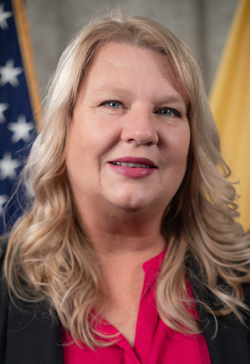
Asm. Mitchelle Drulis
Sponsored bills
Maddy summaryNew Jersey's S 1439 requires health insurance plans (including hospital, medical, health service, and individual policies) to cover orthotic and prosthetic appliances from licensed providers - including podiatrists - when medically necessary for daily activities. It also mandates coverage for *additional* appliances needed for specific sports and recreational activities like running, swimming, skiing, and team sports, as determined by a physician. Insurance plans must reimburse at the same rate as federal Medicare for these appliances. This applies to all relevant health insurance contracts in New Jersey, directly affecting insured individuals needing these devices for mobility or recreation.
Maddy summaryS 4162 limits how New Jersey public and charter schools can use or share personal information from waiver forms students or parents submit to avoid completing financial aid applications for high school diplomas. The bill requires waiver forms to collect only minimal contact details (name, phone, email, date, and signature) and prohibits schools from disclosing this information without consent, in line with federal student privacy laws like FERPA. Schools must include clear disclosure notices on all waiver forms, whether created by the Department of Education or the school. This applies to students in the 2023-2024 grade 11 class through the 2025-2026 school year, and covers waivers submitted before the bill's effective date.
Maddy summaryThis bill requires New Jersey's Board of Public Utilities (BPU) to study how data centers impact electricity rates for residential customers. The BPU must determine if non-data center customers unfairly subsidize data center costs, whether infrastructure for data centers causes unreasonable rate hikes, and project the future portion of residential rates attributable to data centers over the next 20 years. The study will also evaluate policy options to prevent rate increases from data center growth. The BPU must complete the study within one year and submit a report to the governor and legislature within 15 months.
Maddy summaryThis bill allows commercial farms on preserved farmland (producing $10,000+ annually in agricultural products) to host special occasion events like weddings or parties, provided they meet specific conditions. Key restrictions include: events cannot interfere with farming, must stay under 10% of the farm’s annual revenue from such events, and cannot use permanent structures built within the last five years unless the revenue threshold is met. Farms must obtain written approval from the land’s grantee (e.g., state or nonprofit entity), limit events to 26 per year (with no more than six events exceeding 250 guests), and follow local regulations for noise, parking, and temporary structures. The policy aims to support farm revenue while maintaining agricultural use of preserved land.
Maddy summaryThis bill requires Rutgers University (including University Hospital) to provide resident and fellow physicians who are eligible for the State Health Benefits Program (SHBP) with immediate health insurance enrollment on their first day of employment. Current employees eligible for SHBP will gain coverage immediately upon the bill's effective date. The law applies to these physicians and their dependents, eliminating previous delays in access to health coverage for this group.
Maddy summaryNew Jersey Assembly Bill A4915 requires the state Department of State to create a public "Reproductive Health Travel Advisory" for New Jersey residents traveling while pregnant. The advisory categorizes all U.S. states into three color-coded tiers based on reproductive healthcare access: "Blue" (full access without legal risk), "Yellow" (restricted access with potential legal consequences), and "Red" (extreme restrictions risking denial of emergency care). It provides detailed state-specific information on abortion bans, funding, and legal protections, and must be updated on the state website whenever another state changes its reproductive health laws. This helps residents make informed travel decisions regarding pregnancy-related medical needs.
Maddy summaryThis bill (A4878) ensures service members and their dependents (spouses or children) enrolled at New Jersey public colleges can choose specific grade options if unexpected military duty prevents course completion. It raises the required course completion threshold from 8 weeks to 55% of the course duration before certain options apply, and adds "temporary grade" and "transfer to equivalent online course" (if available) as choices. Dependents are now explicitly included under the same protections previously only for service members themselves. The bill clarifies that faculty must determine if sufficient work was completed to justify grades like pass/fail or letter grades, with options like incomplete grades remaining valid for one year.
Maddy summaryThis bill expands eligibility for nonprofit theater liquor licenses in New Jersey to include tax-exempt "disregarded entities" (like single-member LLCs treated as part of a parent nonprofit for tax purposes). It specifically allows community theaters operating as 501(c)(3) nonprofits to obtain licenses for venues with 50-1,000 seats (smaller theaters) or 1,000+ seats (larger theaters), including their tax-exempt subsidiaries. The licenses permit alcohol sales during two hours before, during, and two hours after performances (with a 15-performance annual limit for smaller venues), but do not count toward other license caps. This directly affects nonprofit theaters seeking to serve alcohol during events without needing separate licenses for subsidiary entities.
Maddy summaryThis bill exempts minor league baseball players in New Jersey from the state's wage and hour laws and recordkeeping requirements when they are covered by a collective bargaining agreement between Minor League Baseball and the Major League Baseball Players Association (MLBPA). The exemption applies only during the term of a valid agreement that specifically outlines wages and working conditions, ending if the agreement expires or is replaced. The bill requires Minor League Baseball and the MLBPA to notify the state Department of Labor within one week of any agreement termination or replacement. This change aligns New Jersey's labor laws with the 2023 nationwide collective bargaining agreement that already provides minor league players with guaranteed salaries, health care, housing stipends, and other benefits.