

Maddy summaryThis bill requires New Jersey employers of first responders (law enforcement officers and paid firefighters) to cover workers' compensation for up to 12 hours of confidential mental health counseling after a "critical incident," such as witnessing violence, serious injury, or trauma during duty. Additional up to 24 hours of counseling may be covered if a mental health professional deems it necessary for the responder's well-being. The law also mandates confidentiality for mental health communications between first responders and peer support teams or resiliency program officers, with limited exceptions if a responder poses a risk to themselves or others. All counseling must be completed within one year of the first session and cannot require use of the responder's accrued paid leave.
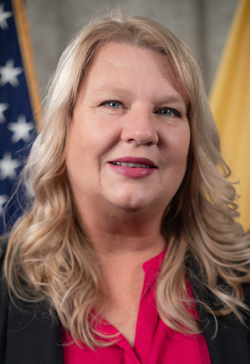
Asm. Mitchelle Drulis
Sponsored bills
Maddy summarySJR 154 directs New Jersey's Board of Public Utilities (BPU) to investigate PJM Interconnection's capacity market pricing model to determine if it ensures reliable electricity at the lowest cost, requiring a report within 12 months. It also mandates the state to collaborate with neighboring PJM states to promote affordable energy practices, urge PJM to implement market reforms protecting ratepayers from rising prices, and accelerate reviews of new power generation projects. The resolution addresses concerns about increasing electricity costs for New Jersey customers, linked to PJM's current pricing structure and delays in new energy resources entering the grid. This action aims to align PJM's operations with New Jersey's energy affordability goals under the Electric Discount and Energy Competition Act.
Maddy summaryThis bill authorizes the New Jersey Infrastructure Bank to provide up to $53.45 million in low-interest loans for transportation infrastructure projects in fiscal year 2026. It specifically funds 17 local government projects across New Jersey, including bridge replacements, road improvements, and street redesigns in cities like Bayonne, Hoboken, and Princeton. The bill also allows for up to $1 million in principal-forgiveness loans for project planning and design costs, with up to $100,000 of that amount forgiven upon project completion. All loans must be repaid within 31 years and are subject to specific eligibility requirements. The funding expires on July 1, 2026.
Maddy summaryThis bill appropriates $107,999,000 from constitutionally dedicated corporation business tax revenues and Green Acres funds to the New Jersey Department of Environmental Protection (DEP). The funds support local governments in acquiring land for recreation and conservation (e.g., parks, open space) and developing existing lands (e.g., park improvements, inclusive playgrounds under "Jake's Law"). Specifically, $22.4 million funds land acquisition projects, $80.3 million supports development projects like park upgrades and inclusive playgrounds, and $3 million establishes a new planning grant program for local conservation planning. It prioritizes projects in densely populated areas and urban aid municipalities, as defined by population density thresholds.
Maddy summaryNew Jersey's A3558 bill establishes the state's official definition of antisemitism using the International Holocaust Remembrance Alliance (IHRA) standard, including specific examples of antisemitic conduct. State agencies and institutions must use this definition when reviewing, investigating, or deciding on cases involving discriminatory acts motivated by antisemitism. The bill appropriates $100,000 for a public awareness campaign by the Attorney General's office to educate residents on identifying and reporting bias crimes through community outreach and the existing bias crimes hotline. This campaign aims to improve reporting of antisemitic incidents without affecting First Amendment rights or conflicting with existing anti-discrimination laws.
Maddy summaryThis bill reorganizes New Jersey's State Health Benefits Program governance by expanding the State Health Benefits Commission to 11 members and eliminating the previous Plan Design Committee. It requires the program to offer exactly five health plans for employees and non-Medicare-eligible retirees, including a new "NJ Gold" plan that doesn't require salary-based employee contributions. The bill establishes an escalator system to adjust employee contribution rates based on premium cost trends, increasing rates if premiums rise significantly above inflation and decreasing them if premiums fall. Additionally, it mandates that local government employers must decide within one year whether to join the SHBP, with a two-year commitment if they choose to participate.
Maddy summaryThis bill extends the filing deadline for members and retirees of New Jersey's Public Employees' Retirement System (PERS), Police and Firemen's Retirement System (PFRS), and State Police Retirement System (SPRS) to qualify for accidental disability retirement benefits related to 9/11 World Trade Center rescue, recovery, or cleanup operations. It allows for a two-year filing period after the bill's effective date (with potential two-year extensions) and replaces the requirement for a pre-employment physical examination with evidence of medical examinations that failed to disclose qualifying health conditions. The bill also permits retirees previously denied due to late filing to petition for reconsideration or resubmit their eligibility forms. Retirement systems must notify all affected members within 60 days of enactment about these provisions using clear language explaining filing requirements and time limits.
Maddy summaryThis bill makes a permanent annual $500,000 allocation from New Jersey's Clean Communities Program Fund to fund public outreach for the state's single-use plastics reduction program. The funding supports the Department of Environmental Protection's outreach efforts, including educational campaigns and a bag redistribution program that repurposes reusable bags for food banks and pantries. The bill changes current law, which limited this funding to the first three years after the 2020 single-use plastics ban law, making it permanent. This directly affects the DEP's outreach activities and the public receiving information about reducing plastic use.
Maddy summaryThis bill appropriates funds to New Jersey's Department of Environmental Protection (DEP) for fiscal year 2026 to provide zero-interest and principal-forgiveness loans to local governments and public water utilities for environmental infrastructure projects. It directly affects municipalities and water utilities that need financing for clean water projects (like combined sewer overflow reduction and water quality restoration) and drinking water projects, with specific funding limits based on project type and affordability criteria. The bill includes detailed lists of 151 qualifying clean water projects totaling $1.7 billion and 59 drinking water projects totaling $652 million, all intended to meet federal requirements under the Clean Water Act and Safe Drinking Water Act. The loans may offer full principal forgiveness for eligible projects or a blended interest rate based on project costs and borrower affordability.
Maddy summaryThis bill (S 3052) expands academic flexibility for New Jersey public college students who are active-duty service members or their dependents (spouses/children) unable to finish a course due to unplanned military obligations like deployment. It changes the attendance threshold from 8 weeks to 55% of a course’s duration to qualify for grade options, adding temporary grades and online course transfers as choices. Students who complete 55% of a course can select a letter grade, pass/fail, incomplete, withdrawal, or online transfer (with approval), while those under 55% can choose incomplete or withdrawal. It also clarifies that pass/fail grades can later be converted to letter grades within a year by completing missed work, and ensures full tuition refunds for withdrawals. The law applies to all public institutions of higher education in New Jersey and takes effect immediately for the next academic year.