

Maddy summaryThis bill (A4577) requires all New Jersey state departments, agencies, and the Office of Information Technology (OIT) to submit annual reports detailing plans to improve digital services for the public and enhance remote work capabilities for employees. Departments must outline strategies like user research for cohesive online/mobile/in-person service experiences and upgrading hardware/software for remote work. The OIT must also provide annual reports with specific recommendations, including transitioning to cloud services, integrating data into a single portal, ensuring secure access, and moving remote work tools to web portals instead of Virtual Private Networks. The goal is to improve government efficiency and maintain operations during emergencies.
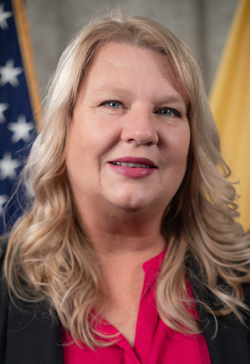
Asm. Mitchelle Drulis
Sponsored bills
Maddy summaryNew Jersey's S 3663 requires the Department of State to create a public "Reproductive Health Travel Advisory" for residents. The advisory will inform pregnant New Jersey residents about state laws restricting reproductive healthcare access in other U.S. states, using a color-coded system: Blue (full access), Yellow (restricted access), and Red (extreme restrictions risking health or legal consequences). The advisory must be published online and updated whenever other states change their reproductive healthcare laws. This bill directly affects pregnant New Jersey residents planning travel who may need emergency reproductive care.
Maddy summaryThis bill expands New Jersey's child care assistance program to include full-time graduate and post-graduate students who meet income, asset, and residency requirements and are enrolled full-time in good academic standing at a public or private college or university. Currently, the program covers only full-time undergraduate students pursuing associate's or bachelor's degrees. The state must update its eligibility rules and seek federal funding through the Child Care and Development Block Grant to cover the costs of this expansion. This change directly affects graduate and post-graduate students who are parents and rely on the program for child care support.
Maddy summaryThis New Jersey bill ensures that district and county election boards, not judges, make the initial determination on whether ballots with unclear markings should be counted. The boards will use their judgment to decide if marks were intended to vote for a candidate (counting the ballot) or to identify the ballot (rejecting it). Currently, such decisions often required judicial review, but this bill shifts that authority to the election boards directly. This change affects how election results are finalized for ballots with ambiguous marks, streamlining the counting process without altering the criteria for ballot validity.
Maddy summaryThis bill extends the time teachers can be away from service while maintaining membership in New Jersey's Teachers' Pension and Annuity Fund (TPAF). It increases the standard discontinuance period from two to seven years, and extends the return-to-service window to 25 years for teachers who were laid off or voluntarily left with 10 or more years of service. Teachers returning within these extended timeframes will be re-enrolled in the TPAF at their previous tier with no additional contributions required. The changes apply to all current and future TPAF members who meet the specified conditions.
Maddy summaryS 4506 exempts minor league baseball players covered by a union-negotiated agreement between Minor League Baseball and the Major League Baseball Players Association from New Jersey's wage and hour laws and recordkeeping requirements. The exemption applies only while the agreement is active and requires the league and union to notify the state labor department within one week of any agreement termination or replacement. This aligns state law with the 2023 agreement, which provides players with salaries, health care, housing, retirement benefits, and other protections that conflict with standard wage laws due to minor league baseball's irregular schedules.
Maddy summaryThis bill prohibits New Jersey employers from requiring employees to attend or listen to workplace communications about political matters, including discussions about political parties, elections, labor organizations, or community activities. It expands existing law by explicitly adding labor organizations and activities to the definition of "political matters" and mandates employers to post a clear notice of these rights in visible workplace areas. Employees who face violations can sue within 90 days for remedies like reinstatement, back pay, or fines up to $5,000 for repeat offenses. The law directly affects all employers in New Jersey - such as businesses, state agencies, and local governments - and their employees.
Maddy summaryThis bill (A1682) requires New Jersey public school districts to include instruction on labor history in social studies curricula for students in grades 6 through 12. It mandates teaching four specific topics: the history of organized labor, notable historical strikes, unionization drives, and the collective bargaining process with workplace legal protections. The Commissioner of Education must provide age-appropriate lesson resources to help schools implement this requirement. The policy applies to all school districts under the state's existing social studies learning standards, beginning with the first full school year after enactment.
Maddy summaryThis bill requires New Jersey's Board of Public Utilities (BPU) to establish a program to incentivize the development of transmission-scale energy storage systems with a minimum capacity of 5 megawatts. The program will solicit applications for projects totaling at least 500 megawatts of capacity, with projects needing commercial operation by December 2030 and interconnection to the PJM grid. The BPU will provide incentive awards totaling at least $60 million annually for 15 years, based on a scoring system that evaluates price, project maturity, and community benefits. The program is designed to help New Jersey meet its 2030 energy storage target of 2,000 megawatts, with the BPU required to report on progress one year after the initial procurement.
Maddy summaryS 3944 allows New Jersey nonprofit theaters to obtain special alcohol licenses by clarifying that "disregarded entities" (like single-member LLCs treated as part of their parent nonprofit for tax purposes) qualify for these licenses. It applies to art-house movie theaters or performing arts venues with seating capacities of 50-1,000 people (for smaller venues) or 1,000+ people (for larger venues), operated by tax-exempt 501(c)(3) organizations. The license permits alcohol sales during specified times: two hours before, during, and two hours after performances (with a 15-performance annual limit for smaller venues). This change directly affects nonprofit theaters seeking to sell alcohol to support their operations, without counting toward other liquor license limits. The bill clarifies existing law to expand eligibility for these specialized licenses.