

Maddy summaryThis bill allocates $3.9 million from the workforce development fund to Enterprise Minnesota, Inc. for fiscal year 2027 to support Minnesota manufacturers through the Made in Minnesota program. The funds will be used for direct investments in manufacturing businesses and to cover Enterprise Minnesota's operational costs. This one-time appropriation is available until June 30 of the fiscal year and is managed by the commissioner of employment and economic development. The legislation directly affects manufacturers in Minnesota and the state's economic development agency.
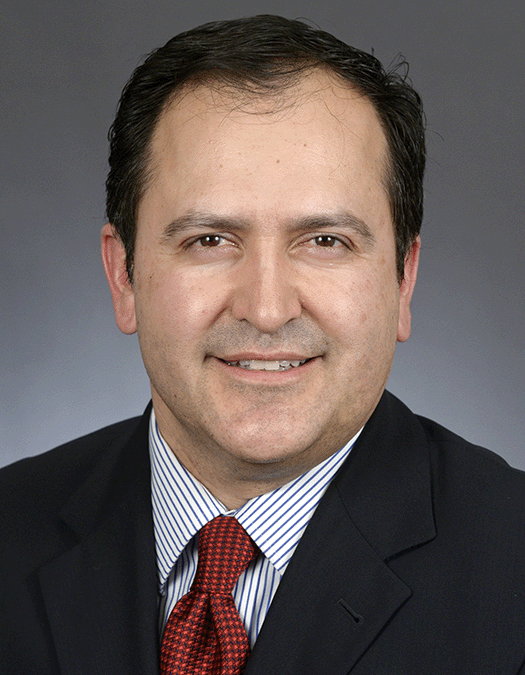
Rep. Jon Koznick
Sponsored bills
Maddy summaryHF 3553 authorizes a pilot project for automated vehicle platoons (groups of connected vehicles operating with minimal human control) on specific roads in Wilkin and Grant Counties, Minnesota. It requires applicants to submit detailed plans to both county road authorities and the state transportation commissioner for approval, including safety details, vehicle specifications, and operating times. The bill mandates counties to consult with law enforcement on safety concerns before approving projects and sets a 60-day timeline for decisions. The pilot is limited to defined routes between cities like Nashua, Breckenridge, Wolverton, and Foxhome, with a requirement to submit a final report after the project concludes.
Maddy summaryHF 952 modifies Minnesota's sales and use tax law to expand exemptions for land clearing services and equipment. It adds land clearing equipment (like machinery for removing trees, bushes, and stumps) to the list of exempt items used in taxable services, and creates a new exemption for land clearing contracts sold to contractors or subcontractors. The bill specifically excludes equipment with a useful life over 12 months and does not apply to standard landscaping, gardening, or lawn care services. These changes take effect for sales after June 30, 2025.
Maddy summaryHF 7 modifies multiple public safety laws in Minnesota. It requires law enforcement agencies to make bail/bond information public and mandates county attorneys to publicly report reasons for dismissing charges. The bill establishes mandatory minimum sentences for certain sex trafficking offenses and requires individuals subject to stays in sexual conduct cases to register as predatory offenders. It also increases penalties for assaulting police officers, obstructing highway/airport traffic, and expands law enforcement's use of tracking devices on fleeing vehicles. These changes apply directly to law enforcement agencies, prosecutors, and individuals involved in criminal cases.
Maddy summaryThis bill modifies Minnesota's "Read Act" to require literacy instruction based on "science of reading" research, emphasizing evidence-based methods like phonics and decoding while explicitly excluding the three-cueing system. It establishes a new Office of Achievement and Innovation within the Department of Education to support literacy implementation and creates a statewide school performance reporting system. The bill also allows school boards to opt out of complying with certain recently enacted state education laws or rules and authorizes fund transfers for education programs through fiscal year 2029. These changes directly affect all Minnesota public school districts, educators, and students by reshaping literacy instruction requirements and school accountability systems.
Maddy summaryHF 21 would require a three-fifths supermajority vote in both the Minnesota House and Senate to extend a peacetime emergency declaration beyond 14 days. Currently, such extensions beyond 14 days could be approved by the Executive Council, but this bill would shift that authority to the legislature. The bill directly affects governors seeking to prolong emergency powers and the legislative process for reviewing those requests. It does not change the initial 14-day emergency declaration period or the governor's authority to declare emergencies under existing criteria. Note: This bill was introduced but not passed during the 2025 legislative session.
Maddy summaryHF 3749 updates Minnesota's bridge inspection standards to align with federal National Bridge Inspection Standards (NBIS). It defines "bridge" more precisely, creates a Bridge and Structure Inspection Program Manual (BSIPM) for the Department of Transportation, and mandates inspection intervals based on bridge type, condition, and traffic factors. The bill requires annual inspections for most bridges under NBIS, with extended intervals for certain structures, and specifies additional checks for underwater elements and fracture-critical members. These changes directly affect state-maintained bridges and the DOT's bridge safety oversight responsibilities.
Maddy summaryHF 1 establishes a centralized Office of Inspector General (OIG) for Minnesota state government, replacing existing agency-specific inspector general offices. The OIG will oversee state spending, require agencies to halt payments when fraud is suspected, and mandate a fraud reporting hotline for employees and contractors. It directly affects all state agencies and recipients of state funds (such as contractors and organizations administering state programs) by requiring them to report suspected fraud and prohibiting retaliation against whistleblowers. The bill also specifies the OIG must coordinate with the legislative auditor and amends statutes related to fraud detection, waste prevention, and oversight.
Maddy summaryHF 3491 authorizes Minnesota to participate in a federal tax credit program that allows scholarship-granting organizations (SGOs) to provide scholarships to students. These SGOs must be tax-exempt nonprofits that spend at least 90% of funds on scholarships, verify household income, prioritize returning students and siblings, and avoid earmarking funds for specific students. The bill requires SGOs to annually report compliance to the Minnesota Department of Education, which must then post a list of qualified organizations online. The law explicitly states it does not grant schools or districts additional control over nonpublic schools or students.
Maddy summaryHF 15, the "Safe Haven In Every Local District (SHIELD) Act," requires all Minnesota public school districts and charter schools to include specific student and staff safety measures in their long-term facility plans by August 2025. The bill creates new grants to fund comprehensive security systems, including features like bullet-resistant doors, emergency alert systems, and staff training, with priority given to schools serving the most students. School districts must apply for these grants through the Minnesota School Safety Center, which will rank applicants and provide lists of approved vendors. The law appropriates funds from the general fund for fiscal year 2026 to support these security upgrades and plan updates.