

Maddy summaryThis bill directs $15 million from Minnesota's transportation advancement account to fund suicide prevention measures on Minneapolis's Washington Avenue Bridge. Specifically, it requires Hennepin County to award a grant to the University of Minnesota for designing and building physical barriers and providing suicide diversion resources on the bridge. The funds are allocated to address safety concerns at this specific location, where bridge-related suicide attempts have occurred. The measure changes how existing transportation funds are used, prioritizing mental health interventions at a high-risk location.
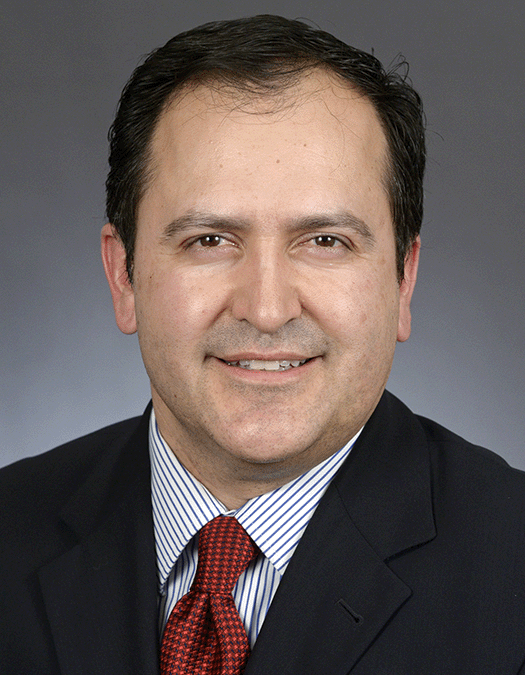
Rep. Jon Koznick
Sponsored bills
Maddy summaryHF 3313 appropriates $1 million from the general fund for the Dakota County Community Development Agency to support Minnesota's bid to host Expo 2031. The funds must be used for activities like licensing fees, development planning, and reimbursing agency costs, contingent on approval by two international bodies (International Association of Horticultural Producers and Bureau International des Expositions). If Expo 2031 is not approved, the money transfers to the Minnesota Investment Fund. This is a one-time appropriation with funds available for two years, allowing reimbursement of expenses up to 90 days before formal spending.
Maddy summaryHF 1355 requires permit holders harvesting or destroying aquatic plants in Minnesota public waters to use scuba diving equipment safely and establishes safety standards for commercial diving operations. It mandates that applicants provide documentation of a recent third-party safety survey by a qualified professional (like a DLI consultant or insurance underwriter) and ensures divers have valid certification from accredited programs. The bill also requires employers to provide buoyancy control devices for workers using scuba equipment during these activities. These requirements apply directly to commercial entities and contractors seeking permits under Minnesota Statutes §103G.615 for aquatic plant management. The law aims to improve workplace safety for divers working in Minnesota's waterways.
Maddy summaryHF 185 establishes a resilient pavement program for Minnesota's trunk highway projects, appropriating $150 million from the general fund for fiscal year 2027. The program provides supplemental funding to modify pavement designs on eligible projects to achieve a minimum 50-year lifespan, requiring a cost-effectiveness ratio of at least 2.0 (comparing baseline project costs to modified project costs). It directly affects trunk highway projects already in state transportation plans with a proposed design life of 20 years or less. Projects must meet specific criteria, including pavement cost analysis and approval by the commissioner of transportation, with funds covering up to 110% of the cost difference between baseline and modified designs.
Maddy summaryHF 2554 designates a specific bridge on Burnsville Parkway over Interstate Highway 35W in Burnsville, Minnesota, as the "Elmstrand * Finseth * Ruge Heroes Memorial Bridge." The bill amends Minnesota Statutes section 161.14 to formally name the structure and requires the transportation commissioner to adopt appropriate signage for it. This is a commemorative measure naming a physical location, not a policy change affecting residents or creating new laws. The bridge itself is the direct subject of the designation, with no broader legislative impact beyond the memorial name and signage.
Maddy summaryHF 3051 exempts sales of admission privileges for PGA World Championship golf tournaments and related events from Minnesota's sales and use tax. The bill directly affects tournament organizers and attendees purchasing tickets to these specific events. It amends Minnesota Statutes section 297A.68 by adding a new tax exemption for the "granting of the privilege of admission" to these PGA-sponsored tournaments. The exemption applies to all sales made after June 30, 2025.
Maddy summaryHF 20 clarified which data maintained by Minnesota's Attorney General's Office must be treated as "private data" under state law. It specifically designated five categories as private: disciplinary records (excluding public hearings), non-final administrative communications, consumer complaint data (excluding confidential data), inactive investigative files, and detailed home protection hotline information (like mortgage details and income). This change directly affects the Attorney General's Office by requiring them to handle these specific data types with privacy protections. The bill was introduced in 2025 but was not passed by the legislature and was laid on the table.
Maddy summaryHF 3150 modifies the due date for a legislative report required under existing law. It changes the final report deadline from July 1, 2025, to January 15, 2026, for the Center for Transportation Studies at the University of Minnesota. The report analyzes traffic safety violation dispositions (speeding, impairment, distraction, seatbelt citations) and enforcement patterns from 2017-2022. This is a procedural adjustment affecting the Center's reporting timeline, not the content or requirements of the analysis.
Maddy summaryHF 8 streamlines Minnesota's environmental permitting process to improve efficiency and transparency. It sets specific timeframes (90 days for simpler permits, 150 days for complex ones), requires the Pollution Control Agency to issue separate construction and operation permits for certain facilities, and mandates that petitioners for environmental assessments must live in affected or neighboring counties. The bill also eliminates preliminary environmental assessment steps for projects requiring full environmental impact statements and requires the agency to publish annual reports tracking permitting progress. These changes directly affect developers, landowners, and the Pollution Control Agency in processing environmental permits.
Maddy summaryHF 3105 modifies how Minnesota distributes traffic fine proceeds between local governments and state highway funds. For fines issued by local law enforcement officers, the bill specifies that two-thirds of the proceeds must stay with the local unit of government (with at least half used for law enforcement), while one-third goes to the state highway user tax fund. For fines issued by Minnesota State Patrol troopers, one-third stays with the local government and two-thirds goes to the state highway fund. The bill amends multiple statutes (including 169.999, 299D.03, and 357.021) to implement these distribution changes, directly affecting cities and counties that collect traffic fines.