

Maddy summaryThis bill authorizes the state of Minnesota to issue up to $12.8 million in bonds to fund municipal sewer and water infrastructure improvements in the City of Credit River. The funds will be used to design, construct, and equip public utilities specifically serving the County Court neighborhood. The state Public Facilities Authority will receive the grant money to oversee the project, and the bonds will be sold through the commissioner of management and budget. Once passed, the legislation takes effect the day after final enactment.
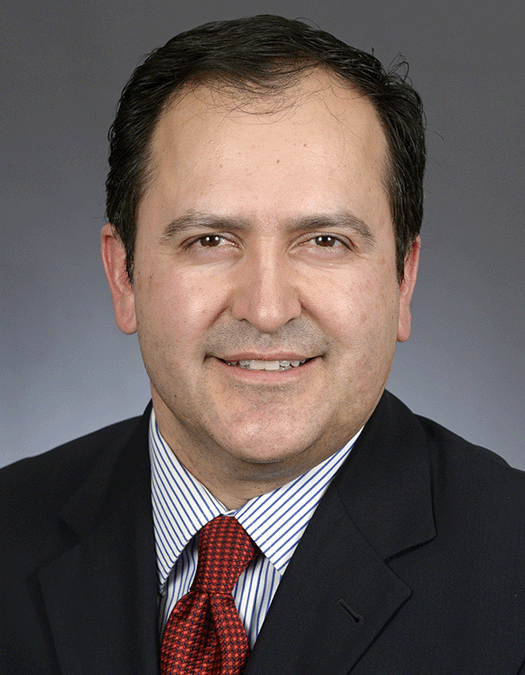
Rep. Jon Koznick
Sponsored bills
Maddy summaryHF 3436 requires drivers approaching a stopped school bus displaying flashing red lights to stop at least 20 feet away. The bill amends Minnesota Statutes section 169.444 to mandate this stop until the bus retracts its stop arm and turns off the red lights. It also adds a new provision requiring drivers to prepare to stop within 20 feet when a bus shows prewarning amber lights, signaling red lights are about to activate. This law directly affects all drivers operating vehicles near school buses in Minnesota, aiming to improve safety for children boarding or exiting buses. The bill takes effect the day after final enactment.
Maddy summaryMinnesota's HF 1269 requires health insurance plans to cover all FDA-approved medical services and prescription medications for treating dementia, including diagnostic tests to assess treatment effectiveness. It also prohibits health plans from using "step therapy" (requiring patients to try cheaper drugs first) for dementia treatments. The bill modifies prior authorization rules for certain medications, ensuring automatic 60-day coverage for brand-name mental health drugs when generics become available, and streamlines approval for oral liquid drugs used with feeding tubes. These changes apply to health plans offered in Minnesota starting January 1, 2026.
Maddy summaryThis bill requires local governments in the Twin Cities metropolitan area to stop directly operating public transit services by July 1, 2027, and instead work through agreements with the Metropolitan Council, which will become the exclusive operator for transit in the region. The law creates a task force to oversee the consolidation process and mandates that the council produce detailed performance reports covering service changes, costs, staffing impacts, and operational efficiency. These reports must be submitted to state legislators and include specific data on routes, service hours, on-time performance, and how consolidation affects passengers and facilities. The bill applies to seven counties in the Twin Cities area but excludes the University of Minnesota from its requirements.
Maddy summaryHF 16 prohibits Minnesota cities, counties, or local governments from passing laws that block law enforcement from sharing immigration status information with federal authorities. It requires county attorneys to notify federal immigration agencies when someone without legal status is arrested for a violent crime. The bill overrides any local "noncooperation" policies that would restrict this information sharing or federal immigration enforcement. It applies to all local law enforcement and government entities in Minnesota, ensuring consistent cooperation with federal immigration enforcement on specific matters.
Maddy summaryHF 13 would amend Minnesota Statutes section 609.06 to eliminate the requirement that individuals must attempt to retreat before using reasonable force in self-defense or defense of others. The bill specifically removes the "duty to retreat" provision, allowing people to use force without first trying to avoid confrontation if they reasonably believe it is necessary. This change would directly affect Minnesotans using force to defend themselves or others in situations where they perceive an immediate threat. The bill was introduced but not passed, as it was laid on the table during the 2025 legislative session.
Maddy summaryThis bill modifies Minnesota's laws regarding fleeing peace officers in motor vehicles and clarifies when officers may use deadly force during police pursuits. It directly affects state patrol officers, local law enforcement, and individuals involved in high-speed chases. The legislation adds a new requirement for state patrol officers to make reasonable efforts to apprehend suspects violating the fleeing peace officer statute, while also updating the legal standard for deadly force to consider the perspective of a reasonable officer at the time of the incident rather than with hindsight. The bill also includes specific guidance for officers interacting with individuals who have physical, mental health, developmental, or intellectual disabilities, and it establishes that fleeing a peace officer in a motor vehicle poses an actual and imminent threat to public safety. These changes take effect on August 1, 2026, and apply to crimes committed on or after that date.
Maddy summaryThis bill repeals Minnesota's transportation greenhouse gas emissions impact assessment requirements and cancels $3 million in funding for related travel demand modeling. It directly affects the state Department of Transportation and metropolitan counties by removing the obligation to conduct emissions assessments for transportation projects. The legislation modifies how transportation funds are allocated, directing specific percentages toward active transportation, safety studies, infrastructure preservation, and transit services. Additionally, it updates the state highway investment plan to focus on performance targets for preservation, safety, and mobility over a 20-year period.
Maddy summaryThis bill updates Minnesota state law to define key terms related to autonomous vehicles, including automated driving systems, human drivers, and minimal risk conditions. It directly affects vehicle manufacturers, transportation companies, and law enforcement by establishing clear language for how these technologies operate and interact with public safety systems. The legislation creates specific definitions for dynamic driving tasks, first responder interaction plans, and on-demand autonomous vehicle networks to ensure consistent terminology across the state. By adding these definitions to existing transportation statutes, the bill provides a regulatory framework for future autonomous vehicle operations without changing current operational requirements.
Maddy summaryHF 3562 modifies Minnesota's motor vehicle registration tax for passenger cars and hearses. It reduces the tax rate from 1.54-1.575% to 1.25-1.285% of a vehicle's manufacturer's suggested retail price (MSRP), depending on whether the vehicle was first registered in Minnesota before or on/after November 16, 2020. The tax amount decreases each year based on the vehicle's age (e.g., 100% of MSRP in year one, dropping to 10% in year ten), then becomes a flat $20 annually after the 10th year. This bill directly affects Minnesota vehicle owners paying registration fees for passenger cars and hearses, effective for registrations starting January 1, 2027.