

Maddy summaryThis bill requires health insurance plans in Minnesota to cover home care nursing services without imposing quantity limits on the number of visits or hours provided. It directly affects individuals enrolled in health plans who also receive medical assistance, ensuring they receive ongoing skilled nursing care without arbitrary caps on coverage. The legislation defines home care nursing services as continuous, medically necessary care that cannot be safely delivered through intermittent visits, and mandates that plans refer to these services by this specific name in all coverage documents. While cost-sharing like copayments may still apply, the bill prohibits plans from restricting coverage based on the total amount of services needed, with most provisions taking effect in 2026.
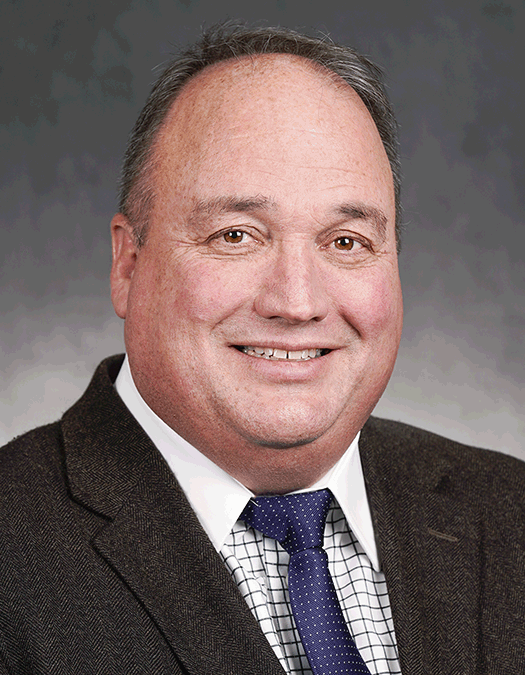
Rep. John Huot
Sponsored bills
Maddy summaryThis bill establishes a formal licensure system for anesthesiologist assistants in Minnesota, creating a new chapter in state law to regulate this healthcare profession. The legislation requires anesthesiologist assistants to work under the supervision of a physician and mandates that they complete an accredited training program and pass a national certification exam to obtain a license. Key provisions include defining the roles and responsibilities of anesthesiologist assistants, setting requirements for provisional licenses, and placing oversight authority with the Board of Medical Practice. The bill directly affects healthcare facilities and medical practices that employ anesthesiologist assistants by creating a standardized regulatory framework for their practice.
Maddy summaryHF 3419 removes the ability of most Minnesota entities - including businesses, nonprofits, cooperatives, and foreign entities operating in Minnesota - to spend money on elections or ballot measures. The bill retracts this power for all entities except registered political committees that exist solely for political activity and claim no entity benefits (like limited liability). It also voids any organizational documents allowing political spending. This change does not affect regular business operations or charitable work, only political activity.
Maddy summaryHF 3468 permits individuals injured due to a failure to render aid in specific legally defined circumstances to file a civil lawsuit. It directly affects victims who were not assisted when required by existing law, allowing them to seek compensation for damages, court costs, and attorney fees. The bill amends Minnesota Statutes 2024, section 609.662, by adding a new civil action provision. This change takes effect on August 1, 2026, applying to cases arising on or after that date.
Maddy summaryThis bill creates two new financial assistance programs in Minnesota to help hospitals and community-based safety net providers cover costs from uncompensated care. To qualify, these healthcare facilities must treat patients who lack health insurance or are ineligible for public programs, with the bill specifically targeting cases where the unpaid care value falls between $5,000 and $50,000. Hospitals and providers must submit detailed reports twice a year to receive funds, which the state will distribute proportionally based on the total amount of unpaid care each facility has provided. The legislation also sets a cap where no single recipient can receive more than 10% of the available funds for any reporting period. Finally, the bill authorizes the state Department of Health to create specific rules for the program and includes an appropriation of money to fund these relief efforts.
Maddy summaryHF 4827 appropriates $20,000 from the state's general fund to help the city of Eagan create a memorial honoring women who served in the U.S. military since the nation's founding. The money will be given as a one-time grant to the commissioner of employment and economic development, who will then provide it to Eagan for designing and building the monument. This legislation is a procedural funding measure that does not change existing laws or create new programs beyond this specific allocation.
Maddy summaryThis bill increases the number of covered physical therapy visits for children under Minnesota's medical assistance program. Currently, the limit is 14 visits per year, but the bill raises this to 30 visits for children recovering from hospital-based surgeries while keeping the 14-visit limit for other situations. The new higher limit takes effect on January 1, 2027, or later if federal approval is required. Additionally, the bill clarifies reimbursement rates for physical therapy assistants, paying them the full rate when working on-site with a therapist and 65% of that rate when working remotely under a therapist's direction.
Maddy summaryThis bill modifies eligibility requirements for Minnesota public television stations to receive state block grants. It updates the statute to specify that only federally licensed stations certified as eligible for community service grants through the Corporation for Public Broadcasting in 2025 will qualify for these funds. The bill maintains existing provisions for equal distribution of block grants for operational costs and matching grants based on previous Minnesota-based contributions, while allowing unused grant funds to carry over into the second fiscal year of a biennium.
Maddy summaryThis bill updates Minnesota's suicide prevention reporting requirements and establishes standards for the state's 988 Lifeline service. It requires the state health commissioner to conduct periodic evaluations of the suicide prevention plan and submit biennial reports to legislative committees starting in 2026. The legislation also mandates that the designated 988 Lifeline center operate 24/7, meet specific operational and clinical standards, and coordinate with emergency services, mental health providers, and community resources. Additionally, the bill requires the commissioner to develop protocols for interactions between 988 and 911 services and publish biennial reports on 988 usage data including answer rates and emergency referrals.
Maddy summaryHF 2393 amends Minnesota Statutes section 145A.02, subdivision 15, to clarify which licensed health professionals can serve as medical consultants for community health boards. Currently, the definition includes licensed physicians, osteopathic physicians, physician assistants, and certified advanced practice nurses. The bill modifies this list to specify exactly which professions qualify under the statute. This change directly affects community health boards seeking medical advisors and the eligible health professionals who may provide such services. The amendment aims to ensure clarity in who can legally advise these boards on medical matters.