

Maddy summaryThis bill would allow nursing homes and assisted living facilities in Minnesota to permit residents to consume and display alcoholic beverages under specific conditions. The changes require that alcohol be consumed only by residents during resident-focused activities, with no one under 21 allowed to drink and all staff serving alcohol being at least 18 years old. Additionally, the bill prohibits selling alcohol or treating it as part of a commercial transaction within these facilities. The legislation directly affects nursing home operators, assisted living facility managers, and the residents who live in these care settings.
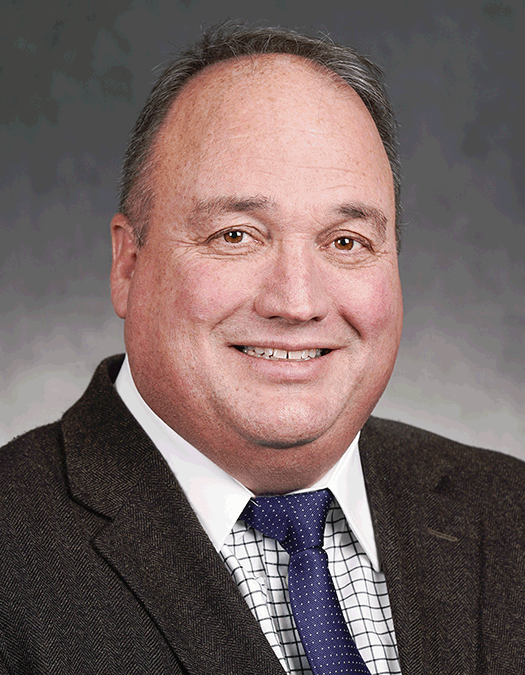
Rep. John Huot
Sponsored bills
Maddy summaryHF 226 allocates $21.62 million in state bond funds to support historic preservation across Minnesota. The bill directs $13.67 million for capital improvements at state historic sites (including buildings, exhibits, and landscaping), $6.7 million for enhancements to the Minnesota History Center, and $1.25 million in matching grants to counties and local jurisdictions for historic preservation projects. These funds will be used to maintain, improve access to, and preserve historical sites and collections under the Minnesota Historical Society's oversight. The bond authorization takes effect upon final enactment.
Maddy summaryThis bill expands health insurance coverage in Minnesota for peace officers and firefighters who are disabled in the line of duty, even if they do not qualify for traditional disability benefits. It requires employers to continue paying their share of health insurance premiums for these individuals and their dependents until they turn 65 or pass away, regardless of whether their specific disability benefits have ended. The legislation also clarifies the process for requesting coverage and outlines how disputes over eligibility are handled through administrative hearings. Additionally, it updates rules for claims filed after May 24, 2025, to include those with disabilities not solely based on psychological conditions.
Maddy summaryThis bill creates a new 100% tax on money obtained through fraud by individuals or organizations, regardless of whether they have already paid fines or restitution. It applies to those convicted by a court, those identified by the state revenue commissioner as having committed fraud, and anyone paid to help facilitate such fraudulent activities. The revenue collected from this tax must be used exclusively to provide relief for state income or property taxes. The law takes effect retroactively for fraud cases determined after December 31, 2019.
Maddy summaryThis bill, known as the Minnesota Public Safety Radio Communications Funding and Interoperability Act, removes the requirement for Minnesota counties to pay for the expansion and maintenance of the ARMER public safety radio network. Instead, the legislation creates a new state-funded account to cover these costs, ensuring that local governments are not forced to use property taxes for this infrastructure. The law also establishes a voluntary program where the state and local jurisdictions can share project costs on an equal basis, with the state covering at least 75 percent of any such expenses. Additionally, the bill sets up a framework to improve interoperability, allowing different law enforcement, fire, and emergency medical agencies to communicate effectively across jurisdictional lines. A new reporting requirement mandates that the commissioner of public safety annually update the legislature on how the funds are being used and the progress of the network.
Maddy summaryThis bill modifies how evidence is handled in Minnesota Tax Court cases involving property tax valuations. It requires government officials to prove their property valuations are correct rather than assuming they are valid, and it allows comparable property sales and assessed valuations to be used as evidence in court. The changes apply to cases filed on or after January 1, 2027, and affect taxpayers, property assessors, and government units involved in property tax appeals.
Maddy summaryHF 3784 requires all high school and middle school athletic coaches and assistant coaches in Minnesota school districts or charter schools to complete cardiopulmonary resuscitation (CPR) and automated external defibrillator (AED) training starting with the 2027-2028 school year. Coaches must maintain current training annually and complete refresher courses every two years, following nationally recognized emergency cardiovascular care guidelines. The bill also provides legal protection, shielding coaches from civil liability for good-faith CPR or AED use during athletic activities, except in cases of gross negligence or willful misconduct. This law directly affects school coaches and aims to improve emergency response for student athletes experiencing cardiac incidents.
Maddy summaryThis bill (HF 3556) is a naming resolution that commemorates Melissa Hortman by designating Minnesota's community solar garden program as the "Melissa Hortman Community Solar Garden Program." It does not change any program rules, funding, or operations - it only adds a short title to Minnesota Statutes section 216B.1641. The bill directly honors Melissa Hortman, a former state legislator, through this naming. It is procedural and has no policy impact beyond the name change.
Maddy summaryThis bill amends Minnesota law to clarify which healthcare professionals can serve as medical consultants for community health boards. It specifies that advanced practice nurses must be certified as clinical nurse specialists or nurse practitioners by a national organization acceptable to the Minnesota Board of Nursing. The change directly affects community health boards and the healthcare providers working with them, ensuring medical consultants meet defined credentialing standards. The bill modifies existing statute (145A.02, subd. 15) to add this clarity without expanding the list of eligible professions.
Maddy summaryThis bill authorizes state agencies to round small cash payments and transfers to the nearest five cents to simplify transactions, while explicitly excluding electronic payments like checks or credit cards. It also amends existing health insurance rules for nonrepresented employees and managers to change the language regarding high-deductible health plan options from mandatory to permissive. Agencies must post their rounding policies at locations where cash is handled, and the changes update the statutory text governing these specific compensation plans.