

Maddy summaryThis bill directs the Minnesota Department of Health to join the World Health Organization's Global Outbreak Alert and Response Network. The commissioner must identify the necessary application process by September 1, 2026, and submit the application by December 1, 2026. This action aims to integrate the state's health response capabilities with a global system for monitoring and addressing disease outbreaks. The legislation does not alter existing funding or staffing but establishes a specific timeline for this international partnership.
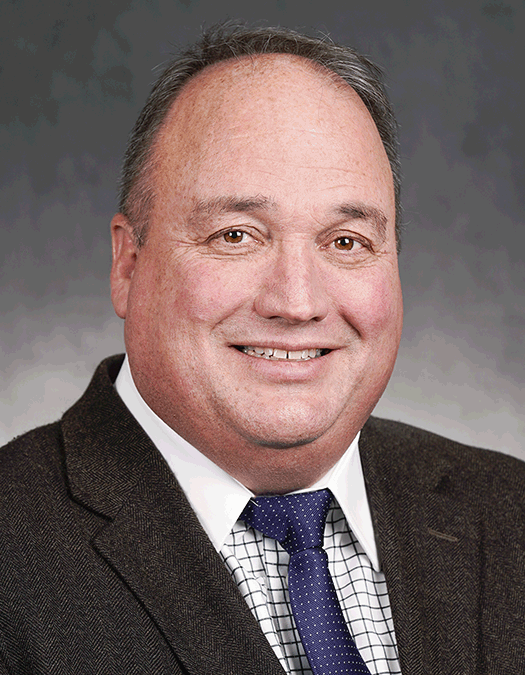
Rep. John Huot
Sponsored bills
Maddy summaryThis bill requires individuals who own firearms in Minnesota to purchase and maintain liability insurance that covers damages from accidental or negligent discharges. The insurance must provide a minimum coverage of $250,000 per occurrence, and owners currently holding firearms must secure this coverage by February 15, 2027. Failure to obtain or keep this insurance is classified as a misdemeanor, with repeat offenses punishable as a gross misdemeanor and mandatory fines. Additionally, the bill mandates that insurers collect a surcharge on these policies, which will be deposited into a state fund designated for gun harm reduction. Law enforcement and active-duty military personnel acting in their official capacities are exempt from these requirements.
Maddy summaryThis bill requires that medical students and residents obtain written informed consent from an unconscious patient or their legal representative before performing treatment, unless the care is necessary for prevention, diagnosis, or treatment. The law mandates that this consent form clearly describes the specific procedure and warns the patient that a student or resident will be performing it, using a form approved by the state health commissioner. If a student or resident violates this requirement, they face disciplinary action from their educational institution or professional licensing board. The measure directly affects health care training programs and the patients receiving care from trainees in Minnesota.
Maddy summaryThis bill expands Minnesota's property tax refund program to provide additional relief for homeowners whose homestead property taxes increased by more than six percent compared to the previous year. Under the new rules, eligible homeowners would receive a refund equal to 60 percent of the tax increase, with a maximum refund amount raised from $1,000 to $2,500. The legislation requires homeowners to file a property tax refund return along with their current year's tax statement to claim the refund, and counties must provide electronic lists of potentially eligible taxpayers upon request. The changes apply to property taxes payable in 2026 and later years, affecting homeowners who meet the specified increase thresholds.
Maddy summaryThis bill prohibits large meat retailers from owning stakes in livestock dealers or meat packing companies and from signing exclusive contracts that require those suppliers to sell only to them. It defines a "dominant retailer" as a company selling over $18 billion in meat annually with locations in at least 20 states, including Minnesota. The law requires these retailers to divest any existing ownership interests by January 1, 2028, with a possible 180-day extension if they show good faith efforts to comply. The attorney general will identify which retailers fall under this definition starting in 2027, and violators could face daily fines of $25,000.
Maddy summaryHF 3356 requires sellers to remove all emergency vehicle identifying features - like sirens, lights, emblems, and antennas - from public safety vehicles (such as police or fire vehicles) before selling them to the public. This applies to private sales but excludes transfers to government entities, licensed ambulance services, or collector vehicles registered under specific statutes. Sellers must provide a certificate confirming the removal, and violations carry a $2,500 civil penalty, with funds directed to Minnesota’s victims of crime account. The bill aims to prevent misleading sales that could allow misuse of emergency vehicle markings.
Maddy summaryHF 3695 establishes a task force to create a standardized identification system for Minnesota emergency responders (including police, firefighters, and EMTs). The task force, composed of state agency leaders and representative organizations, must design an ID card including a photo, name, role (e.g., peace officer or EMT), physical description, and certification details. It will also develop a plan for mandatory use of this ID by responders and their employers, and recommend whether the state or local governments should issue it. The bill appropriates funds for the task force’s work and requires a final report to the legislature by 2028. This is a procedural proposal to develop standards, not an immediate law.
Maddy summaryHF 3701 prohibits long-term care, life, and disability insurers in Minnesota from denying coverage, changing premiums, or requiring genetic testing based on an individual's genetic information. The bill bans insurers from using genetic test results to make coverage decisions or forcing applicants to undergo genetic testing as a condition for obtaining or renewing policies. It allows insurers to access existing genetic information in medical records only with the individual's separate, written consent, and permits consideration of medical diagnoses (even if based on genetic tests) without requiring consent. The law takes effect August 1, 2026, for new or renewed policies.
Maddy summaryHF 3643 establishes Melissa and Mark Hortman Memorial State Park in Ramsey County, specifically within St. Paul, as a new public park. The bill designates precise boundaries for the park using 18 directional points in St. Paul and requires that no park permit or entry fee be charged. It directs the commissioner of natural resources to manage the park under standard state park rules, while specifying that the commissioner of administration and Minnesota Historical Society retain authority over existing buildings and monuments within the park. The legislation also appropriates funds for the park’s establishment, directly affecting public access to this newly designated green space in the city.
Maddy summaryHF 3435 limits access to Minnesota school sites by federal immigration officials. It requires U.S. Immigration and Customs Enforcement (ICE), Customs and Border Protection (CBP), and other DHS agents to show valid identification, provide a written statement of purpose, and obtain a judicial warrant before entering schools. School officials must also approve entry and restrict such agents to areas without students present, even if all requirements are met. The bill applies directly to federal immigration enforcement personnel and school districts operating under Minnesota law.