

Maddy summaryHF 1415 increases funding for Minnesota's school unemployment aid program, which provides financial support to hourly school employees who face unemployment between academic terms. The bill appropriates specific additional funds from the general fund to the Department of Education for fiscal years 2026 and 2027. This directly affects hourly school workers, such as those in maintenance or summer programs, who qualify for unemployment aid under existing rules. The change simply adds more money to an existing account without altering eligibility or program structure.
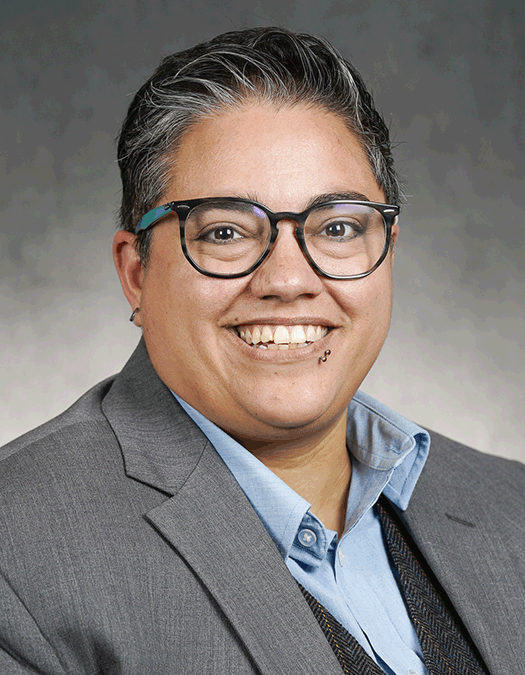
Rep. Brion Curran
Sponsored bills
Maddy summaryHF 1305 requires permit applicants for public events with over 1,000 attendees on Minnesota public property to include a written sensory-friendly accommodations plan. The plan must include at least one of four options: a designated sensory-friendly area, sensory-friendly design elements in the venue layout, mobile toolkits for sensory needs, or scheduled quiet times. Organizers must also describe how accommodations information will be communicated to attendees and how staff will handle requests. Noncompliance results in fines and ineligibility for future permits, effective July 1, 2025.
Maddy summaryHF 1041 imposes an additional tax on Minnesota corporations with high executive-to-median-worker pay ratios, ranging from 0.2% to 1.5% based on the ratio tier (e.g., 0.2% for 50:1 to 100:1 ratios). It directly affects corporations meeting specific pay ratio thresholds, using the federal disclosure standard (17 CFR § 229.402(u)(1)(iii)) to calculate the ratio. The bill also disqualifies these corporations from receiving state grants or subsidies, as specified in amended Minnesota Statutes sections 16B.981 and 290.06. The tax applies to taxable years beginning after December 31, 2025, with disqualification effective January 1, 2026.
Maddy summaryHF 666 modifies Minnesota's medical assistance program for employed people with disabilities. It allows individuals who earn above $65 per month (after a $65 earned income disregard) to keep coverage, including a four-month extension if they temporarily lose a job or have a medical condition requiring time off. Enrollees must pay a minimum $35 premium or a sliding-scale fee based on income (1%-7.5% of earnings), with American Indians exempt from premiums. The bill affects Minnesotans with disabilities who work and might otherwise lose health coverage due to earnings changes or job loss.
Maddy summaryHF 773 prohibits health insurance companies in Minnesota from requiring cost-sharing (like copays or deductibles) for specific short office visits for infants, children, and adolescents. The bill applies when visits are under 15 minutes and focus on evidence-based preventive care aligned with federal Health Resources and Services Administration guidelines. It also requires insurers to allow providers to bill separately for preventive services delivered during these visits. This directly affects health insurers, pediatric providers, and families seeking routine preventive care for young patients. The law amends Minnesota Statutes section 62Q.46 to add these protections.
Maddy summaryHF 665 amends Minnesota's medical assistance rules to raise the income threshold for aged, blind, or disabled individuals from 100% to 133% of the federal poverty guidelines. This change directly affects Minnesotans in these categories who seek state medical assistance, allowing them to earn more while remaining eligible. The bill modifies the existing statute (Minnesota Statutes 256B.056, subd. 4) to align the income limit for this group with other eligibility categories, effective July 1, 2025.
Maddy summaryHF 664 increases Minnesota's medical assistance income limit for two groups: Minnesotans with disabilities and people age 65+ who qualify for state medical aid. The bill amends Minnesota Statutes § 256B.056, raising the income threshold from 100% to 133% of the federal poverty guidelines. This change, effective January 1, 2026, allows more individuals in these categories to qualify for medical assistance without losing benefits due to higher income. It directly affects current or prospective recipients of medical assistance under specific eligibility categories (subdivisions 7, 7a, and 12 of § 256B.055).
Maddy summaryHF 30 requires Minnesota's Commissioner of Revenue to create a free, electronic system allowing residents to file individual income tax returns directly online without cost. The system must be hosted on the Department of Revenue website, and any contracted software vendor cannot offer paid tax preparation services through it. By tax years starting after December 31, 2025, the system must support at least 70% of resident individual tax returns, and the state must coordinate it with federal filing systems where possible. This directly affects Minnesota taxpayers who currently file individual income taxes, providing a free filing option instead of relying on paid services.
Maddy summaryHF 265, also known as "Brent's Law," requires Minnesota 911 call centers to identify mental health crisis calls and prioritize mental health crisis teams as primary responders when available. It mandates that 911 telecommunicators receive specific training or mental health staff screen calls to recognize crises, and establishes protocols for public safety answering points to comply. The bill also creates a civil lawsuit option for individuals or families harmed by violations, allowing claims for damages, attorney fees, and up to $15,000 in punitive damages for willful violations. This directly affects all Minnesota public safety answering points and the government entities operating them.
Maddy summaryHF 243 appropriates $3 million from Minnesota's general fund for a one-time grant to the White Bear Lake Area Historical Society, a nonprofit organization. The funding is specifically for renovating, constructing, furnishing, and equipping the White Bear Armory in White Bear Lake to create a history museum. This bill directly affects the historical society and the local community by enabling the repurposing of a public building into a cultural facility. The appropriation is available until the project is completed or abandoned, as specified in Minnesota Statutes section 16A.642.