

Maddy summaryHF 728 modifies Minnesota's rules for providing out-of-home respite care services for children in unlicensed residential settings. It allows licensed providers to offer this care in homes that aren't licensed for such services, but only if they meet strict requirements: background checks for all household members, annual assessments of the home's suitability by a case manager, annual authorization from a child's legal representative, and limits on the number of children (max four, with siblings allowed to share a room) and service duration (max 46 days per year). These rules do not apply to children in foster care under chapters 260C or 260D. The bill requires providers to maintain detailed documentation of all assessments and authorizations, effective January 1, 2026.
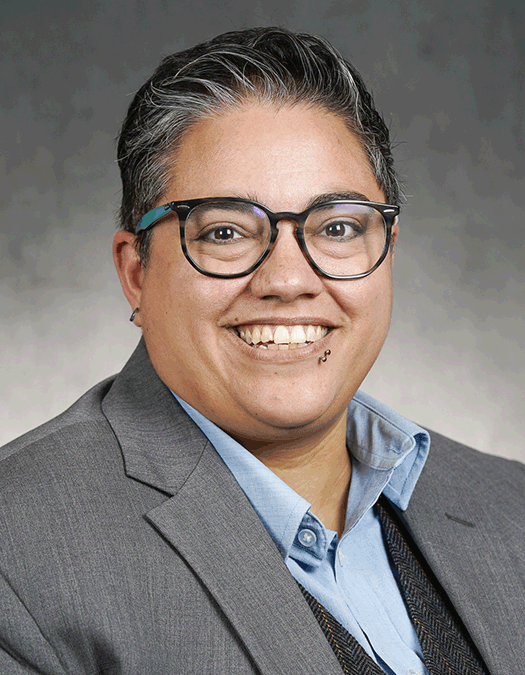
Rep. Brion Curran
Sponsored bills
Maddy summaryHF 33 establishes two new grant programs to support Minnesota's ambulance and emergency medical services (EMS). The ambulance service cost of readiness grant helps licensed ambulance providers cover operational and capital expenses, while the emergency medical services improvement grant assists counties, cities, and townships in modernizing local EMS systems. The bill also creates two new fees - a monthly emergency medical services telecommunications fee and a prepaid wireless emergency medical services fee - to fund these programs. These changes directly affect ambulance services, rural EMS providers, and local governments responsible for emergency response systems across Minnesota.
Maddy summaryHF 206 appropriates $6 million from state bond proceeds to fund a 2.25-mile multiuse trail in Vadnais Heights, Minnesota, along Vadnais Lake. The Metropolitan Council will provide a grant to the city for designing and constructing the trail, which aims to enhance safety, improve scenic access to natural areas, and increase regional recreational opportunities for pedestrians and cyclists. The bill authorizes the state to issue up to $6 million in bonds under Minnesota law to cover this funding. This directly affects the city of Vadnais Heights, which will use the funds for the trail project, benefiting local residents and regional trail users.
Maddy summaryHF 86 modifies certification requirements for Community Emergency Medical Technicians (CEMTs) and changes how their services are covered under Minnesota's medical assistance program. It requires CEMTs to complete culturally appropriate care training, have 2 years of EMT/AEMT experience, and earn 12 additional continuing education hours annually. The bill specifies that CEMT services - like post-hospital discharge follow-ups, medication reminders, home hazard checks, and safety evaluations for at-risk patients - must align with a patient's care plan. Medical assistance will cover these services at $100 per hour (billed as $25 per 15 minutes) for CEMTs holding a Unique Minnesota Provider Identifier, effective January 2026.
Maddy summaryHF 662 amends Minnesota's State Building Code to authorize the commissioner to adopt rules increasing accessibility specifically for examination rooms in healthcare and dental facilities. This bill directly affects public and private healthcare providers that operate examination rooms, requiring them to meet new accessibility standards. The key mechanism allows the commissioner to create these rules using an expedited rulemaking process, focusing on features like room layout, equipment, and space to better accommodate patients with disabilities. The changes apply to new or remodeled facilities and aim to improve physical access during medical examinations.
Maddy summaryHF 77 requires sellers to disclose the location and status of underground drainage systems (drain tile) when selling agricultural land classified as tax class 2a or 2b. Before closing a property sale, sellers must provide buyers with a written disclosure statement - either confirming no drain tile exists or detailing its location, size, outlets, and water flow path using a map. This applies to all property transfers after January 1, 2026, and mandates a specific disclosure certificate to be included with deeds or recorded documents. The law aims to provide transparency about subsurface drainage infrastructure during real estate transactions, directly affecting buyers and sellers of eligible agricultural properties.
Maddy summaryHF 659 appropriates $250,000 from the general fund for fiscal year 2026 to create a Community Engagement Response Team (CERT) in Rochester. The grant funds a nonprofit organization to hire community leaders and volunteers who will act as liaisons between law enforcement and the Black community. The team’s focus includes mediating conflicts, curating opportunities, and providing advocacy specifically for Black, Indigenous, and people of color (BIPOC) communities. This direct funding mechanism aims to improve public safety through community-centered partnerships in Rochester.
Maddy summaryHF 205 allocates $4.75 million from the state general fund to provide a one-time grant to the nonprofit organization People Serving People. The funding is specifically for renovating their homeless family shelter facility in Minneapolis, covering design, construction, furnishings, and equipment. This bill directly affects the shelter's residents (homeless families in Minneapolis) and the organization managing the facility. The appropriation is available until the project is completed or abandoned, effective upon final enactment.
Maddy summaryThis bill appropriates $250,000 from the general fund for fiscal year 2026 to create a Community Engagement Response Team in Rochester. The funding supports a nonprofit organization that will establish a team composed of community leaders and volunteers. The team’s work focuses on improving public safety by bridging connections between the Black community and law enforcement, mediating community issues, curating opportunities, and providing advocacy specifically for Black, Indigenous, and People of Color residents. The initiative directly affects Rochester residents in these communities through this targeted grant program.
Maddy summaryHF 668 requires Minnesota's Medicaid program (medical assistance) to cover prescription drugs already covered by a patient's primary private insurance, eliminating gaps where Medicaid might otherwise deny coverage for such drugs. It also mandates that Medicaid cover in-network medical services without requiring referrals or network verification when the primary insurance has an in-network provider. This bill directly affects Medicaid beneficiaries and healthcare providers who bill Medicaid, streamlining access to care for patients with dual coverage. The law aims to reduce administrative barriers and ensure consistent coverage for services already authorized by primary insurance.