

Maddy summaryThis bill establishes a uniform process for handling firearm restrictions when children are involved in abuse cases or need protection services in Minnesota. It requires that petitions filed by individuals for children in need of protection include a description of any firearms believed to be possessed by the abusing party or present in the child's home. The legislation also mandates that courts prohibit abusing parties from possessing firearms for the duration of protective orders when specific conditions are met, and requires those individuals to transfer their firearms to licensed dealers, law enforcement, or other authorized parties within three business days. These changes directly affect judges, social service agencies, law enforcement, and individuals involved in child protection and domestic abuse proceedings.
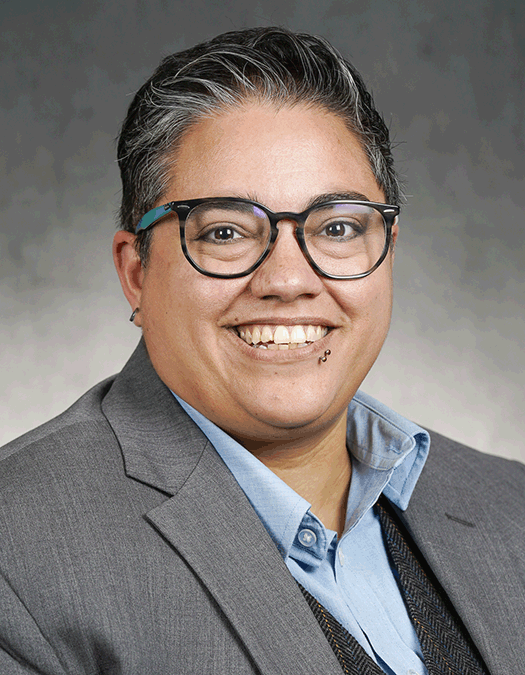
Rep. Brion Curran
Sponsored bills
Maddy summaryThis bill modifies eligibility requirements for private detective and protective agent licenses in Minnesota by updating definitions for applicants, license holders, and specific roles like Minnesota managers and proprietary employers. It requires that key individuals within corporate or partnership applicants meet licensing qualifications and be actively involved in daily management and supervision of licensed activities. The legislation also establishes a Board of Private Detective and Protective Agent Services with members representing licensed professionals and the public to oversee licensing applications and investigations. These changes aim to clarify who qualifies for licensure and strengthen oversight of security-related businesses operating in the state.
Maddy summaryThis bill increases penalties for impersonating a police officer in Minnesota. It upgrades the base offense to a felony (up to 2 years in jail or $4,000 fine) and creates a new crime for impersonating while carrying a firearm (up to 10 years in jail or $20,000 fine). The bill also requires anyone pretending to be a law enforcement officer to identify themselves when asked and imposes harsher penalties if they commit other crimes while impersonating an officer (e.g., a misdemeanor becomes a gross misdemeanor). It directly affects individuals who falsely pose as police officers, including those using fake uniforms, vehicle markings, or equipment to mimic law enforcement.
Maddy summaryThis bill requires law enforcement agencies to disclose the name, product number, and quantity of chemical irritants (like pepper spray) used during specific operations in buildings. It applies when officers execute search warrants, apprehend suspects, or attempt to apprehend suspects. Upon request, agencies must share this information with building owners, tenants, insurers, and cleaning/remediation service providers. The disclosure must be made regardless of data classification rules, ensuring transparency about chemical deployments. The bill directly affects law enforcement practices and building occupants' awareness of chemical exposure.
Maddy summaryHF 3769 clarifies and expands health care requirements for people in Minnesota's correctional facilities. It updates tuberculosis screening rules to require testing within 14 days of intake and annually, with options including blood tests or X-rays, and adds procedures for court-ordered testing if inmates refuse. The bill also requires correctional facilities to establish at least one mental health unit for short-term care and expands access by allowing transfers for "assessment, evaluation, or stabilization" when needed. Additionally, it aligns substance use disorder treatment programs with community standards while allowing flexibility for correctional settings. These changes directly affect incarcerated individuals and staff across Minnesota's state correctional facilities.
Maddy summarySF 3210 prohibits discrimination against individuals with disabilities by public or private entities receiving state funding in Minnesota. The bill requires these organizations to provide reasonable accommodations and ensures people with disabilities cannot be excluded from services or denied benefits due to their disability. It specifically bans the denial of access to service animals in public places like restaurants and hotels, and prohibits charging extra fees for service animals. This law directly affects state-funded organizations and individuals with disabilities across Minnesota.
Maddy summaryThis bill amends Minnesota's organized retail theft law to explicitly include gift card fraud as a form of retail theft. It defines "retail merchandise" to cover all gift cards (both physical and digital) and specifies that the "value" of stolen gift cards includes their full face value. Retailers and law enforcement will now have a clearer legal framework for prosecuting gift card fraud under existing organized retail theft statutes. The change takes effect August 1, 2025.
Maddy summaryHF 2358 increases penalties for coercion crimes that cause serious injury or death, imposing a maximum sentence of 15 years in prison or a $30,000 fine for such cases. It replaces the previous penalty structure - which depended on monetary value (e.g., $300-$2,500 losses) - with this fixed felony penalty when coercion directly results in great bodily harm or death. The bill also mandates a public awareness campaign by the public safety and education commissioners to inform the public and students about the law change, to begin by September 15, 2025, and repeat biennially. This law takes effect on August 1, 2026, applying to crimes committed after that date.
Maddy summaryThis bill creates a legal process in Minnesota that allows victims of domestic abuse or sexual assault to remove a perpetrator's ownership interest from a contract for deed on residential property. The law enables unmarried victims who share an interest in such contracts to petition a court to extinguish the perpetrator's claim, provided they submit proof of abuse such as a protection order, law enforcement documentation, or a verified statement from a qualified professional like a healthcare provider or domestic abuse advocate. Once the petition is filed, the perpetrator and property seller have 90 days to contest the request, after which a court may issue an order removing the perpetrator's interest from the property agreement. The legislation directly affects victims of abuse who hold shared ownership in contracts for deed and their abusive partners, offering a streamlined path to secure housing without the perpetrator's involvement.
Maddy summaryThis bill establishes a new "public safety radio and crime victims account" funded by a 50-cent monthly fee on wireless and wire-line telecommunications services (excluding prepaid wireless). The fee applies to each customer access line or basic service, with proceeds deposited into the account to cover two specific purposes: purchasing interoperable public safety radio equipment for Minnesota's statewide emergency response system, and providing grants to crime victim service providers. The bill amends existing telecom fee statutes to create this dedicated funding stream and requires annual reporting on how the funds are used. It does not change the existing 95-cent fee for general 911 service maintenance.