

Maddy summarySF 476 expands Minnesota's medical assistance program to cover "care evaluations" - face-to-face assessments to develop or update home care plans (excluding personal care). It modifies payment rates for homemaker services, home health agencies, and home care nursing. The bill directly affects home care recipients (including seniors and people with disabilities) and the providers delivering these services. Key changes include adding care evaluations to covered services and requiring county public health nurses to conduct certain assessments and updates. All provisions take effect January 1, 2026, or after federal approval.
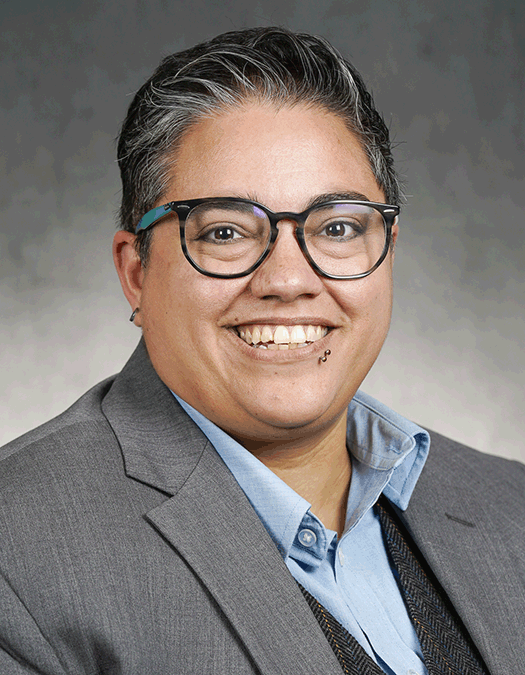
Rep. Brion Curran
Sponsored bills
Maddy summaryThis bill modifies how Minnesota calculates registration taxes for passenger automobiles and hearses, directly affecting vehicle owners and dealers. It establishes a new tax rate of 1.575 percent based on the manufacturer's suggested retail price for vehicles registered on or after November 16, 2020, while maintaining a slightly lower rate for older registrations. The legislation introduces a tiered tax devaluation schedule that reduces the taxable value of a vehicle by a specific percentage each year it remains in use, with the reduction amount varying depending on the vehicle's price range. Additionally, the bill clarifies that the tax calculation excludes the cost of optional accessories and destination charges, except for pre-2020 registrations.
Maddy summaryThis bill introduces new regulations in Minnesota to restrict the ownership and sale of semiautomatic military-style assault weapons and large-capacity magazines, while also banning the sale of binary trigger systems. It expands criminal penalties for possessing dangerous weapons in schools and for negligently storing firearms, and it specifically criminalizes the manufacture and sale of untraceable "ghost guns." Additionally, the legislation strengthens the state's extreme risk protection order system, requires law enforcement to report firearm discharges more comprehensively, and allocates funding to support public awareness campaigns and mental health services.
Maddy summaryThis bill allows the state, counties, or municipalities in Minnesota to use eminent domain to take property owned by public utilities or electric cooperatives. It clarifies that while these entities can acquire the physical property, they cannot immediately gain the right to provide electric service during the legal process. The law also specifies that compensation paid to the utility must include the original cost of the property adjusted for depreciation, lost revenue, and other related expenses. This change directly affects government bodies planning infrastructure projects and the utility companies that might have their land taken for those purposes.
Maddy summaryHF 3793 requires large groundwater users (those exceeding 100 million gallons annually or 50% of a municipality's current water allocation) to apply for their own water-use permits instead of modifying existing municipal permits. This affects industrial and commercial entities, including data centers, whose water use meets these thresholds. Key provisions include mandatory public comment periods for new permits, potential aquifer testing, and monthly reporting for threshold users - compared to annual reporting for smaller users. The bill aims to strengthen oversight of significant groundwater withdrawals while ensuring public input and watershed protection.
Maddy summaryHF 2380 prohibits discrimination against individuals with disabilities in services, programs, or activities receiving state funding in Minnesota. It directly affects public and private entities (like schools, hospitals, and businesses) that receive state money. The bill requires these entities to provide reasonable accommodations and bans exclusion or denial of benefits due to disability. It also specifically prohibits businesses from banning service animals or charging extra fees for them, defining "disability" broadly to include conditions substantially limiting major life activities.
Maddy summaryThis bill creates a new Greenhouse Gas Pollution Superfund in Minnesota to address climate change impacts. It establishes a program that requires fossil fuel companies responsible for over one billion metric tons of emissions between 1995 and 2026 to pay into a dedicated account. The collected funds will be used to finance climate change adaptation projects for state, local, and Tribal governments, as well as for disadvantaged communities. The bill defines specific terms like "responsible party" and "covered greenhouse gas emissions" to determine which companies must contribute and what types of projects can receive funding.
Maddy summaryThis bill prohibits health insurance plans in Minnesota from covering conversion therapy for minors under 18 and vulnerable adults, effective January 1, 2027. It also requires the commissioner of human rights to take appropriate actions to protect Minnesotans from conversion therapy, including investigating complaints against mental health practitioners who engage in such practices. The legislation defines conversion therapy using existing state law definitions and directs the commissioner to prioritize investigating discriminatory practices related to this issue. Health plans offered, sold, issued, or renewed to Minnesota residents after the effective date must comply with these coverage restrictions.
Maddy summaryThis bill creates a legal cause of action allowing individuals who were minors when they underwent conversion therapy to sue mental health professionals for harm caused by those practices. It defines conversion therapy as attempting to change a person's sexual orientation or gender identity, and specifies that psychological harm includes conditions like depression, anxiety, and suicidal ideation. If a lawsuit is successful, the court can award damages, order the professional to stop the practice, and require payment of at least $50,000 to the injured person or their guardian. The law also allows parents or guardians to file suits on behalf of minors or when the affected individual is deceased or unable to participate.
Maddy summaryThis bill establishes the Minnesota Business Recovery Loan Program to provide financial assistance to businesses that have suffered revenue losses exceeding 30% due to staffing shortages or disruptions caused by increased immigration enforcement activities. The program allocates $100 million in one-time funding, with $18 million designated for zero-interest loans to businesses in greater Minnesota and $82 million for zero-interest loans to businesses in the seven-county metropolitan area through nonprofit lenders. To qualify, businesses must be Minnesota-based, in good standing, and demonstrate that their revenue decline stems from immigration-related events between the bill's enactment and December 1, 2025. Loan amounts vary by business size and location, ranging from $25,000 to $200,000, and funds must be used exclusively for business operations within Minnesota rather than debt repayment or real estate investment.