

Maddy summaryThis bill modifies Minnesota's laws regarding employment and occupational licensing restrictions for people with criminal convictions. It requires hiring and licensing authorities to consider evidence of rehabilitation, including military honorable discharge, release orders, and documentation showing compliance with probation or parole. The legislation also mandates that when an applicant is denied employment or a license due to a criminal record, the authority must provide written notice explaining the reasons and outlining the process for reapplication. These changes aim to create a more structured framework for evaluating applicants with prior convictions while maintaining transparency in the decision-making process.
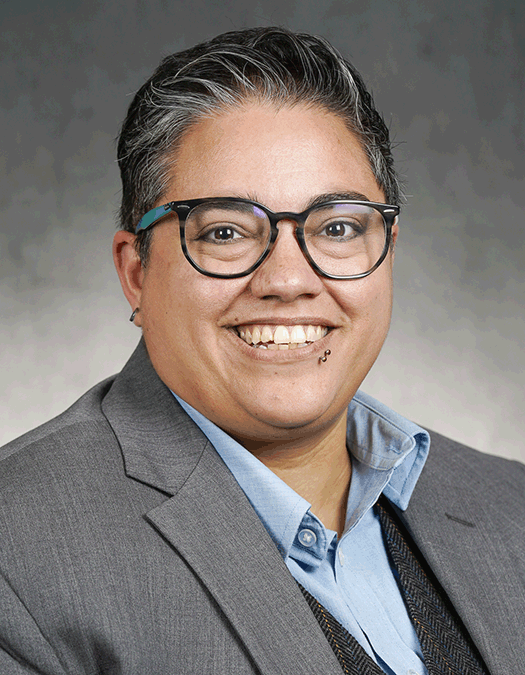
Rep. Brion Curran
Sponsored bills
Maddy summaryThis bill prohibits the state Public Utilities Commission from issuing route permits for carbon dioxide pipelines that are longer than 1,000 feet or that cross, go under, or pass through public waters. It directly affects companies seeking to build or operate these pipelines in Minnesota by requiring them to obtain a permit for any project, while simultaneously banning applications for exemptions from standard route selection procedures. The legislation defines a carbon dioxide pipeline as any line transporting the substance in liquid, gaseous, or supercritical states within the state and sets these specific restrictions into law immediately upon enactment.
Maddy summaryThis bill repeals a previous exemption that allowed large data centers to avoid paying sales and use taxes on their equipment and software. It directly affects businesses building or operating data centers in Minnesota by requiring them to pay standard taxes on purchases like servers, computers, and related materials. The legislation defines a "qualified large-scale data center" as a facility with at least 25,000 square feet and a total investment of $250 million in construction and technology over a six-year period. Additionally, the bill removes a special reduction in state funding for special education that was previously tied to the data center tax exemption. These changes take effect on July 1, 2026, ensuring that data center projects contribute to state revenue like other commercial developments.
Maddy summaryThis bill allows individuals in Minnesota to request changes or additions to the sex indicators on their birth and death records, including options beyond just male or female. For adults and emancipated minors, the state health commissioner must approve these requests if supported by medical documentation, a court order, or a sworn statement of good faith. The legislation also permits parents or guardians to make these changes for minors and requires courts to grant such petitions when there is no intent to defraud. Additionally, the bill mandates that once a birth record is updated, the original document becomes private data that cannot be disclosed without a court order.
Maddy summaryHF 2354 strengthens Minnesota's response to Medicaid fraud by expanding the Attorney General's authority to subpoena records from entities like phone companies, financial institutions, and healthcare providers. It establishes criminal penalties for submitting false Medicaid claims, including fines up to $100,000 and up to 20 years in prison for fraud exceeding $35,000, with lesser penalties for smaller amounts. The bill directly affects Medicaid providers and individuals who submit fraudulent claims for medical assistance funds. Key mechanisms include new subpoena powers for investigations and tiered penalties based on the value of the fraudulent claims. The law amends existing statutes (256B.12, 609.467) and repeals outdated provisions.
Maddy summaryMinnesota Senate File 1943 prohibits pet shops (physical retail stores selling animals to the public) from selling or transferring ownership of cats and dogs, effective August 1, 2026. The bill allows pet shops to provide space for nonprofit animal shelters, humane societies, or 501(c)(3) rescue groups to offer animals for adoption, but pet shops cannot own the animals or charge fees for this space. It does not affect breeders, direct sales from breeders, or nonprofit adoption organizations themselves. The law aims to shift pet sales toward adoption-focused organizations while maintaining transparency requirements for pet dealers.
Maddy summaryThis bill creates a temporary Minnesota Entrepreneurship Task Force to evaluate and improve the state's business environment. The group will consist of the commissioner of employment and economic development and ten appointed members representing entrepreneurs, business owners, labor, education, and financing experts. Their main duties include assessing current programs, identifying barriers to starting a business, and proposing reforms to streamline licensing and permitting processes. The task force must submit a final report with its findings and recommendations by February 15, 2028, after which the group will dissolve.
Maddy summaryThis bill officially designates a specific segment of Ramsey County State-Aid Highway 96 as the "Master Sergeant Nicole Amor Memorial Highway" to honor her memory. The law requires the road authority to install and maintain signs for this designation, but only after securing funding from non-governmental sources to cover all associated costs. Additionally, the bill establishes a process allowing the removal of these signs if they require repairs and the necessary funds cannot be obtained from private donors.
Maddy summaryHF 2627 prohibits pet shops (defined as physical retail stores selling animals to the public) from selling, offering to sell, or transferring ownership of cats or dogs. The bill directly affects retail pet shops operating in Minnesota, requiring them to stop selling these animals by August 1, 2026. However, pet shops may still host nonprofit animal rescues or shelters (501(c)(3) organizations) for adoption events, provided the shops don’t own the animals or charge fees for the space. The law does not restrict breeders, shelters, or adoption centers, only retail pet shops selling cats and dogs directly to customers.
Maddy summaryHF 1082 establishes the Minnesota Victims of Crime Account, funded by increased fees/penalties from criminal cases and additional general fund transfers. It appropriates specific funds for fiscal years 2026-2027 to provide grants to organizations that received crime victim service grants in 2024. These grants must support direct services for victims of sexual assault, domestic violence, child abuse, and general crime - including client assistance, housing supports, culturally responsive programming, and prevention efforts like restorative justice. The bill requires services to prioritize underserved communities and reflect Minnesota’s diversity, with up to 10% of funds allowed for grant administration.