

Maddy summaryThis Minnesota bill restricts state and local government participation in federal civil immigration enforcement efforts, prohibiting agencies from using resources to investigate, detain, or arrest individuals for immigration violations. It defines civil immigration enforcement to exclude criminal law enforcement and clarifies that cooperation with federal authorities on criminal matters remains permitted. The legislation also establishes a cause of action for constitutional rights violations related to immigration, prohibits denying education based on immigration status, and requires hospitals to create policies for interactions with law enforcement. Additionally, the bill appropriates funding to support these provisions and amends existing state statutes regarding immigration-related activities.
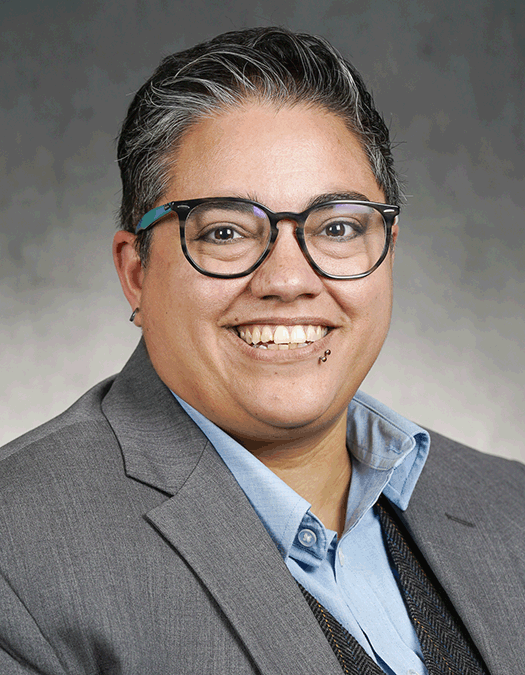
Rep. Brion Curran
Sponsored bills
Maddy summaryThis bill increases funding for Minnesota's agricultural programs by directing additional state money to specific accounts for research, testing, and promotion. It allocates $261,000 annually to the Minnesota Grown account to support local food marketing grants, while also funding avian influenza testing in food products and agricultural workers. The legislation provides $10.677 million per year for agricultural research and education, including studies on turkey diseases, wild rice, and crop contamination, with some funds designated for university programs and rural leadership training. These changes affect state budget allocations and benefit farmers, agricultural workers, and Minnesota-based agricultural institutions through grants and research initiatives.
Maddy summaryHF 3407 prohibits the sale, possession, and distribution of "ghost guns" - firearms without unique serial numbers, undetectable by metal detectors, or made via 3D printing by unlicensed individuals. It restricts 3D printing of firearms to federally licensed manufacturers, bans sharing 3D gun design files, and requires all firearms to have engraved serial numbers. Owners of existing ghost guns must either have a licensed dealer add a serial number, remove the item from Minnesota, make it permanently inoperable, or surrender it within 180 days (or 30/60 days for inheritors/new residents). Violations carry penalties of up to five years in prison or $10,000 fines.
Maddy summaryHF 3634 expands the list of human services requiring electronic visit verification in Minnesota. It adds three new categories: services provided by "high-risk" providers (based on Medicare criteria), "high-risk" services designated by the commissioner, and any other program or service the commissioner designates. This affects home care and community-based service providers, requiring them to document service details (like time, location, and recipient) electronically through a system compliant with the 21st Century Cures Act. The change broadens verification requirements beyond current personal care, community first services, and home health services.
Maddy summaryThis bill removes the legal authority for federal agents from U.S. Customs and Border Protection and U.S. Citizenship and Immigration Services to make arrests under Minnesota state law. It directly affects these federal agencies by eliminating their ability to conduct warrantless arrests within the state, except when assisting local law enforcement. The change amends existing statutes to delete provisions that previously allowed these officers to arrest individuals for specific crimes like assault or felonies when on duty or with a warrant. This policy adjustment limits arrest powers to state-authorized peace officers and private citizens, while still permitting federal agents to aid in executing warrants when requested by local officers.
Maddy summaryThis bill modifies Minnesota's law on concealing identity in public places. It adds "protection from smoke, gas, or other airborne toxin" as a valid exception for wearing masks or disguises, while clarifying that the law generally prohibits such concealment (except for religious, entertainment, weather, or medical reasons). The bill specifically creates two new exceptions for law enforcement: undercover officers may conceal identity when necessary for investigations or safety, and tactical team members may wear face masks to prevent facial disfigurement. The law would not apply to these officers while performing official duties under these specified circumstances. (Note: This is a proposed bill pending in committee as of February 2026.)
Maddy summaryHF 3405 requires Minnesota's Bureau of Criminal Apprehension (BCA) to use its existing Use of Force Investigations Unit to investigate incidents involving federal agents. Specifically, it amends Minnesota Statutes 2024, section 299C.80, to include "federal agents" (defined as those employed by DHS, ICE, CBP, or USCIS) under the unit's duty to investigate cases involving peace officers or federal agents. The bill expands the unit's current mandate - which already covers incidents with state/local officers - to now cover all incidents involving the specified federal agencies. This change directly affects federal law enforcement personnel from those agencies operating in Minnesota.
Maddy summaryHF 3413 prohibits Minnesota state, county, and local government units - including county sheriffs - from entering new agreements with the federal government that allow them to enforce civil immigration law. The bill also requires immediate termination of any existing agreements of this type within 24 hours of the law taking effect. It defines "immigration enforcement agreement" broadly to include contracts, memorandums, or intergovernmental agreements that authorize local entities to carry out federal immigration enforcement actions. This policy change directly affects all state and local law enforcement agencies that previously participated in such federal programs. The law takes effect the day after final enactment, eliminating both new and ongoing participation in these specific federal-local immigration enforcement partnerships.
Maddy summaryThis bill prohibits Minnesota law enforcement officers from detaining or transporting suspects in vehicles not specifically designed for human transport, such as standard patrol cars. It requires all such vehicles to be owned/leased by a law enforcement agency, clearly marked with the agency's identification, and equipped with seats and seat belts for each person transported. Exceptions apply during emergencies threatening life/safety or for undercover operations. The law directly affects police departments and officers who transport detainees, aiming to standardize safe transport conditions.
Maddy summaryHF 3712 requires employers to post accessible printed materials outlining workers' rights under Minnesota's Human Rights Act, including how to file complaints or sue, and encourages plain-language explanations about preventing discrimination. It also mandates school districts to post annual website notices for students, parents, and guardians detailing their rights under the Act, including contact information for compliance coordinators (typically school principals). Both provisions emphasize using clear language and include encouragement for schools to provide age-appropriate education on civil rights. The bill amends Minnesota Statutes sections 363A.08 (employer notices) and 363A.13 (school notices).