

Maddy summaryHF 3662 amends Minnesota's individual income tax code to require taxpayers to include certain employer-reimbursed travel expenses as taxable income. Specifically, it adds an "addition" for travel costs (like fares, meals, and lodging) paid by or reimbursed by an employer while traveling within Minnesota for immigration enforcement activities or supporting such activities. This provision applies only to expenses incurred in Minnesota and takes effect for tax years starting after December 31, 2025. The bill directly affects Minnesota taxpayers whose employers cover travel related to immigration enforcement within the state.
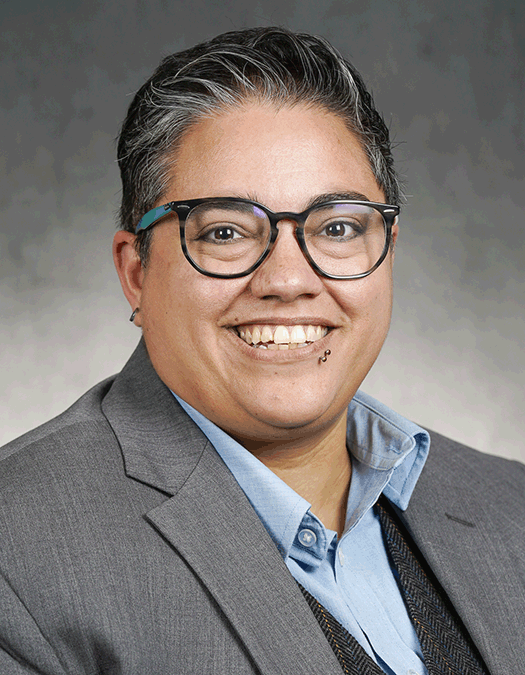
Rep. Brion Curran
Sponsored bills
Maddy summaryHF 3659 requires individuals who earned income in Minnesota while participating in immigration enforcement activities or providing material support to such activities to file a Minnesota income tax return. This requirement applies even if the individual's income would normally be too low to trigger a filing obligation under standard tax rules. The bill amends Minnesota Statutes to add this specific filing requirement, which takes effect for tax years beginning after December 31, 2025.
Maddy summaryHF 3357 would prohibit the possession of dangerous weapons (including guns, ammunition, or explosives) in Minnesota's Capitol complex buildings, making it a felony punishable by up to five years in prison or a $10,000 fine. The bill specifically applies to state buildings within the Capitol Area described in chapter 15B, excluding the National Guard Armory. Key exemptions include licensed peace officers on duty, permit holders who notify law enforcement, individuals displaying weapons as evidence with sheriff approval, and retired officers working in security roles under specific federal rules. The law would take effect on August 1, 2026, and directly affects anyone entering Capitol complex buildings, with limited exceptions for authorized personnel and specific lawful activities.
Maddy summaryHF 1296 requires Minnesota's Board of Animal Health to post specific information online about kennels, dealers, and commercial breeders, including current license statuses, annual inspection records, and reasons for license revocations. It also mandates that all advertising for animal sales must include the seller's current license number or a link to it. The bill clarifies that most breeder data (like addresses and premises locations) remains private, but the Board may disclose it for public health, safety, or law enforcement purposes. These changes directly affect licensed breeders, dealers, and the public seeking transparency about animal facilities.
Maddy summaryHF 3374 modifies how Minnesota's disability waiver program adjusts service rates for inflation. It sets an 8% annual cap on rate increases based on the Consumer Price Index (CPI), requiring the commissioner to implement full CPI changes if below 8% or limit increases to 8% if higher. The bill also requires manual reviews for service agreements where proposed increases exceed legislatively approved rate changes, unless tied to documented changes in a person's needs. This directly affects people receiving disability waiver services and the agencies administering them, ensuring rate adjustments align with inflation while maintaining oversight for larger proposed changes. The policy changes take effect January 1, 2026.
Maddy summaryHF 3434 bans the possession of semiautomatic military-style assault weapons (like AR-15s and AK-47s) and large-capacity ammunition magazines (holding more than 10 rounds) in Minnesota. It defines these weapons by specific models (e.g., Colt AR-15, Beretta AR-70) or features (folding stocks, pistol grips, threaded barrels). The bill creates criminal penalties for possessing these banned items and amends state law to clarify prohibited firearms and magazines. It directly affects individuals who own or possess these specific weapons or magazines. The law does not cover all semiautomatic firearms but targets models and features associated with military-style weapons.
Maddy summaryHF 3406 makes specific firearm permit data public, including details about permit revocations, suspensions, or voidances, and information on permit holders who died by firearm suicide or police use of force. It extends retention requirements for certain records: sheriffs must keep data on denied or revoked permits, voided permits due to prohibited possession, and the specified deaths for six years instead of purging it annually. This applies to government entities like county sheriffs that collect firearm permit information in Minnesota. The bill changes public access to limited permit-related data while ensuring specific records are preserved longer.
Maddy summaryHF 1335 authorizes Minnesota to issue electronic driver's licenses that comply with national standards (AAMVA and ISO/IEC 18013-5). It affects Minnesota drivers who choose to use electronic credentials and requires the Department of Public Safety (DVS) to develop the system with specific privacy safeguards. Key provisions include mandating secure verification by businesses or law enforcement, prohibiting tracking without consent, and requiring physical licenses to be carried while driving. The bill also allows DVS to charge a separate fee for electronic licenses and sets rules for data handling under existing privacy laws. It takes effect July 1, 2026.
Maddy summaryThis Minnesota House resolution (HF 142) urges Congress to pass federal legislation granting statehood to Washington, D.C. It directly supports D.C. residents, who pay federal taxes but lack voting representation in Congress. The resolution cites D.C.'s population size (689,545 per 2020 census), its 86% referendum approval for statehood in 2016, and its status as the only U.S. capital without voting rights. Minnesota directs its Secretary of State to send copies of this resolution to federal officials and its congressional delegation. The resolution does not create new policy but advocates for Congress to advance existing statehood bills like H.R. 51/S. 51.
Maddy summaryHF 3317 is a symbolic resolution passed by the Minnesota legislature condemning federal executive orders that target immigrants. It does not create new laws but expresses the state's opposition to policies it views as inhumane, urging the president to stop such actions and calling on Minnesota's congressional delegation to oppose these policies. The resolution also recommends federal passage of the Neighbors Not Enemies Act to repeal an outdated law and affirms that all people in Minnesota, regardless of immigration status, deserve due process under U.S. and state constitutions. It directs the Secretary of State to send copies to federal officials as a formal statement of the legislature's position.