

Maddy summaryHF 2510 increases and adjusts Minnesota school districts' local optional revenue funding. It sets a fixed allowance of $724 for fiscal years 2026-2027, then indexes future allowances to the state's formula allowance starting in 2028 using a specific ratio calculation. The bill establishes a two-tier system: a first tier at $300 per adjusted pupil unit and a second tier calculated as the total allowance minus $300. School districts use this structure to determine their maximum local levy amounts based on property values per student, with the second tier's cap changing annually. The changes take effect July 1, 2025, directly affecting all Minnesota public school districts.
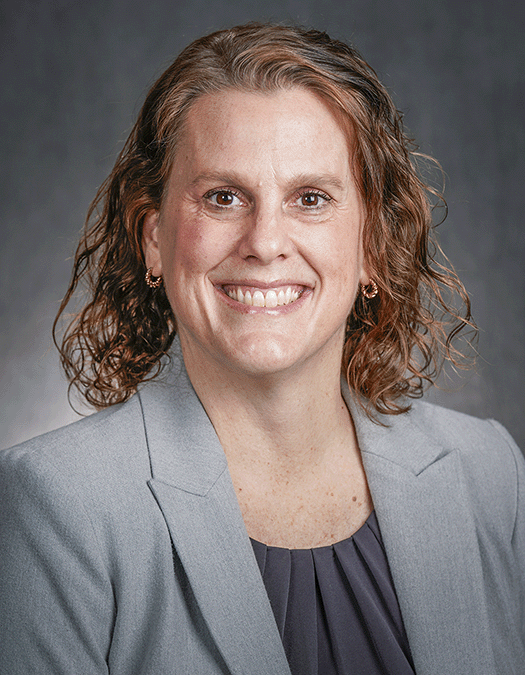
Rep. Kari Rehrauer
Sponsored bills
Maddy summaryHF 491 appropriates $250,000 for fiscal year 2026 and $250,000 for fiscal year 2027 from the general fund to provide grants to Hometown Hero Outdoors, a Stillwater-based nonprofit. The funding supports mental health services and outdoor recreational activities for current and former law enforcement officers, firefighters, and emergency medical services personnel. The bill directs these services to promote positive mental health, longevity, quality of life, and interactions with mental health professionals through organized outdoor programs. It does not create new policy but allocates specific funds to an existing nonprofit for targeted support of first responders.
Maddy summaryHF 2215 creates a state-run low-cost auto insurance program called the "Minnesota Lifeline Insurance Program" for low-income residents who meet specific eligibility criteria. The Commissioner of Commerce must establish this program, requiring a facility to develop and operate it, set affordable rates based on claims data and administrative costs, and offer online applications through a dedicated website. The bill appropriates state funds for the program, mandates annual reports to the legislature detailing participation and costs, and requires rates to cover claims, expenses, and investment income while remaining accessible. This program directly affects low-income Minnesotans who struggle to afford standard auto insurance, providing them with a state-supported alternative.
Maddy summaryHF 2511 allows Minnesota school districts to use long-term facilities maintenance revenue for school safety facility enhancements, such as security upgrades, violence prevention modifications, and equipment related to facility security. The bill amends Minnesota Statutes to explicitly add "school safety facility enhancements" as an allowed use under the district's ten-year facility plan, effective for fiscal year 2026 and later. This change does not alter existing restrictions on revenue use, such as prohibitions on new facility construction or energy-efficiency projects unrelated to safety. School districts must include these safety projects in their approved facility plans to qualify for the funding.
Maddy summaryHF 2209 appropriates state funds from Minnesota's arts and cultural heritage fund to support the Lundstrum Center for the Performing Arts. The bill allocates money for fiscal years 2026 and 2027 to fund after-school educational programs focused on dance, voice, and drama. Up to a portion of the grant may also be used for capital improvements to the Center's facilities. This bill directly provides financial support to the Lundstrum Center for its youth programming and physical infrastructure.
Maddy summaryHF 2304 creates a refundable tax credit for eligible Minnesota teachers. It provides up to $15,000 for full-year teachers earning under $60,000 annually (or $7,500 for part-year teachers earning under $30,000), and $2,000 for teachers earning above those thresholds. To qualify, teachers must hold a valid license, work at least 60% full-time, and teach a minimum number of student contact days (150 for full-year, 75-149 for part-year). Employers must provide annual income and service records, and the credit can be refunded even if the teacher owes no income tax.
Maddy summaryHF 2507 establishes a program to fund affordable homeownership projects specifically targeting African American households and using African American workers in development. It appropriates money for grants to cities, tribal governments, nonprofits, and community land trusts to cover costs like land acquisition, environmental cleanup, design, rehabilitation, and construction training. Projects must serve African American households earning 80% or less of the state median income for African Americans and prioritize African American-run workforce development and housing programs. The program requires grant funds to directly support both affordable housing construction and job training/employment opportunities for African Americans.
Maddy summaryHF 2068 allocates $89 million for each of fiscal years 2026 and 2027 from the state general fund to provide grants under Minnesota Statutes section 256K.45, subdivision 1. The bill directly provides funding to organizations serving homeless youth in Minnesota, supporting existing programs rather than creating new policies. This appropriation enables the commissioner of human services to distribute funds for services like shelter, counseling, and transitional housing. The bill focuses solely on funding, with no new eligibility rules or program requirements specified.
Maddy summaryHF 1677 appropriates a specific amount from the general fund for Minnesota's Developing Markets for Continuous-Living Cover Crops Program. The bill directs the Commissioner of Agriculture to use these funds to support market development for soil-protecting cover crops (plants grown to prevent erosion and improve soil health) and requires two annual reports detailing fund usage and program achievements by February 1, 2026, and 2027. The funding is a one-time appropriation available until June 30, 2028, with up to 6.5% allowed for administrative costs. This bill directly affects the Minnesota Department of Agriculture, which administers the program, and supports farmers adopting continuous-living cover crop practices.
Maddy summaryHF 2286 allocates $1 million for fiscal year 2026 and $1 million for fiscal year 2027 from the state general fund to Minnesota Independence College and Community (MICC). The funds will support workforce development services for adults with autism and learning differences, including employment preparation, job placement, job retention, and service coordination. This bill directly affects adults with autism and learning differences in Minnesota by providing targeted employment support. The appropriation is a concrete policy change that allocates state funds to MICC for these specific services.