

Maddy summaryHF 492 appropriates $250,000 for fiscal year 2026 and $250,000 for fiscal year 2027 from the general fund to fund mental health services and outdoor recreational activities for currently serving military personnel and veterans in Minnesota. The funds are directed to Hometown Hero Outdoors, a Stillwater-based nonprofit, to support programs promoting mental wellness, community interaction with professionals, and quality of life through outdoor engagement. This bill specifically provides dedicated funding for an existing nonprofit's established services rather than creating new state programs. It directly affects military members and veterans by expanding access to mental health support and outdoor activities through this designated organization. The appropriation is limited to these specific fiscal years and services as outlined in the bill.
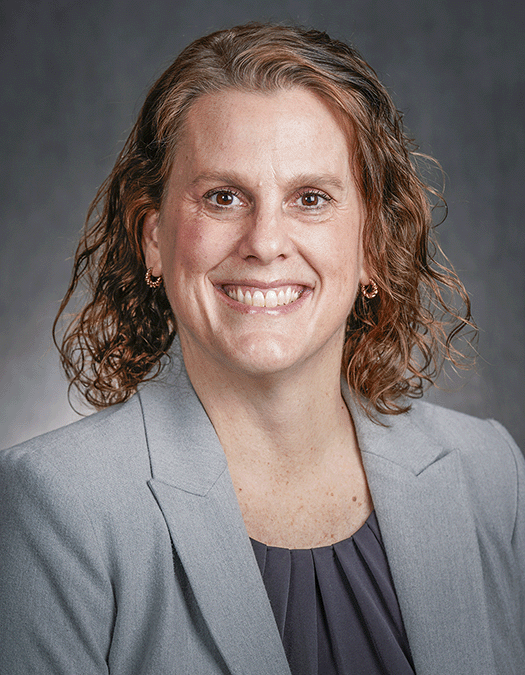
Rep. Kari Rehrauer
Sponsored bills
Maddy summaryHF 1989 increases funding for Minnesota school districts by raising the "local optional revenue" allowances used to calculate state aid. It sets the first-tier allowance at $550 for fiscal year 2027 (up from $300) and maintains the second-tier allowance at $424 through 2027, with future increases tied to the general education funding formula. School districts receive more state aid when they levy less than the maximum allowed under these new formulas, which include specific "equalizing factors" for different fiscal years (e.g., $626,450 for second-tier in 2025). The bill appropriates funds to cover this increased aid, effective for fiscal year 2027 and later.
Maddy summaryHF 1387 prohibits the use, manufacture, and sale of lead fishing weights (sinks and jigs) that weigh one ounce or less or measure 2.5 inches or less in length. It directly affects recreational fishers, tackle manufacturers, and retailers in Minnesota. The law bans these specific small lead weights starting July 1, 2027, while excluding items like artificial lures and weighted flies from the definition. The bill aims to reduce lead contamination in aquatic environments by targeting the most common small lead fishing gear.
Maddy summaryHF 2195 proposes adding a new constitutional section to Minnesota's state constitution, specifically stating "Marriage is a fundamental right and shall not be restricted based on gender or race" (Sec. 18). If approved by voters, this amendment would prohibit legal restrictions on marriage based on gender or race. The amendment must be submitted to voters in the 2026 general election, with potential implementation starting January 1, 2027, if ratified. This bill directly affects marriage rights and legal protections for all Minnesotans, requiring voter approval rather than legislative passage alone.
Maddy summaryHF 2218 appropriates $1.5 million from the general fund for fiscal year 2026 to the Metropolitan Council. This funding will be used to provide grants to regional park agencies within the Metropolitan Council system to manage aquatic invasive species. The grants support prevention, containment, control, and enforcement efforts to reduce the spread of these species. The funds are available until June 30, 2027, and directly affect regional park management agencies in the Minneapolis-St. Paul area.
Maddy summaryThis bill amends Minnesota Statutes section 626.19, subdivision 3, to explicitly authorize law enforcement agencies to use drones (unmanned aerial vehicles) during the lawful pursuit of a fleeing suspect. It directly affects police departments and the public, as it expands drone use for suspect chases beyond existing emergency or disaster scenarios. The key provision adds a specific exception to the list of permitted drone uses, allowing agencies to deploy drones "in risk of, or for purposes of, the lawful pursuit of a fleeing suspect." This change clarifies and formalizes an existing practice under Minnesota law.
Maddy summaryHF 1100 requires Minnesota's human services commissioner to establish a $4.50 per prescription payment to eligible community pharmacies in rural or underserved areas. This payment, added to existing fees, must be paid by managed care plans, county health programs, and pharmacy benefit managers to qualifying pharmacies that serve medically underserved populations or share ownership with 12 or fewer Minnesota pharmacies. The bill appropriates funds for this program in fiscal years 2026 and 2027, with the payment ending if federal approval isn't obtained. It explicitly states this payment cannot replace or reduce other fees paid to pharmacies.
Maddy summaryHF 1485 requires Minnesota health insurers and medical assistance programs to cover over-the-counter (OTC) contraceptive drugs, devices, and products without cost-sharing (like co-pays or deductibles). It applies directly to health plans and enrollees, mandating coverage of all FDA-approved OTC contraceptives at the point of sale without prescription requirements or quantity limits. The bill also requires health plans to list covered contraceptive services accessibly and cover provider-recommended methods based on medical necessity. This law takes effect January 1, 2026, for health plans offered, issued, or renewed after that date.
Maddy summaryHF 2468 appropriates $500,000 for fiscal year 2026 and $500,000 for fiscal year 2027 from the general fund to support mental health initiatives in Minnesota's construction industry. The funds, available until June 30, 2027, are designated for outreach, education, stigma reduction programs, and worksite strategies to prevent suicide. They can be used for grants to industry groups and developing resources targeting construction workers. This bill directly affects construction industry workers by funding concrete mental health support services through state-administered programs.
Maddy summaryHF 805 establishes a property tax refund program for nonprofit child care facilities that rent their facilities. Eligible providers - nonprofits with 501(c)(3) status operating licensed child care centers or family day care that accept state child care assistance - receive a 10% refund on cash rent paid for their facility space. To claim the refund, providers must apply annually to the commissioner by the following year, with payments made according to state schedules. The bill appropriates funds for these refunds and requires reporting, effective for rent paid in 2024 and later.