

Maddy summaryThis bill establishes a uniform process for handling firearm restrictions when children are involved in abuse cases or need protection services in Minnesota. It requires that petitions filed by individuals for children in need of protection include a description of any firearms believed to be possessed by the abusing party or present in the child's home. The legislation also mandates that courts prohibit abusing parties from possessing firearms for the duration of protective orders when specific conditions are met, and requires those individuals to transfer their firearms to licensed dealers, law enforcement, or other authorized parties within three business days. These changes directly affect judges, social service agencies, law enforcement, and individuals involved in child protection and domestic abuse proceedings.
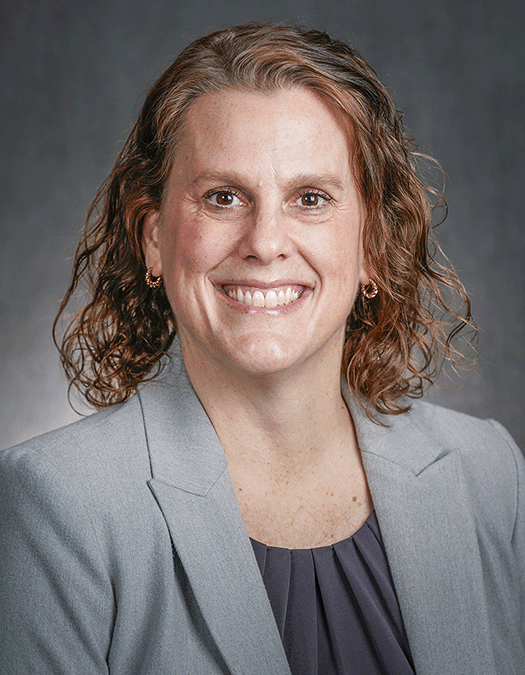
Rep. Kari Rehrauer
Sponsored bills
Maddy summaryHF 3741 modifies Minnesota's educational assistance program for veterans' families, providing an annual $750 stipend for eligible children and spouses of veterans. It affects children and spouses of deceased veterans (including those who died in service), prisoners of war, or missing in action personnel who meet residency requirements and maintain satisfactory academic progress at Minnesota public institutions. The bill specifies the stipend cannot be used by individuals who have already earned a bachelor's degree. It updates definitions to clarify eligibility criteria and repeals an outdated provision, ensuring funds are directed to qualifying family members pursuing higher education in Minnesota.
Maddy summaryHF 3467 allows Minnesota's Commissioner of Veterans Affairs to redirect agency resources toward specific veterans' initiatives, including addressing food insecurity, homelessness, and suicide prevention. The bill requires the commissioner to submit an annual report by October 15 to the governor and relevant legislative committees, detailing resources used and the critical issues supported in the previous year. This legislation directly affects veterans by enabling targeted support for urgent needs through state agency resources. It creates a formal mechanism for tracking how funds and resources are allocated to veterans' programs. The bill is currently in its initial legislative stage, having been introduced on February 19, 2026.
Maddy summarySF 3210 prohibits discrimination against individuals with disabilities by public or private entities receiving state funding in Minnesota. The bill requires these organizations to provide reasonable accommodations and ensures people with disabilities cannot be excluded from services or denied benefits due to their disability. It specifically bans the denial of access to service animals in public places like restaurants and hotels, and prohibits charging extra fees for service animals. This law directly affects state-funded organizations and individuals with disabilities across Minnesota.
Maddy summaryHF 3298 establishes a reimbursement program for owners of underground petroleum storage tank systems to replace outdated pressurized single-walled steel piping. This directly affects property owners and operators of gas stations or similar facilities with these specific piping systems. The bill amends Minnesota Statutes to add a new provision (115C.09, subdivision 3l) allowing reimbursement from the existing petroleum tank release cleanup fund for the cost of replacing this piping. The program covers eligible piping between storage tanks and dispensers, excluding the tanks themselves or other site improvements. This creates a concrete financial mechanism to address a known safety and environmental risk associated with this aging infrastructure.
Maddy summaryThis bill modifies deadlines for professional development training related to Minnesota's Read Act. It requires school districts to provide evidence-based training to specific educators by July 1, 2026 (including K-3 classroom teachers and reading intervention staff) and by July 1, 2027 (for grades 4-12 reading teachers). The bill also allows districts to reduce elementary students' instructional hours by 5.5 hours during the 2024-2025 and 2025-2026 school years if teachers receive required training on days when other students are learning. This change applies to all public and charter schools meeting the training agreement requirements.
Maddy summaryThis bill establishes a $10 million grant program to improve safety for students walking or biking to school. It appropriates $10 million from state bond proceeds to fund these grants, administered by the Minnesota Department of Transportation under statute 174.40. The funding comes from bonds the state will issue following specific legal procedures outlined in Minnesota law. The program directly affects school districts and communities seeking to create safer routes to schools.
Maddy summaryThis bill establishes a new "public safety radio and crime victims account" funded by a 50-cent monthly fee on wireless and wire-line telecommunications services (excluding prepaid wireless). The fee applies to each customer access line or basic service, with proceeds deposited into the account to cover two specific purposes: purchasing interoperable public safety radio equipment for Minnesota's statewide emergency response system, and providing grants to crime victim service providers. The bill amends existing telecom fee statutes to create this dedicated funding stream and requires annual reporting on how the funds are used. It does not change the existing 95-cent fee for general 911 service maintenance.
Maddy summaryHF 3067 defines new qualifications for paraprofessionals working in Minnesota public schools, effective for the 2025-2026 school year. It requires paraprofessionals to meet one of three standards: earn two years of college credits or an associate’s degree, score 440+ on the ParaPro assessment, or demonstrate 17 specific competencies. These competencies cover understanding school roles, following teacher instructions, promoting student safety, supporting diverse learners, and maintaining ethical communication. The bill directly affects paraprofessionals employed in Minnesota K-12 schools, aligning their qualifications with federal requirements under the Elementary and Secondary Education Act.
Maddy summaryThis bill repeals a previous exemption that allowed large data centers to avoid paying sales and use taxes on their equipment and software. It directly affects businesses building or operating data centers in Minnesota by requiring them to pay standard taxes on purchases like servers, computers, and related materials. The legislation defines a "qualified large-scale data center" as a facility with at least 25,000 square feet and a total investment of $250 million in construction and technology over a six-year period. Additionally, the bill removes a special reduction in state funding for special education that was previously tied to the data center tax exemption. These changes take effect on July 1, 2026, ensuring that data center projects contribute to state revenue like other commercial developments.