

Maddy summaryThis bill establishes a price ceiling for specific prescription drugs in Minnesota that are subject to federal Medicare drug price negotiations. It requires drug manufacturers to stop accepting payments higher than the federal "maximum fair price" for these medications, while also ensuring pharmacies receive at least that amount or the national average cost, whichever is higher. To enforce these rules, the law prohibits manufacturers from removing drugs from the market to evade price limits unless they provide advance notice, and it mandates that health plans and pharmacy benefit managers share detailed financial data with the state's Prescription Drug Affordability Board. The provisions will take effect on January 1, 2027, impacting drug manufacturers, health insurance plans, pharmacy benefit managers, and pharmacies operating in the state.
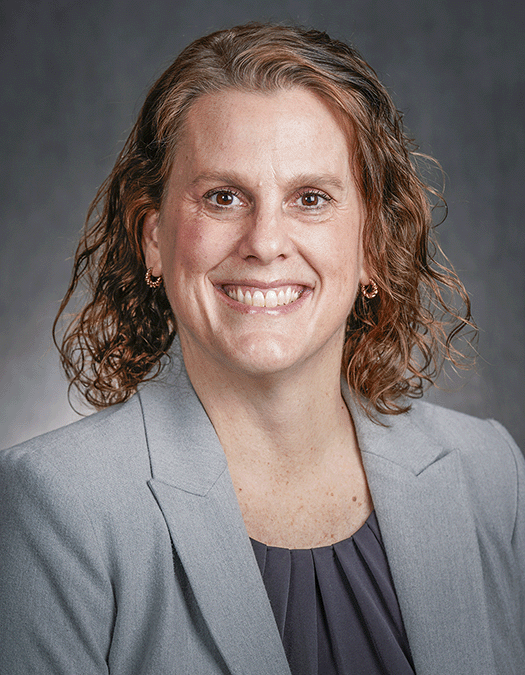
Rep. Kari Rehrauer
Sponsored bills
Maddy summaryMinnesota Senate File 1943 prohibits pet shops (physical retail stores selling animals to the public) from selling or transferring ownership of cats and dogs, effective August 1, 2026. The bill allows pet shops to provide space for nonprofit animal shelters, humane societies, or 501(c)(3) rescue groups to offer animals for adoption, but pet shops cannot own the animals or charge fees for this space. It does not affect breeders, direct sales from breeders, or nonprofit adoption organizations themselves. The law aims to shift pet sales toward adoption-focused organizations while maintaining transparency requirements for pet dealers.
Maddy summaryHF 2486 authorizes the state to issue up to $3 million in bonds to fund planning, construction, and renovation of early childhood learning and child protection facilities in Minnesota. The funds, drawn from bond proceeds, will be distributed as grants by the state human services agency to child care providers. This bill directly affects licensed child care centers and facilities serving young children by providing dedicated funding for facility improvements. The legislation creates a specific funding mechanism through state bonds rather than altering existing eligibility rules or service requirements.
Maddy summaryHF 2627 prohibits pet shops (defined as physical retail stores selling animals to the public) from selling, offering to sell, or transferring ownership of cats or dogs. The bill directly affects retail pet shops operating in Minnesota, requiring them to stop selling these animals by August 1, 2026. However, pet shops may still host nonprofit animal rescues or shelters (501(c)(3) organizations) for adoption events, provided the shops don’t own the animals or charge fees for the space. The law does not restrict breeders, shelters, or adoption centers, only retail pet shops selling cats and dogs directly to customers.
Maddy summaryHF 1082 establishes the Minnesota Victims of Crime Account, funded by increased fees/penalties from criminal cases and additional general fund transfers. It appropriates specific funds for fiscal years 2026-2027 to provide grants to organizations that received crime victim service grants in 2024. These grants must support direct services for victims of sexual assault, domestic violence, child abuse, and general crime - including client assistance, housing supports, culturally responsive programming, and prevention efforts like restorative justice. The bill requires services to prioritize underserved communities and reflect Minnesota’s diversity, with up to 10% of funds allowed for grant administration.
Maddy summaryHF 744 modifies professional development requirements under Minnesota's Read Act by setting new deadlines for educators to complete evidence-based literacy training. It requires K-3 classroom teachers, reading intervention staff, special education teachers, and others to complete training by July 1, 2026, with additional training for grades 4-12 teachers by July 1, 2027. School districts can reduce elementary school instructional hours by 5.5 hours per year if they schedule this training during regular school days, provided teachers complete the required training. The bill directly affects Minnesota public school districts, their teachers, and instructional staff implementing the state's literacy initiative.
Maddy summaryThis bill allocates $2 million each for fiscal years 2026 and 2027 to fund the Lawns to Legumes program in Minnesota. The money will come from the state's general fund and be given to the Board of Water and Soil Resources to support the initiative. The program encourages landowners to replace grass lawns with legumes, which are plants that naturally enrich the soil and reduce the need for fertilizers. By providing this funding, the state aims to help implement the program's goals without changing the underlying rules or regulations.
Maddy summaryThis bill increases funding for student support personnel in Minnesota schools by raising the per-pupil allowance amounts and establishing minimum funding floors for districts and charter schools. It directly affects independent school districts, special districts, charter schools, and cooperative units by adjusting how much money they receive for staff like counselors, nurses, and social workers. The law sets specific dollar amounts for the per-student allowance in 2025, 2026, 2027, and beyond, while also requiring districts to reserve funds in their balances and limiting cooperative aid to actual expenditures. Additionally, the bill appropriates state money to cover these increased funding levels for fiscal years 2026 and 2027.
Maddy summaryThis bill establishes a new state wealth tax in Minnesota that would apply to individuals and trusts with taxable wealth exceeding $10 million. The tax would be calculated as one percent of the amount above that threshold, based on the total value of all property owned within Minnesota minus any debts owed by the taxpayer. Property values would be determined using the same valuation methods used for federal estate taxes, and the tax would apply to both residents and nonresidents who own property in the state. The legislation would take effect for taxable years beginning after December 31, 2025, and would be collected in addition to existing state taxes.
Maddy summaryHF 3403 allocates $44 million for counties and $6 million for Tribal governments in fiscal year 2026 to provide emergency rental assistance. It requires counties and Tribal governments to use these funds solely for rental assistance to eligible households meeting three criteria: income at or below 200% of the federal poverty level, Minnesota residency, and homelessness or imminent housing crisis. Funds must be distributed within 15 days of the bill's effective date and spent within 180 days, with unspent money returned to the state general fund. This one-time appropriation directly supports low-income renters facing housing instability across Minnesota.