

Maddy summaryHF 1751 requires Minnesota State Colleges and Universities to use state funds to provide hospital, medical, and dental benefits to part-time or adjunct faculty who teach six or more credits annually and currently lack such coverage. The bill appropriates specific funding for fiscal years 2026 and 2027 to cover these benefits for eligible faculty. It also mandates that the Board of Trustees collect participation data and submit a cost analysis report to legislative committees by November 1, 2027, to inform future budget decisions. This is a one-time appropriation focused on expanding benefits for a specific group of faculty members.
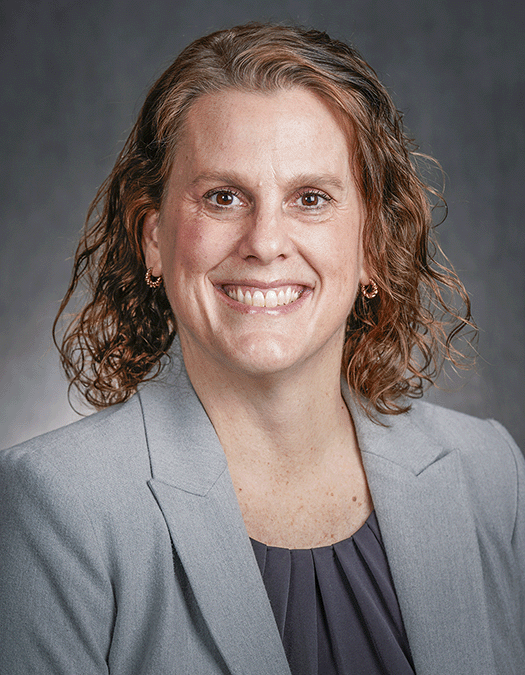
Rep. Kari Rehrauer
Sponsored bills
Maddy summaryHF 1377 appropriates $1.75 million annually (2026-2027) for matching grants, $350,000 annually for equipment grants, and $1 million annually for block grants to Minnesota public television stations. The bill directs the commissioner of administration to allocate these funds based on recommendations from the Minnesota Public Television Association. It directly affects public television stations eligible under Minnesota Statutes, section 129D.13, by providing dedicated state funding for operational support and equipment. The funding is sourced from the general fund and applies specifically to fiscal years 2026 and 2027.
Maddy summaryHF 2502 modifies Minnesota's child tax credit to reduce the "marriage penalty" by raising the income level at which the credit begins to phase out for married couples filing jointly. The bill increases the phaseout threshold from $35,000 to $63,900 for joint filers (while slightly raising the threshold for other filers to $31,950), meaning married couples will retain more of their child credit at lower income levels. This change directly affects married Minnesota taxpayers filing jointly who currently lose credit benefits at lower incomes than single filers. The adjustment takes effect for taxable years beginning after December 31, 2024, and includes automatic inflation adjustments starting in 2025.
Maddy summaryHF 982 creates a new education benefit in Minnesota for dependents of disabled veterans. It provides full tuition, mandatory fees, and book coverage (after subtracting other aid) for dependents of veterans with a 100% permanent disability, and 50% coverage for dependents of veterans with a 70%+ disability rating. The benefit applies to undergraduate programs at Minnesota state colleges, universities, or the University of Minnesota Board of Regents institutions. Eligible students must be enrolled at these institutions, and institutions apply for the benefit on their behalf through the Office of Higher Education.
Maddy summaryHF 2210 allocates $105 million from the general fund to the Minnesota Department of Education for school unemployment aid under existing law (Minnesota Statutes § 124D.995). This one-time funding directly supports school districts and employees eligible for unemployment benefits during school-related layoffs. The bill provides no new policy changes but ensures existing unemployment aid programs receive additional financial resources for the 2026 fiscal year.
Maddy summaryHF 2172 extends Minnesota's medical assistance (Medicaid) coverage to include audio-only telehealth services for Medicaid enrollees from July 1, 2025, through July 1, 2028. The bill requires health care providers to document that audio-only communication was used and meet existing telehealth documentation standards, including specifying the mode of transmission and service details. This change directly affects Medicaid recipients who use phone-based telehealth appointments and the providers delivering these services. The policy update does not alter coverage for in-person services but expands telehealth options during the specified three-year period.
Maddy summaryHF 2162 appropriates $1,000,000 from Minnesota's renewable development account for fiscal year 2026 to fund geothermal planning grants. The bill directs the commissioner of commerce to award these one-time grants to eligible applicants under Minnesota Statutes section 216C.47, which covers local governments and entities planning geothermal energy projects. It provides concrete funding for preliminary planning activities related to geothermal systems but does not establish new requirements or regulations. The bill directly affects applicants seeking financial support for geothermal feasibility studies and project planning.
Maddy summaryHF 2353 requires Minnesota public schools to include organ donation education in health standards for students in grade 9. This amendment adds organ donation education as a mandatory topic under existing statewide health education requirements, specifically for ninth-grade students. The bill modifies current law to ensure school districts provide this education as part of their health curriculum. It directly affects all Minnesota public school students in grade 9 and school districts responsible for implementing the statewide health standards.
Maddy summaryHF 1854 prohibits landlords from refusing to renew leases for tenants in residential rental units when the landlord received government funds (federal, state, or local) to renovate the unit to accommodate the tenant's health, safety, or disability. The bill requires landlords to allow tenants to continue residing in the unit after such renovations, making any lease nonrenewal in violation void. Landlords who violate this section are liable for tenant costs, including attorney fees, incurred due to the violation. This law directly affects tenants in units with renovation funding and applies to Minnesota Statutes, chapter 504B.
Maddy summaryHF 2475 reduces the percentage Minnesota homeowners must pay toward their homestead credit property tax refunds. The bill amends Minnesota Statutes section 290A.04 by lowering the "co-pay" rate for qualifying homeowners, decreasing the claimant's required payment from 12% to as low as 1.0% of property taxes for the lowest income brackets. This change directly affects homeowners with household incomes up to $135,409 who claim the homestead credit, increasing their state refund amount by reducing their out-of-pocket share. The state refund maximum remains $3,500 for most income levels, but the reduced co-pay means homeowners retain more of their property tax refund.