

Maddy summaryHF 1756 increases property tax exclusions for Minnesota veterans with service-connected disabilities and modifies benefits for surviving spouses. Veterans with a 70% or higher disability rating receive a $150,000 exclusion (doubling to $300,000 for 100% disability), with the base amount adjusted annually for inflation using a federal economic index. Surviving spouses of qualifying veterans or service members who died in active duty can continue the full $300,000 exclusion until they remarry or sell the home. The bill directly affects veterans, their spouses, and primary family caregivers who qualify under the existing program.
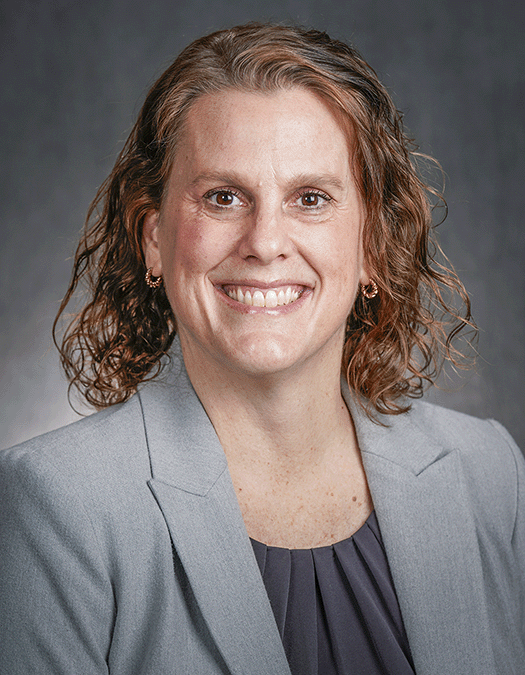
Rep. Kari Rehrauer
Sponsored bills
Maddy summaryHF 2549 authorizes the issuance of $44.66 million in housing infrastructure bonds specifically for the St. Paul Port Authority’s The Heights housing development project. The funds must be used for affordable housing meeting income limits set in Minnesota law (section 462A.33, subdivision 5). The bill adds a new provision to Minnesota Statutes allowing this bond authorization and requires annual transfers from the general fund to support debt service on these bonds. This bill directly affects the St. Paul Port Authority and residents of The Heights development, which is intended to provide housing for low-to-moderate-income households.
Maddy summaryHF 1481 requires biofuel plants in Minnesota to monitor ethanol, biodiesel, and advanced biofuel production for neonicotinoid pesticides and perfluoroalkyl substances (PFAS) in the fuel, air emissions, wastewater, and byproducts like dried distillers grains. It mandates that plants maintain permanent records of these tests and make them available to the public and regulators. The bill also provides for voluntary biomonitoring of biofuel plant employees to assess workplace exposure to these chemicals, with $250,000 appropriated to the Department of Health for this purpose. The law appropriates a total of $1.1 million across state agencies for implementation, including $500,000 for wastewater and air monitoring under the Pollution Control Agency.
Maddy summaryHF 2211 allocates $3.6 million from the general fund for each of fiscal years 2026 and 2027 to the Minnesota Commissioner of Health. This funding is specifically for grants to local and Tribal health departments to support substance misuse prevention, education, and recovery programs under Minnesota Statutes §144.197, subd. 4. The bill directly affects health departments that will receive these grants to expand community-based services. It does not create new requirements but provides dedicated funding for existing program frameworks focused on addressing substance misuse.
Maddy summaryHF 1168 requires Minnesota's Commissioner of Revenue to create an online system for individuals to claim refunds on political contributions. It modifies the existing refund program to allow electronic data sharing between the Campaign Finance Board and the Department of Revenue, including contributor names, contribution amounts, and unique receipt validation numbers. All shared data is classified as nonpublic, protecting contributor privacy while enabling streamlined refund processing. This change affects political contributors seeking refunds, political parties/candidates issuing refund receipts, and the agencies managing campaign finance data, replacing paper-based processes with digital systems effective January 2027.
Maddy summaryHF 2036 provides $450,000 for each of fiscal years 2026 and 2027 to fund employment services for people with disabilities through Minnesota Diversified Industries (MDI), and $250,000 for career skills programming in 2026. The bill funds inclusive job opportunities, virtual and in-person career classes using virtual reality tools, and employer outreach for individuals with disabilities. MDI must report by January 15, 2028, on program participation, demographics, service hours, and recommendations. This one-time funding directly supports people with disabilities seeking employment and MDI’s service delivery model.
Maddy summaryHF 775 requires Minnesota school districts to create written policies ensuring parents of children with disabilities can fully participate in their child's education. Specifically, districts must establish processes for providing free language assistance (like interpreters or translated documents) for non-English-speaking parents and reasonable accommodations (such as sign language interpreters or modified meeting formats) for parents with disabilities, without requiring health information disclosure. These policies must be posted in multiple languages on district websites, shared annually with parents, and kept confidential. The bill directly affects school districts and parents interacting with special education programs, effective July 1, 2025.
Maddy summaryHF 745 modifies how Minnesota school districts calculate compensatory revenue eligibility for low-income students, requiring districts to count children eligible through both direct certification (like SNAP benefits) and education benefits (such as school meal programs) as of October 1 each year. It adjusts spending rules, requiring at least 80% of compensatory revenue to be spent at individual school sites (with a temporary 40% allowance for 2026-2027 if meal program data is incomplete) and mandates reporting for adjustments due to enrollment changes. The bill establishes a Compensatory Revenue Task Force, composed of education officials, school board representatives, and parent advocates, to analyze the funding formula and make recommendations. It appropriates funds for these changes and takes effect for fiscal year 2026.
Maddy summaryHF 1175 requires Minnesota public school districts and charter schools to develop written cardiac emergency response plans by the 2026-2027 school year. These plans must include specific steps for responding to cardiac arrests, such as placing automatic defibrillators in accessible locations, training staff in CPR and defibrillator use, and conducting annual emergency simulations. The bill appropriates $2 million from the general fund to help schools implement these plans, covering costs for defibrillators, training, and related equipment. It directly affects all Minnesota schools, ensuring they are prepared for cardiac emergencies during school activities.
Maddy summaryHF 1985 allocates $2.5 million for fiscal year 2026 and $2.5 million for fiscal year 2027 from the general fund to support employment programs for Minnesotans with mental illness. The funds must be used by the commissioner of employment and economic development to provide evidence-based job support services through existing or new programs, including expanding services to areas without current programs. This appropriation is specifically intended to sustain current services, grow access in underserved regions, and support programs that previously received no state funding. The bill directly affects service providers and individuals seeking employment assistance under Minnesota Statutes sections 268A.13 and 268A.14.