

Maddy summaryHF 1309 prohibits Minnesota local governments (cities and counties) from requiring minimum parking spaces for new residential, commercial, or industrial buildings. The bill directly affects developers and property owners by removing a common zoning requirement that previously mandated a set number of parking spots. Key provisions state that political subdivisions cannot impose these minimums, though they may still require ADA-compliant disability parking or make non-binding parking space recommendations. This change aims to increase flexibility for development projects, potentially allowing more housing or commercial space without dedicated parking.
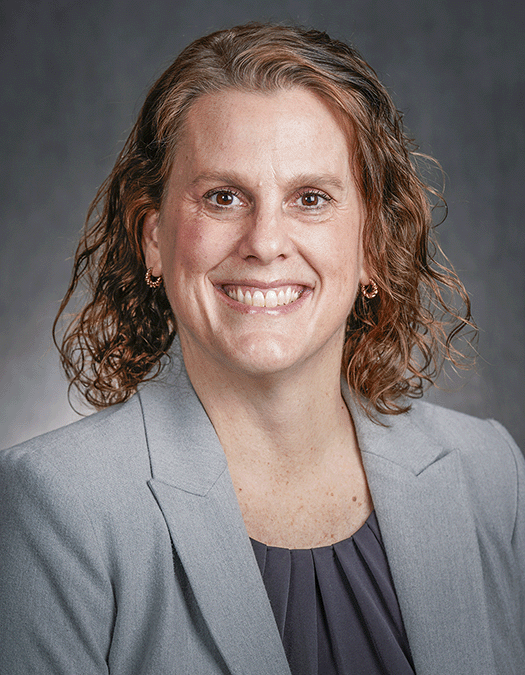
Rep. Kari Rehrauer
Sponsored bills
Maddy summaryThis bill appropriates $2.8 million for fiscal year 2026 and $2.8 million for fiscal year 2027 from the state general fund to the Minnesota Department of Health. The funds are designated as a grant to Greater Twin Cities United Way to support expanded services including call follow-up, operational support, outreach efforts, and increased assistance for callers. The bill directly affects the United Way organization by providing dedicated state funding for its existing service operations in the Twin Cities region. It is a straightforward funding measure with no new policy requirements or eligibility changes.
Maddy summaryHF 2621 appropriates $3 million from the general fund for community tree-planting grants administered by the Metropolitan Council. The funds are designated for fiscal year 2026 as a one-time allocation, available until June 30, 2028. This bill directly affects communities in the metropolitan area eligible to apply for these grants under Minnesota Statutes section 473.355, providing financial support for local tree-planting initiatives. The legislation establishes a specific funding mechanism without altering existing environmental policies.
Maddy summaryHF 1511 appropriates $5 million from the state general fund for a veteran mentorship program targeting Black youth in Minnesota. The bill directs the Commissioner of Veterans Affairs to fund an organization that will develop and run the program, where veterans mentor Black youth to prevent violence and explore military careers. The funds are allocated specifically: $1.5 million for veteran mentor salaries, $2 million for community outreach, $1 million for youth engagement, and $500,000 for program administration. This is a one-time appropriation for fiscal year 2026, directly affecting Black youth in Minnesota through mentorship and career exploration opportunities.
Maddy summaryHF 689 allows county attorneys to use official orders (administrative subpoenas) to obtain specific records during wage theft investigations. The bill amends Minnesota law to let county attorneys subpoena payroll, banking, and financial records from employers, including documents required under state labor laws. This directly affects employers facing wage theft allegations and county attorneys conducting these investigations. The change takes effect August 1, 2025, and applies only to business records, not private individuals' personal information.
Maddy summaryHF 1641 requires Minnesota public school districts to maintain opiate antagonists (medication for opioid overdose emergencies) at all school sites, including at least two nasal doses per building. It allows high school students in grades 9-12 to possess and administer these medications to other students if their parent or guardian provides written authorization. Schools must follow state guidelines for storage and administration, and student possession is protected under existing law (section 604A.04). This bill directly affects high school students, schools, and parents/guardians by enabling student-led emergency response with parental consent.
Maddy summaryHF 2726 allocates funds from the arts and cultural heritage fund to celebrate the 50th anniversary of Southeast Asian communities in Minnesota. The bill directs the commissioner of administration to provide a grant to Visit Saint Paul, which will distribute subgrants to organizations representing these communities. To qualify, organizations must provide a 10% match and use the funds for events between May 1 and December 31, 2025, with reimbursement allowed for events from May 1 to June 30, 2025. This funding supports community-led events honoring Southeast Asians' contributions to Minnesota over five decades.
Maddy summaryHF 1686 expands training requirements for licensed security officers in Minnesota. It mandates 40 hours of pre-employment training (up from 12 hours) within 21 days of hire, plus 24 hours of annual continuing education for all officers, with an additional 6 hours yearly for those armed with firearms or weapons. The bill requires new training content including mental health crisis response, de-escalation techniques, CPR/AED use, legal use of force standards, and building safety disruptions. These requirements apply to all licensed security officers, managers, and employees in Minnesota, effective January 1, 2026. The bill also ensures employees can obtain copies of their training certificates from employers at no cost.
Maddy summaryHF 2693 establishes a locally controlled housing fund in Minnesota and modifies how state housing infrastructure bonds can be used. The bill expands allowable bond uses to include affordable single-family housing, manufactured home parks, cooperative housing, and senior housing projects that meet specific affordability standards (e.g., housing for households earning 50% or less of area median income). It adds priority rules, such as favoring permanent supportive housing for veterans and senior projects with strong affordability commitments, and requires new construction to include accessible units meeting specific design standards. This bill directly affects local housing authorities, developers, and community organizations seeking state funding for affordable housing projects across Minnesota.
Maddy summaryThis bill expands eligibility for the state's Housing Challenge Program to include charter schools, contract alternative schools, and Tribal contract schools as recipients of small grants (under $100,000) for housing projects. It modifies existing law to allow these school types - previously limited to school districts - to access funds for constructing owner-occupied homes. Schools using the grant for home construction must require future occupants to complete homeownership education and counseling under separate law. The change directly affects these specific school entities by broadening their access to housing program funding. The bill does not alter the maximum grant amount or the requirement for homeownership education.