

Maddy summaryHF 3066 establishes a state-funded program providing adaptive swimming lessons and water safety education for children aged 3-21 with developmental delays and their parents. The program, funded with $500,000 annually for 2026-2027, offers 12 weeks of lessons per child through vouchers distributed equitably, including swim kits and culturally appropriate parent education. Eligible participants must meet income requirements (e.g., enrolled in Medicaid, MinnesotaCare, or free school meals programs), and instructors must hold specific certifications for neurodivergent children and water safety. The commissioner of health will administer the program in partnership with St. Paul and autism advocacy groups, ensuring access in low-income communities and tracking participation.
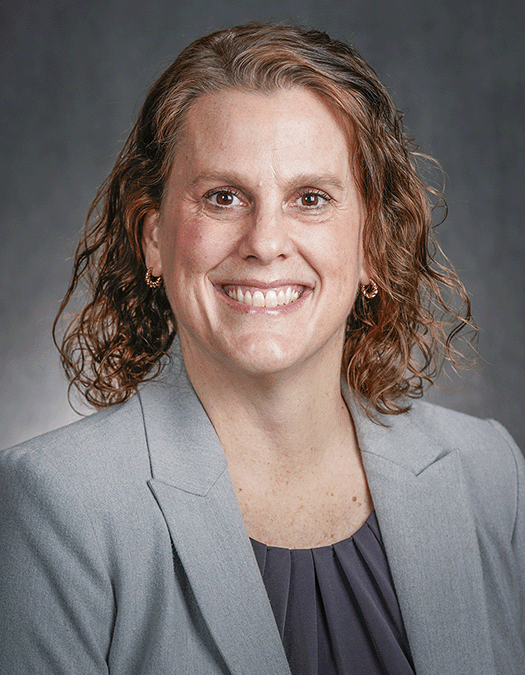
Rep. Kari Rehrauer
Sponsored bills
Maddy summaryHF 3015 requires state commissioners to submit certain permit applications to affected Minnesota Tribal governments when the permit has a substantial direct effect on those tribes. Specifically, it mandates that commissioners send complete permit applications - and any additional significant information received later - to the tribal government's governing body as soon as possible. This applies to permits governed under sections 84.027 and 116.03 of Minnesota Statutes. The bill directly affects tribal governments by ensuring they receive timely notice of permit applications impacting their lands or resources.
Maddy summaryHF 1740 appropriates $X from Minnesota's arts and cultural heritage fund for fiscal year 2026 to support community cable television programming. The funds will be distributed through the Minnesota Association of Community Telecommunications Administrators to public, educational, and governmental cable channels across the state. This grant program specifically aims to fund local programming that promotes community and civic engagement. The bill directly affects community cable providers by providing dedicated funding for locally produced content, with no changes to existing regulatory frameworks.
Maddy summaryHF 2140 requires certain Minnesota municipalities to create "mixed-use housing zones" by June 30, 2027. Covered cities include those in Anoka, Carver, Dakota, Hennepin, Ramsey, Scott, or Washington counties, plus any municipality with 10,000+ residents. These zones must permit residential developments with at least three units (within 0.5 miles of certain streets) or four units (within 0.25 miles), including duplexes, triplexes, and fourplexes. The bill defines "mixed-use development" as buildings where at least 50% of usable space is for residential units, and it exempts these zoning changes from requiring comprehensive plan amendments before 2029.
Maddy summaryHF 2965 requires the Minnesota Housing Finance Agency to include specific information in annual assessment letters sent to manufactured home park owners. The letters must detail whether funds are being collected, explain the collection process, provide an invoice for each licensed lot, include a notice for residents, and offer a sample form for tracking resident information. This bill modifies existing requirements under Minnesota Statutes 327C.095, ensuring park owners receive clear, standardized communication about the $15 annual assessment per lot. It directly affects manufactured home park owners who must pay this assessment, and applies to all parks licensed under Minnesota law.
Maddy summaryHF 1914 appropriates state funds for three key human services programs in Minnesota. It provides emergency services grants for immediate crisis support, county grants to address homelessness gaps (prioritizing Tribal Nation partnerships and interventions like 24/7 shelters), and funding for provider capacity-building collaboratives. The capacity-building program helps service providers access stable funding streams, including Medicaid waivers and housing support programs. These funds are allocated for fiscal years 2026 and 2027, with unspent first-year money rolling over to the second year. The bill directly affects counties, service providers, and people experiencing homelessness by expanding access to crisis support and housing-focused services.
Maddy summaryHF 2620 appropriates $5 million for fiscal year 2026 to address emerald ash borer infestations in the metro area and $5 million for community tree-planting grants statewide. The metro funds support local governments for ash borer response activities like waste facility planning, wood transportation, and disposal. The tree-planting grants, administered by the Department of Natural Resources under existing law, help communities replace lost trees. Both funds are one-time appropriations available until June 30, 2028.
Maddy summaryHF 2013 limits certain local regulations on residential development in Minnesota. It prohibits municipalities from requiring specific building materials, designs, or aesthetic features beyond the State Building Code (chapter 326B), and bans minimum square footage requirements for residential projects. The bill directly affects developers and homeowners seeking building permits, as local governments can no longer impose these specific restrictions. It includes an exception for developments built by the municipality itself. The law takes effect the day after final enactment.
Maddy summaryHF 3005 appropriates $497,500 for fiscal years 2026 and 2027 to fund home-delivered meals for veterans through Metro Meals on Wheels, plus technical assistance for member programs. The bill requires Metro Meals on Wheels to submit detailed reports by September 1, 2026 and 2027, documenting how funds were used and the number of veterans/servicemembers served. This is a one-time funding appropriation, not a recurring budget item, directly supporting veterans' access to meal services in Minnesota. The bill affects veterans receiving meals and Metro Meals on Wheels as the grant recipient.
Maddy summaryHF 1679 allocates $5 million for fiscal year 2026 and $5 million for fiscal year 2027 from the state's arts and cultural heritage fund to support public television. The funding is specifically designated for the Minnesota Public Television Association (MPTA) to provide production and acquisition grants for public television programming. This bill directly affects MPTA's ability to fund local and national content for Minnesota viewers through existing state law. The funding mechanism provides stable, multi-year support for public broadcasting services.